
Here's a quirk that costs hobby sellers real money: if the IRS calls your money-making activity a hobby, you must report the income but cannot deduct the expenses. If it's a business, you subtract those same expenses first and pay tax only on the profit. Same tomatoes, same jam, same woodworking — very different tax bill. Crossing that line, legitimately, is one of the highest-value moves a side-hustler can make.
Key takeaways
- Hobby income is taxable but non-deductible (since the 2018 tax law). Business expenses are deductible.
- The IRS looks for a genuine profit motive — businesslike records, effort, and (roughly) profit in 3 of 5 years.
- You don't need an LLC. A sole proprietor on Schedule C is a real business.
- Deductions include supplies, mileage, fees, equipment, home office, and software — if you can prove them.
- Contemporaneous records are what turn "expenses" into audit-proof "deductions."
Why the hobby-vs-business line matters so much
Imagine you sell $4,000 of handmade goods and spent $2,500 on materials, booth fees, and mileage. As a business, you're taxed on $1,500 of profit. As a hobby, you're taxed on the full $4,000 and the $2,500 of costs vanish. That's the difference between owing a little and owing a lot — on identical activity.
How the IRS decides you're a business
There's no single switch; the IRS weighs whether you're genuinely trying to profit. The factors that matter most:
- You keep businesslike books and records.
- You put in real time and effort and try to improve profitability.
- You depend on the income or intend to.
- You've earned a profit in about 3 of the last 5 years (a safe-harbor guideline, not an absolute rule).
- You have expertise or seek advice to run it better.
You don't need every factor — you need to look like someone trying to make money, and to have the records that show it.
The 5 steps to cross the line
1. Decide to run it like a business
Set prices for profit, keep going week to week, and treat it seriously. Intent backed by action is the core test.
2. Separate the money
Open a dedicated bank account (and ideally a card) for the activity. Nothing signals "business" — or simplifies bookkeeping — like clean separation of business and personal funds.
3. Keep contemporaneous records
Log income and expenses as they happen, not in April. Track mileage by trip. Save receipts. This is the single most important habit, and the thing auditors ask for first.
4. Report on Schedule C
As a sole proprietor you file Schedule C with your personal return, and Schedule SE for self-employment tax once net profit tops $400. No LLC or corporation required to start.
5. Consider an LLC later (optional)
An LLC adds liability protection and a professional footing but isn't required for the tax deductions — those come from operating as a business, not from the legal entity.
What you can deduct once you're a business
- Supplies & materials — the direct cost of what you sell
- Mileage — trips to markets, suppliers, the post office (standard mileage rate)
- Fees & licenses — booth/stall fees, permits, marketplace fees
- Equipment — tools, a canopy, tables, a card reader, a laptop (sometimes depreciated)
- Home office / storage — a portion of home costs for space used regularly and exclusively for the business
- Software & services — bookkeeping/invoicing apps, website, packaging design
- Marketing — business cards, signage, ads, a market booth banner
Records are everything — make them automatic
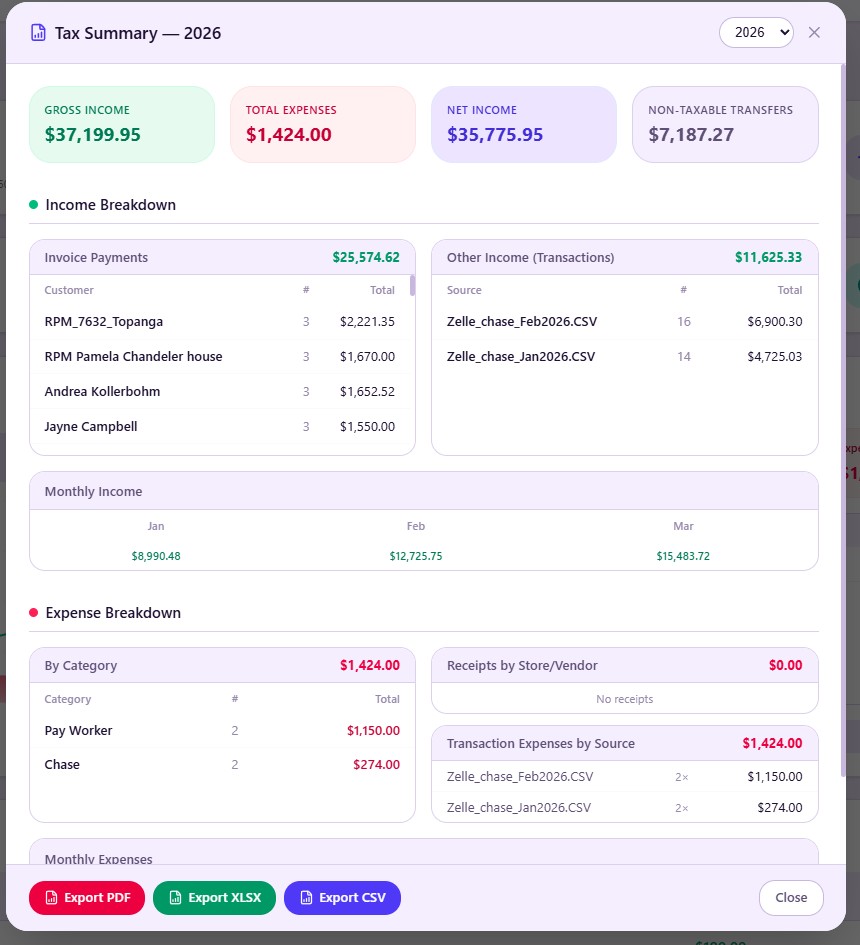
The deductions above are only as good as your proof. The winning move is to make record-keeping automatic: log every sale, snap and attach expense receipts, track mileage, and separate business money. A simple invoicing-and-bookkeeping app such as Daily Invoice Maker handles this in one place and exports a clean Schedule C summary — so "expenses" become documented, audit-ready deductions instead of a shoebox you dread. (Free trial in the sidebar.)
Watch-outs
- Don't invent a business to deduct a hobby's costs — you need genuine profit motive and effort.
- Home-office rules are strict — the space must be used regularly and exclusively for the business.
- Consistent losses year after year invite scrutiny; aim to show a path to profit.
- Mixing personal and business funds undermines the whole case — separate accounts.
FAQ
Do I need an LLC to deduct business expenses?
No. A sole proprietor filing Schedule C deducts the same expenses. An LLC adds liability protection, not extra deductions.
How many years can I lose money before the IRS objects?
The safe-harbor guideline is profit in about 3 of 5 years. Losing money longer isn't automatically disqualifying, but you'll need to show genuine profit motive and businesslike operation.
Can I deduct expenses from before I "started" the business?
Certain start-up costs can be deducted or amortized once the business is active. Keep those receipts too.
What's the easiest way to prove my deductions?
Contemporaneous digital records: an app that logs income, attaches expense receipts, and tracks mileage with timestamps. That turns an audit into a non-event.
Is my side income taxable even as a hobby?
Yes — income is taxable either way. The difference is that a business can offset it with deductions; a hobby cannot. See our farmers-market tax guide.
The bottom line
If your hobby is making money and costing money, running it as a real business — with a profit motive and clean records — legitimately converts your costs into deductions. Separate the money, track everything as it happens, file Schedule C, and keep the receipts. Then put the tax savings to work: here's how to invest your first $1,000.


Comments (0)
Be the first to comment.
Leave a comment