
You set up a folding table, sold $1,800 of heirloom tomatoes and zucchini bread over a summer, and pocketed the cash. Congratulations — you're a business in the eyes of the IRS, and that income is taxable. The good news: with a little tracking, the tax bill on market income is usually small, and the deductions can wipe out most of it.
Key takeaways
- All income is taxable — cash included. There's no "under $600 is tax-free" rule; that threshold only governs when others must send you a 1099.
- Most market sellers report on Schedule C (business) or Schedule F (farming), plus Schedule SE for self-employment tax once net profit tops $400.
- Your deductions — seeds, soil, booth fees, mileage, packaging, a canopy — come off your income before tax. Track them and the taxable number shrinks fast.
- Hobby vs. business matters: a real business can deduct expenses; a hobby cannot (since 2018).
- Keep a simple log of every market day — sales in, expenses out. That one habit is the whole game.
Is my market income actually taxable?
Yes. The U.S. tax code taxes income "from whatever source derived," and cash sales at a farmers market are income. The common myth is that you only owe tax if someone issues a 1099 or if you cross $600. That $600 figure is the threshold for third-party reporting — it decides when a payment app or buyer has to file a form about you. It has nothing to do with whether your income is taxable. It always is.
What actually changes your obligation is how much profit you make and whether the IRS sees your stand as a business or a hobby.
Business or hobby? The distinction that decides your deductions
If you sell with the intent to make a profit — you set prices, track costs, come back week after week — you're running a business, and you report on Schedule C (or Schedule F if you grow the food yourself). A business can subtract expenses from revenue and is taxed only on the profit.
If it's truly a hobby (you sell surplus occasionally with no profit motive), you still report the income, but under current law you cannot deduct the expenses. That's the worst of both worlds — so if you're spending real money on supplies, you generally want to operate, and document, like a business. The IRS weighs factors like whether you keep books, whether you depend on the income, and whether you've turned a profit in roughly three of the last five years.
Which form: Schedule C vs. Schedule F
| You mostly… | Use | Notes |
|---|---|---|
| Grow/raise what you sell (produce, eggs, honey) | Schedule F | Farming income; special rules for livestock & crops |
| Make or resell goods (baked goods, jam, crafts, woodwork) | Schedule C | General small-business form |
| Net profit over $400 (either form) | + Schedule SE | Self-employment tax (~15.3%) on top of income tax |
Self-employment tax catches people off guard. On top of ordinary income tax, net earnings over $400 owe about 15.3% for Social Security and Medicare. On $2,000 of profit that's roughly $283 — before income tax. It's exactly why deductions matter so much.
What you can deduct (this is where the bill shrinks)
- Seeds, seedlings, soil, compost, fertilizer
- Booth / stall / market fees and any vendor permits or licenses
- Packaging — bags, jars, labels, twist ties, boxes
- Mileage to and from the market and the supply store (2026 IRS standard mileage rate, tracked by trip)
- Equipment — a canopy, folding tables, a cash box, a card reader, coolers, scales
- Ingredients for value-added goods (flour, sugar, jars for jam)
- A portion of home/garden costs tied to production, and possibly a home-office or storage deduction if you qualify
Add it up honestly. Many first-year sellers spend more on canopy, tables, seeds, and fees than they earn — which can mean little or no tax owed, and sometimes a loss that offsets other income. But you can only claim what you can prove.
The one habit that makes taxes painless: track every market day
The difference between a stressful April and a five-minute one is a running log. Each market day, record what came in and what went out — sales total, booth fee, mileage, any supplies bought. If you also invoice wholesale or standing orders (a café that buys your bread, a neighbor's weekly veggie box), keep those receipts in the same place.
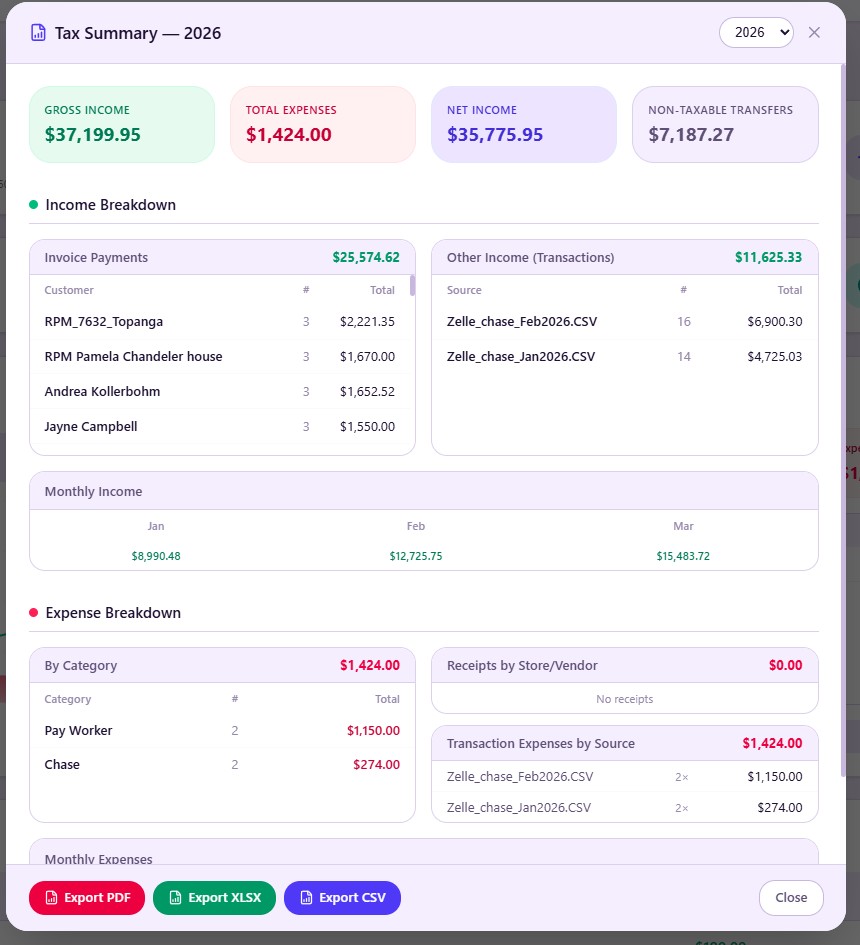
This is exactly the kind of tracking a simple invoicing and bookkeeping app is built for. A tool like Daily Invoice Maker lets you log each sale, attach expenses, track mileage, and export a clean Schedule C summary at year-end — so you're not reconstructing a season from a shoebox of receipts. (See the sidebar for the free trial.)
Quarterly estimated taxes — do you need to pay them?
If you expect to owe $1,000 or more in tax for the year from your selling (and other untaxed income), the IRS wants quarterly estimated payments rather than one lump sum in April. For most part-time market sellers the profit is small enough that this doesn't apply, but if your stand grows into real money, set aside roughly 25–30% of profit and pay quarterly to avoid an underpayment penalty.
Sales tax is a separate thing
Income tax (federal) and sales tax (state/local) are different obligations. Many states exempt raw, unprocessed produce from sales tax but require it on prepared foods and crafts — and rules vary by state and even by market. Check your state's department of revenue and your market manager's guidance; some markets handle vendor sales-tax registration for you.
FAQ
Do I owe taxes if I only made a few hundred dollars?
The income is still reportable. But if your net profit (after deductions) is under $400, you won't owe self-employment tax, and a small profit may add little or nothing to your income-tax bill — especially once expenses are counted.
What if I got paid through Venmo or Cash App?
Same rules — it's taxable income regardless of how you were paid. You may also receive a 1099-K from the app if you cross the reporting threshold. We cover this in detail in our guide to turning a hobby into a real business.
Can I deduct my garden if I also eat some of the produce?
You deduct the portion tied to what you sell, not what your family eats. Keeping rough records of how much you harvested vs. sold supports a reasonable split.
Do I need an LLC to sell at a farmers market?
No. You can operate as a sole proprietor and report on Schedule C/F. An LLC adds liability protection and can come later; it isn't required to start.
What records does the IRS actually want?
A contemporaneous log of income and expenses, plus receipts for purchases and a mileage record. You don't need fancy software — but a simple app that timestamps entries makes an audit a non-event.
The bottom line
Market income is taxable, but the tax is usually modest once you count deductions — and a five-minute-per-market-day log is all it takes to keep it that way. Track sales and expenses as you go, report on Schedule C or F, and set aside a little for self-employment tax. Do that and selling at the market stays what it should be: fun, and profitable. Next, learn how to turn that side income into a proper tax-deductible business, or how to invest your first $1,000 of profit.


Comments (0)
Be the first to comment.
Leave a comment