
If you are self-employed, sloppy mileage logs and missing receipts cost you real money every April. The good news: the IRS does not need a fancy spreadsheet. It needs three things, kept honestly, and a few quarterly habits. This is the 2026 playbook.
Key takeaways
- The 2026 IRS standard mileage rate is $0.70 per business mile. Verify the current figure at IRS.gov.
- You need a contemporaneous mileage log, receipts for any purchase over $75, and a clear business purpose tied to each expense.
- Digital receipts are fine. Paper is optional once scanned.
- Set aside roughly 30% of every payment into a separate account for quarterly estimated taxes.
- Round numbers, 100% vehicle use, and weak home-office claims are the most common audit triggers.
What the IRS actually requires
Most contractors think the IRS wants pristine bookkeeping. It wants evidence. Three pieces of it:
- A contemporaneous log. Contemporaneous means written close to when the trip or purchase happened, not reconstructed in April. A note on a receipt counts. A calendar entry counts. A backdated spreadsheet does not.
- Receipts for purchases over $75. Below $75, a card or bank statement is generally enough. Above $75, you need the actual receipt.
- A business purpose for each expense. Not just Home Depot $124. It needs to be linked to a job: Home Depot, chemicals for Smith pool service, Mar 14.
Get these three right and you survive an audit. Get them wrong and you forfeit deductions you legitimately earned.
Mileage tracking: what to record
For every business trip, capture five fields: date, starting odometer or address, ending odometer or address, total miles, and business purpose. Monthly odometer snapshots (January 1 and December 31) are mandatory to anchor the year.
What counts as business mileage
- Counts: driving between customer jobs, from a qualifying home office to a customer, to pick up supplies for a specific job, or to the bank to deposit business checks.
- Does not count: commuting to a regular workplace, personal errands during the workday, school drop-off, grocery runs.
The most common mistake is claiming the morning drive from your house to the first job when you do not have a qualifying home office. Only contractors with a designated home office space can claim home-to-first-job miles.
Schedule C categories that matter for trades
Receipts are easier to file when you sort them by the Schedule C line they will eventually land on. The most-used lines for service businesses:
- Line 8 Advertising: yard signs, business cards, social ads.
- Line 9 Car and truck: standard mileage rate or actual fuel, repairs, depreciation. Pick one method per vehicle per year.
- Line 13 Depreciation: equipment over $2,500 tracked separately.
- Line 14 Insurance: general liability, business vehicle policy.
- Line 17 Legal and professional: CPA, attorney, consultants.
- Line 22 Supplies: consumables, materials used on jobs, tools under $2,500.
- Line 24b Meals: 50% deductible, but only during business travel.
- Line 25 Utilities: business cell, business internet.
The two most misclassified items: materials vs supplies (materials are job-specific consumables, supplies are general shop consumables) and tools (under $2,500 to supplies, over $2,500 depreciated or expensed under Section 179). The 2026 Section 179 limit is $1,250,000. Confirm at IRS Publication 946.
How to capture receipts without losing your mind
Snap on the spot
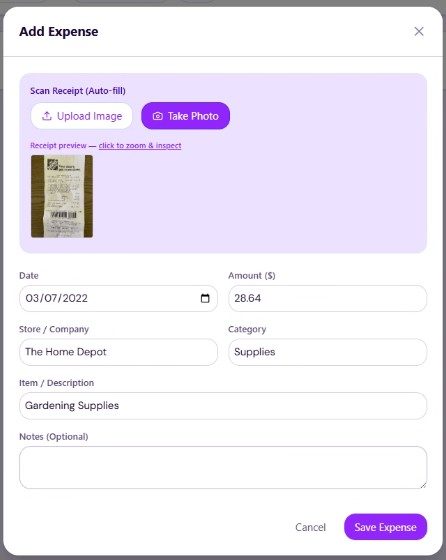
Phone camera plus a receipt scanner app. Modern invoice apps pull vendor, amount, date, and category from a photo in seconds. The image is stored next to the data, so if the IRS asks for the original, you have it.
Email to a folder
Free and works. Photograph each receipt and email it to yourself or drop it in a Google Drive folder named Receipts 2026. The cost is hours of categorization in April.
Shoebox and notebook
The classic approach is also the worst. Thermal receipts fade, paper gets lost, nothing is pre-categorized. Audit-defensible if you are obsessive, miserable otherwise.
The quarterly rhythm
Self-employed contractors owe quarterly estimated taxes on April 15, June 15, September 15, and January 15. Skip them and the IRS adds penalties.
- Total gross income for the quarter.
- Subtract deductible expenses.
- Take 92.35% of net (the SE-tax-adjusted base).
- Apply 15.3% self-employment tax plus your federal income bracket.
- Pay via IRS Direct Pay.
Shortcut: park 30% of every payment you receive in a separate savings account. By the next quarterly deadline you will be within a hair of what you owe.
Common mistakes that trigger audits
- Round numbers. $5,000 mileage screams reconstruction. $5,427.30 says you kept a log.
- Home office without a real home office. The space must be used regularly and exclusively for business.
- 100% business use of a vehicle. Almost nobody actually does this. 80 to 85% is realistic for a service truck.
- Meals deducted that are not travel meals. Lunch at home during the workday is not deductible. Lunch in another city during a business trip is, at 50%.
- Not tracking 1099 income. If a single business customer paid you $600 or more, you owe the income even if no 1099-NEC arrives.
A worked example the tracking guides skip
Numbers make the choice obvious. Say a 1099 contractor drives 14,000 business miles in a year and spends $9,200 running the vehicle (gas, insurance, repairs, depreciation). At the 2025 standard rate of 70 cents/mile, the standard-mileage deduction is $9,800 — higher than the $9,200 actual method here, but only if business use is, say, 78% of total miles, capping the actual deduction lower. The methods are not interchangeable year to year: if you use actual expenses the first year the car is in service, you are locked out of the standard rate for that vehicle for its life. Confirm the current year's rate at the IRS standard mileage rates page, and note the substantiation rules in Publication 463 apply to both methods. Receipts matter for actual expenses; a contemporaneous log matters for both. Action: total your miles at both rates before choosing, and check whether year one locks your method — that single decision can cost hundreds annually.
FAQ
What is the 2026 IRS standard mileage rate for business?
The 2026 standard mileage rate is $0.70 per business mile. Verify the current rate at IRS.gov, since it can be adjusted mid-year. Use the standard rate or actual vehicle expenses, not both.
Do I have to keep paper receipts if I scan them?
No. The IRS accepts legible digital copies as long as they are stored reliably. Most contractors shred paper once a scan is verified.
How long should I keep receipts and mileage logs?
Three years from the filing date if you did not underreport income, six years if you underreported by more than 25%. Seven years is the safe default.
Can I claim the standard mileage rate and actual vehicle expenses?
No. You pick one method per vehicle per year. Once you choose actual expenses, you must stay on actual expenses for that vehicle. You can start with standard mileage and switch to actual later.
What is the difference between Schedule C and a 1099?
A 1099-NEC is a form a payer sends saying this person earned $X this year. Schedule C is where you report all your self-employment income, including 1099 and cash income, minus deductible expenses, to arrive at your taxable profit.
What is the easiest way to start if my records are a mess?
Start today, not in April. Photograph everything in the truck and the desk drawer this week, log monthly odometer readings going forward, and import the last three months of bank statements into any tool that auto-categorizes. Perfect is the enemy of filed.


Comments (0)
Be the first to comment.
Leave a comment