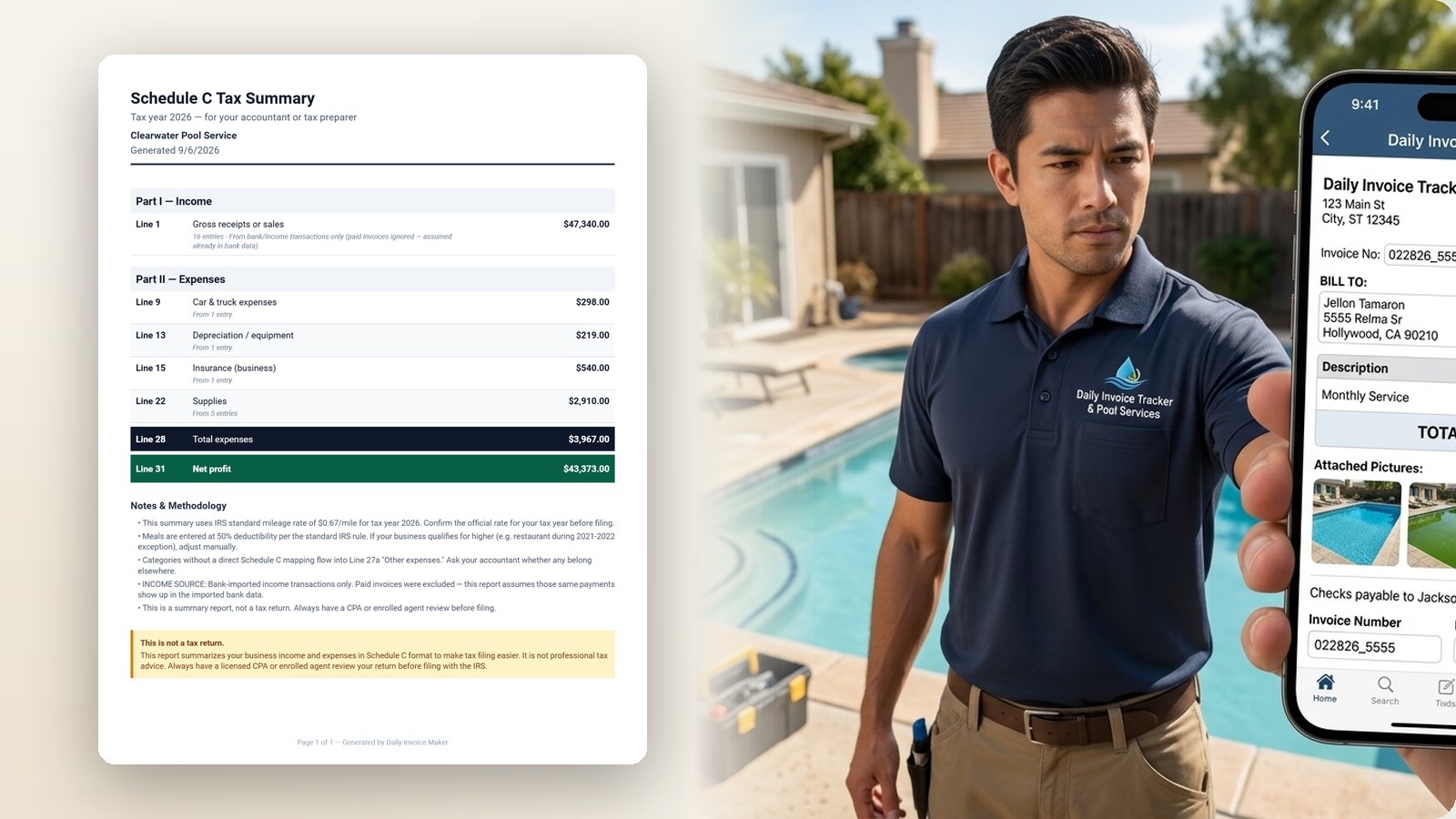
A pool route is a subscription business that buys its own raw materials at retail, and the price of those materials has risen faster than the rates. Chlorine tabs roughly doubled between 2020 and 2023 and have not come back; a route priced in 2019 and never re-priced has quietly lost a third of its margin. This article is about the money in a small pool service company: what a pool actually costs to service, when to itemize chemicals, why repairs are where the year is made, and what the tax return needs. The example is Clearwater Pool Service in Phoenix, set up in Daily Invoice Maker, a desktop invoicing app from the publisher of this site that began life as a pool company's own tool; the screenshots are its real output.
Key takeaways
- A residential pool at $160 a month costs about $95 to service with chemicals, labor, fuel and truck. The margin is real but thin enough that a $20 chemical increase matters.
- Itemize chemicals on commercial accounts and re-price residential every January by the chemical increase; nobody leaves over $10 if the reason is on paper.
- Repairs earn two to three times the margin per hour of route work. A route of 60 pools should produce $25,000 to $40,000 of repair revenue a year.
- Extras (green pool, monsoon, filter cleans) are worth 8 to 12 percent of route revenue if you bill them and zero if you do not.
- Mileage is usually the largest deduction on a route; log it.
What one pool costs
Take a residential pool at $160 a month, weekly service, 4.3 visits.
| Cost per month | Amount | Note |
|---|---|---|
| Chemicals (tabs, acid, occasional shock) | $28 | Up from about $16 in 2019 |
| Labor, 4.3 visits × 25 minutes at $28 loaded | $50 | Your own time counts at what a tech would cost |
| Truck and fuel, allocated across 60 pools | $11 | |
| Insurance, phone, software, allocated | $6 | |
| Total | $95 | Gross margin $65, 41 percent |
At sixty pools that is $3,900 of gross margin a month from the route, before the owner is paid. It is a living, not a fortune, and the point of the table is the chemicals line: it was 10 percent of the rate in 2019 and is 17 percent now. A company that did not raise rates by at least $12 a month over that period gave the increase to the supply house.
Itemize or fold in?
Two ways to handle chemicals on the invoice, and the example business uses both deliberately:
- Commercial and HOA accounts: itemize. The condo association's invoice shows $620 for service and $118 to $164 for chemicals as a separate line each month. Boards approve line items, and a visible chemicals line is what lets you pass through a supplier increase without a renegotiation.
- Residential: fold in. A homeowner wants one number. The number is re-priced every January with a one-line explanation ("chemical costs rose 9 percent this year; your rate is now $172"). Written re-pricing loses fewer customers than owners fear, and the ones it loses were underpriced.

Repairs are where the year is made
The pump replacement in the example bills $1,650: a variable-speed pump, fittings, a weir door and gauge under Parts, 2.5 hours at $110 under Labor, and the utility rebate paperwork at $0 because filing it is the reason the customer said yes.
| Section | Billed | Cost | Margin |
|---|---|---|---|
| Pump and fittings | $1,375 | $1,060 | $315 (23%) |
| Labor, 2.5 hours | $275 | $70 | $205 (75%) |
| Repair | $1,650 | $1,130 | $520 in 2.5 hours |
That is $208 of gross margin per hour, against about $150 an hour of route work at the margins above. A route of 60 pools has perhaps 8 to 12 pumps, filters and heaters reach end of life each year; a company that quotes every one in writing, with the rebate handled, books $25,000 or more of repair revenue it did not have to sell. The estimate with Parts and Labor sections is the sales document; the invoice with the photos attached and the rebate number in the notes is what keeps the customer.

Extras: the 10 percent most companies leave on the pool deck
Green pool recovery ($210 in the example), monsoon cleanup ($45), quarterly filter cleans ($95): on a 60-pool route, extras billed properly add roughly $8,000 to $12,000 a year. They are lost when the tech does the work and does not write it down, or when the owner feels awkward charging a regular customer. The fix is the invoice: a dated, named line that explains itself ("Green pool recovery 5/12: shock, floc, 2 extra visits"), on the same monthly invoice, with a photo. Customers pay for what they can read, and they cancel over surprises, not over charges.
The Phoenix year
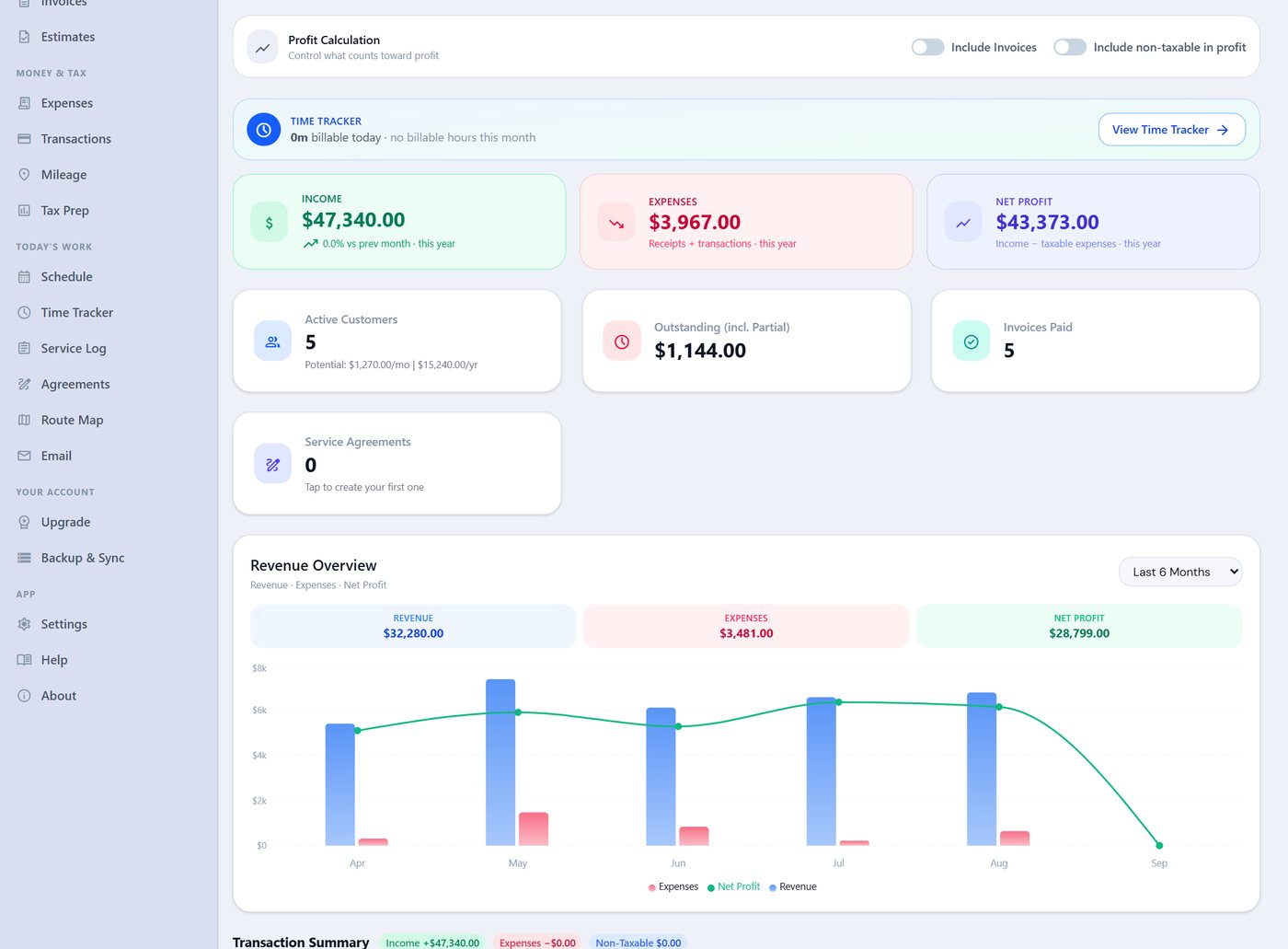
Pool income in Arizona is year-round with a summer bump; in the northern half of the country it is a six-month business with openings and closings at each end. The example dashboard shows Clearwater's year to date, with May's spike from the pump job and green-pool work. The management habit that follows is the same as any seasonal trade: know the monthly net profit, keep three months of fixed costs in reserve, and sell the repair and upgrade work in the months when the route is quiet.
What the tax return needs
| Expense | Schedule C line | Note |
|---|---|---|
| Chemicals | Line 22 supplies | The largest variable cost; every receipt |
| Pumps, filters, heaters resold on repairs | Cost of goods sold (Part III) | Tie the purchase to the invoice |
| Poles, vacuum heads, test kits | Line 22, or line 13 if over a few hundred dollars | |
| Route truck | Line 9 | Mileage rate for a 60-pool route is often $6,000 or more a year |
| Liability insurance | Line 15 |
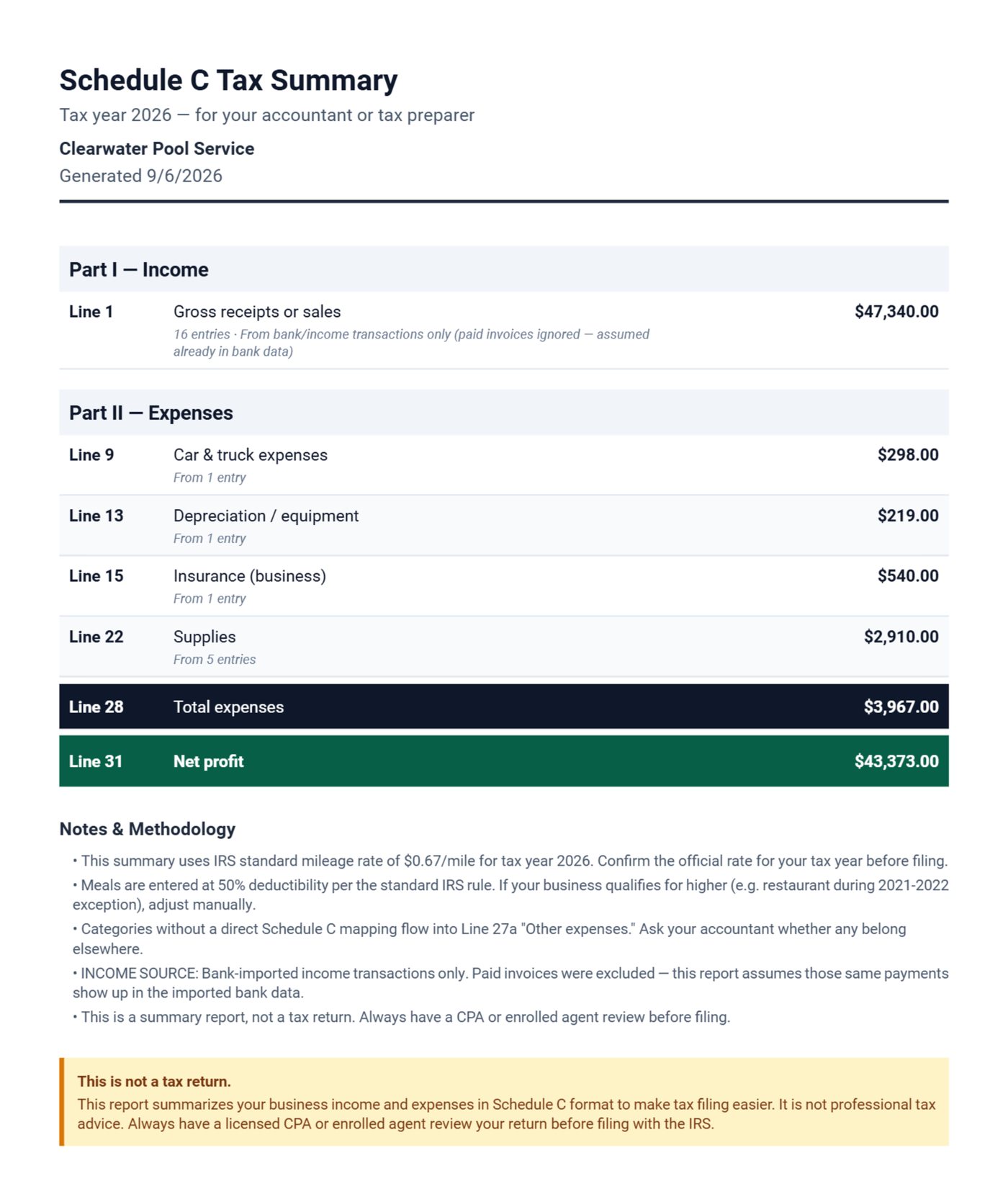
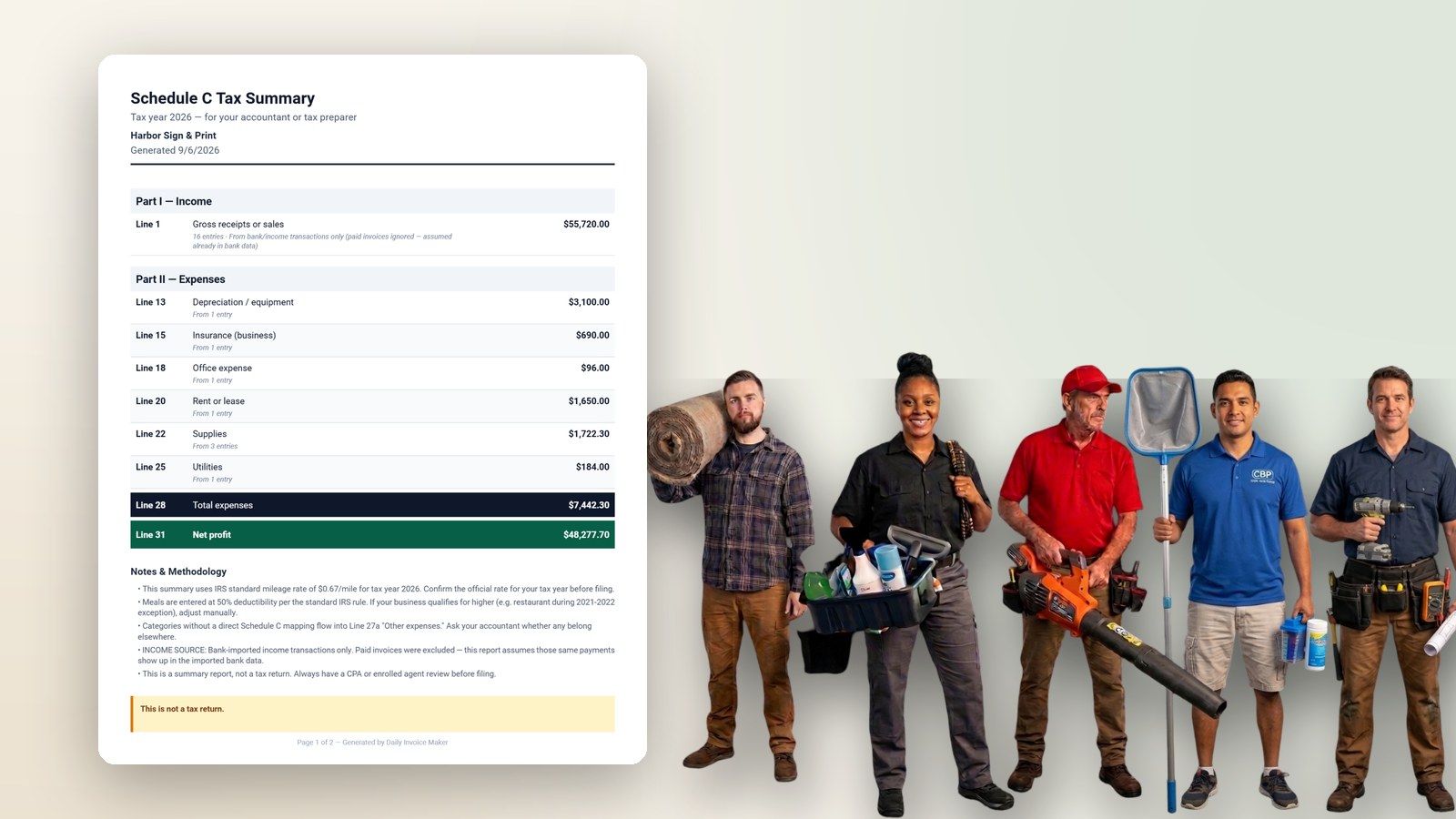
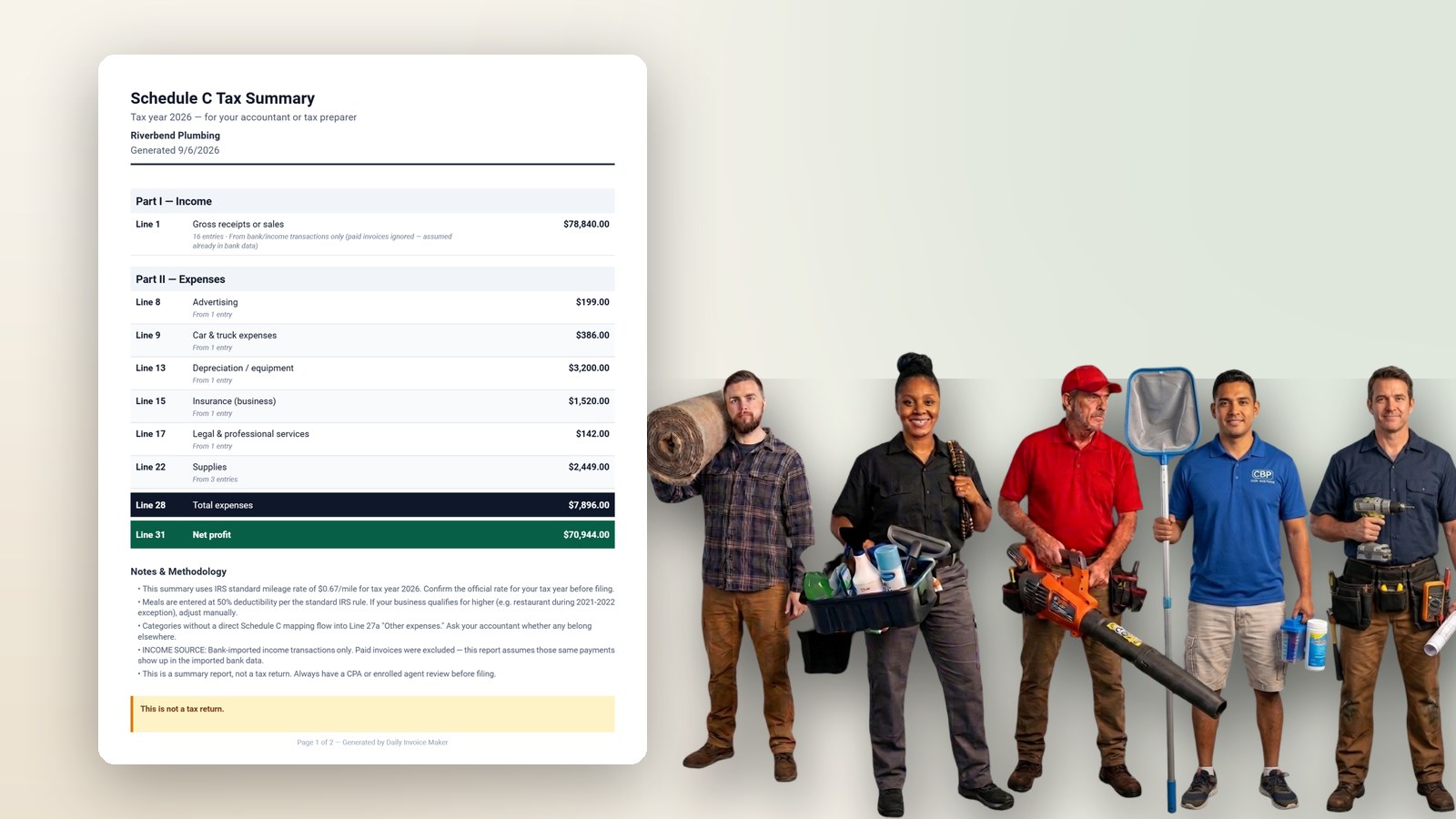
The app's Schedule C summary maps the categories to the lines, and its mileage tracker logs the route by GPS at the IRS rate. The IRS standard mileage rate page has the current figure.
FAQ
How much should I raise rates each year?
By your cost increase plus a point or two, in writing, every January. In the years chemicals jumped, that meant $10 to $15 a month on a $150 pool. Skipping a year means a larger, harder increase later.
Should I charge for the initial green pool clean-up when I take over an account?
Yes, as a separate one-time invoice with photos. Folding it into the first month is how new accounts start unprofitable.
Is it worth getting certified for repairs?
If you have more than 40 pools, almost certainly. The repair margin per hour is double the route margin, and the customers are already yours.
The bottom line
Know what a pool costs, itemize chemicals where the customer wants to see them and re-price where they do not, quote every repair in writing, and bill the extras. Daily Invoice Maker, which produced these documents, is a one-time purchase with a free demo at donlinestore.com; the monthly batch, the repair estimate with sections and the Schedule C summary are all in it.
Comments (0)
Be the first to comment.
Leave a comment