Most people with a side income do not have a bookkeeping problem. They have a plumbing problem. Money from a W-2 job, money from a weekend business and money from a rental all pour into one checking account, get spent from one debit card, and then in February somebody has to work out which of last year's 1,400 transactions belonged to which activity. That is not an accounting task. It is an archaeology task, and it is the reason so many people with genuinely profitable side income end up either overpaying or filing something they could not defend.
The fix is boring and structural: give each source of money its own pipe. This article is about how to lay those pipes when your income comes from more than one place — what accounts to open, how much to move where, and what each pipe has to produce by 15 April. It is the money-architecture half of the subject; the practical, tool-level version for a full-time service business runs on our sister site and is linked at the end.
Key takeaways
- Separation is not about tidiness. It is about being able to answer "how much did this activity earn" without reconstructing a year from memory.
- One checking account and one card per activity, not per person. A trade and a rental need their own, because they file on different forms.
- The tax set-aside belongs in its own account, moved on the day income lands, at 25–30% of profit.
- A transfer to yourself is not an expense. Getting this one wrong distorts everything downstream.
- The reality: you will contaminate the accounts occasionally. Design for catching it, not for perfection.
Why the single-account version quietly costs money
Three specific ways, all of which we have watched happen in real files.
You lose deductions you actually earned. When business purchases are scattered through a personal statement, you claim the ones you remember. A $186 supply run sitting between a grocery shop and a phone bill does not get claimed. At a 22% marginal rate plus 15.3% self-employment tax, every $100 of missed deduction is roughly $37 of tax you did not have to pay.
You cannot tell whether the side business is worth doing. This is the expensive one, and it is not a tax issue at all. If the money is mixed, "it makes about $1,500 a month" is a feeling, not a number — and the costs of running it are invisible, so the feeling is always too optimistic.
If you formed an LLC, you may have undone it. Mixing personal and business funds is the standard fact pattern for arguing that a company is not genuinely separate from its owner. The liability protection you set the entity up for is the thing at risk, and it fails exactly when you need it.
The architecture, by activity
Do not think of it as business versus personal. Think of it as one pipe per tax form.
| Activity | Files on | Accounts it needs | Why it cannot share |
|---|---|---|---|
| W-2 job | Form 1040, wages | Personal checking only | Withholding is already handled; nothing to track |
| Side trade or freelance | Schedule C | Business checking + business card + tax savings | Self-employment tax applies; deductions must be substantiated |
| Rental property | Schedule E | Its own checking account | No self-employment tax, different expense lines, often a separate 1098 |
| Investments | Schedule B / D | Brokerage, already separate | Reported to you on 1099s; do not commingle contributions |
The row people skip is the rental. A trade and a rental sharing one account is the single most common structural mistake we see, and it is painful precisely because the two file on different forms with different rules — rental income is not subject to self-employment tax, and mortgage interest, depreciation and management fees have their own lines that do not exist on a Schedule C.
The set-aside, and where it should live
A W-2 employee never sees this problem because withholding happens before the money arrives. Side income arrives gross, and the tax on it is real and due quarterly once it is large enough.
The working rule: move 25–30% of net profit — not gross revenue — into a separate savings account on the day income lands. Not monthly, not "when I get round to it": on the day, as a standing rule, so the decision is made once rather than twelve times a year. If your side income is small relative to your W-2, there is a cleaner alternative worth knowing about: increase the withholding on your day job with a new Form W-4 instead of making quarterly payments. Withholding is treated as paid evenly through the year regardless of when it actually happened, which can eliminate an underpayment penalty that quarterly estimates would not. The IRS explains both routes in its guidance on estimated taxes.
Keep the set-aside in a separate high-yield savings account, not a sub-ledger in your head and not the same account you spend from. The entire mechanism is that the money is somewhere you would have to deliberately move it back from.
What separation looks like at the end of the year
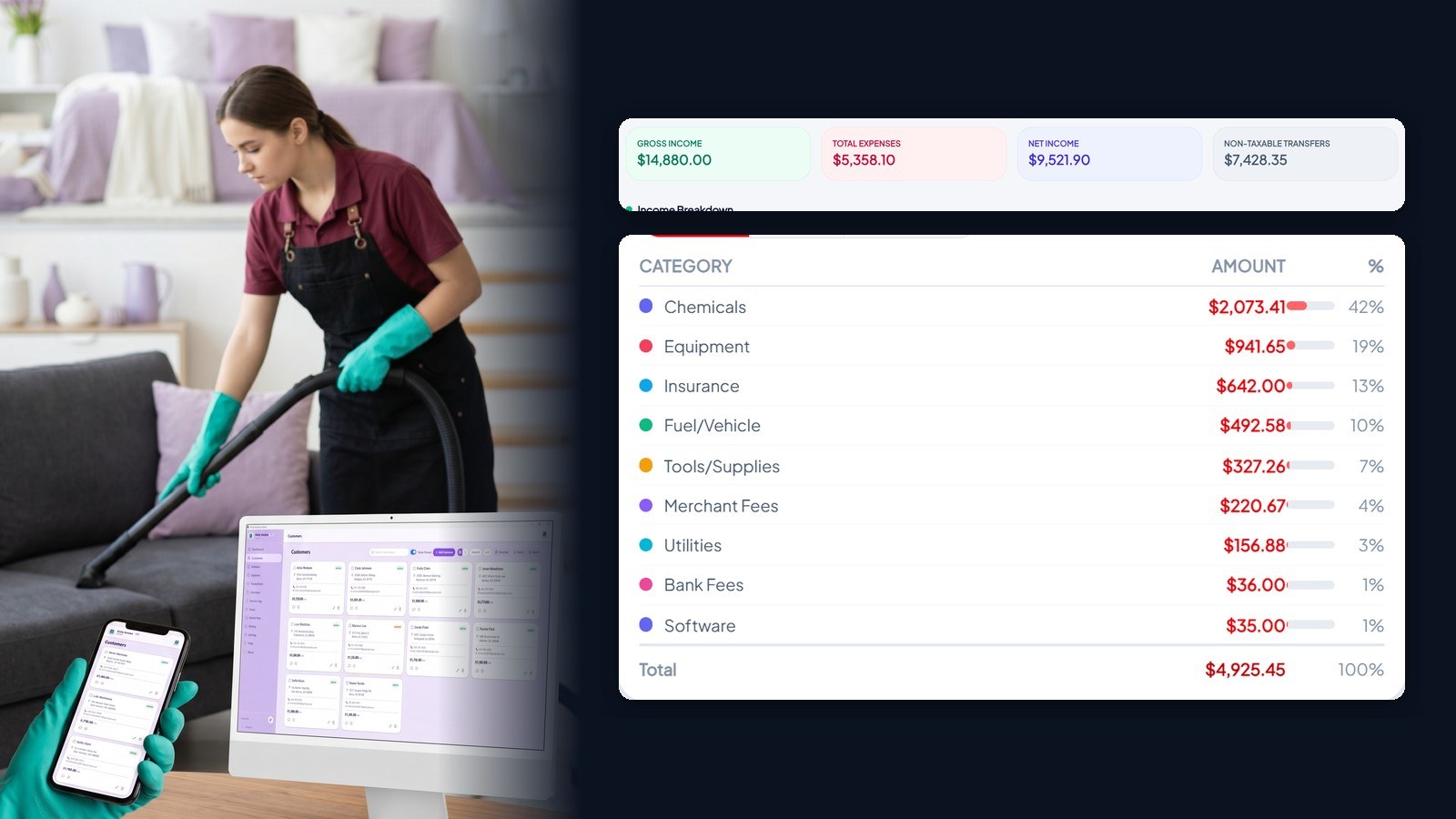
Here are three months of a fictional single-activity business run on exactly this structure — every payment into one business checking account, every purchase on one business card. The figures come from a demo file we built for this article in Daily Invoice Maker, the desktop bookkeeping app published by the same people who publish this site.

Note what the fourth card is doing. $7,428.35 of "non-taxable transfers" is money that left the business account and is neither income nor an expense: $7,200 of owner draws paid to a personal account, plus $228.35 of personal spending that landed on the business card. If those had been treated as business expenses, this file would report a net profit of about $2,093 instead of $9,521.90 — a return understating profit by more than three quarters, which is both wrong and the direction that attracts attention.
The set-aside maths on the real number: 27% of $9,521.90 is about $2,571 for the quarter. That is the transfer to make, and it is knowable only because the profit figure is trustworthy.
Where the money actually went
Separation buys a second thing that nobody advertises: a costs list you can make decisions from.
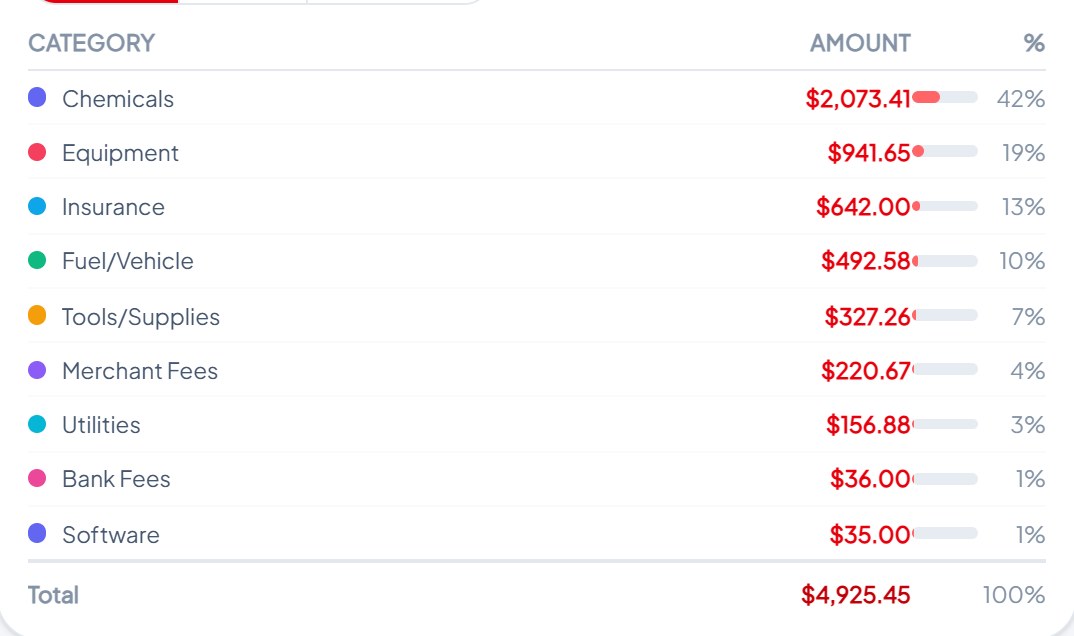
Two lines here are decisions rather than data. Supplies at 42% of total spend is the number that justifies a supplier account or a bulk order. And merchant fees of $220.67 plus $36.00 of bank fees — about 1.7% of revenue — is the actual cost of accepting card payments, which is precisely the sort of cost that disappears forever inside a personal statement. Neither figure is hidden in a commingled account. It is worse than hidden: it is unrecoverable, because the data to compute it was never separated in the first place.
The mistake that survives good intentions
Here is a failure mode that only affects people who are trying hard. You photograph receipts as you go and import the card statement at month end. Now every purchase exists twice, and your expenses are overstated.

In practice we found the pairs are best matched on amount plus a three-day window rather than an exact date, because the card posts one to three days after the purchase. The bottom line for a reader without our software: if you photograph receipts, pick one of the two records as the source of truth for a given purchase and be consistent, or check the overlap before you file.
How to unwind a year that is already mixed
Almost nobody reads this before starting. If you are eight months into a commingled year, the honest sequence is:
- Open the accounts today. The remaining months being clean is worth more than a perfect reconstruction of the past ones.
- Move every recurring charge — insurance, subscriptions, phone — within the week. Auto-pays are what drag the old account back into the story.
- Work backwards one statement at a time, marking business charges. Most people recover the bulk of the missed deductions in two evenings.
- Do not backdate transfers to make it look like the structure existed earlier than it did. The value of the record is that it is true.
- Draw a line at the switch date and treat the year as two halves. That is a defensible position; a fabricated clean year is not.
The rules that actually hold
Four, in order of how often they get broken.
- Never buy anything personal on the business card. Not lunch, not "I'll pay it back". The moment the rule has an exception it becomes a judgement call at every till.
- Pay yourself on a schedule, by transfer. Fortnightly or monthly, a set amount, from business checking to personal checking. Irregular ad-hoc draws are what make people reach for the business card at the supermarket.
- Every dollar of income enters the business account, including cash. Cash that never lands is income you still owe tax on and cannot prove you received.
- One account per activity. When the second venture starts, open the second account on day one, not after the first confusing tax season.
FAQ
I only made $4,000 on the side this year. Is this overkill?
No, and $4,000 is roughly where it starts paying for itself. Self-employment tax alone on $4,000 of profit is about $565, and the deductions you can only substantiate with a clean account are what reduce it. A second checking account is usually free.
Business account or just a second personal account?
A real business account is better — it is what a bank, a lender and a court expect to see, and it is required if you want to accept payments in a business name. But a second personal account used exclusively for the side business captures most of the bookkeeping benefit today, and is far better than waiting until you have an EIN and a formation certificate. Upgrade later.
What about a business credit card if my credit is thin?
Dedicate one existing card to the business and stop using it for anything else. The point is one statement that contains only business purchases; whose name is on the card matters less than whether the rule holds. Note that a personal card used for business does not build business credit, so revisit it once the income is established.
Do I need separate accounting software as well?
Not at first. A separated account plus a spreadsheet beats mixed accounts plus expensive software every time, because the sorting problem is solved upstream. Software earns its place when you have more than one activity, more than a hundred transactions a year, or you are producing invoices.
Should the rental have its own card too?
Its own checking account is the one that matters; a card is nice but less critical, because rental expenses tend to be fewer and larger. What matters is that mortgage, insurance, taxes and repairs for the property all move through one account you can hand to a preparer.
The bottom line
Separating your money is not an accounting preference. It is the difference between knowing what your side income earns and guessing, and between claiming the deductions you are owed and claiming the ones you happen to remember. It costs one phone call to a bank and about ten minutes a month afterwards.
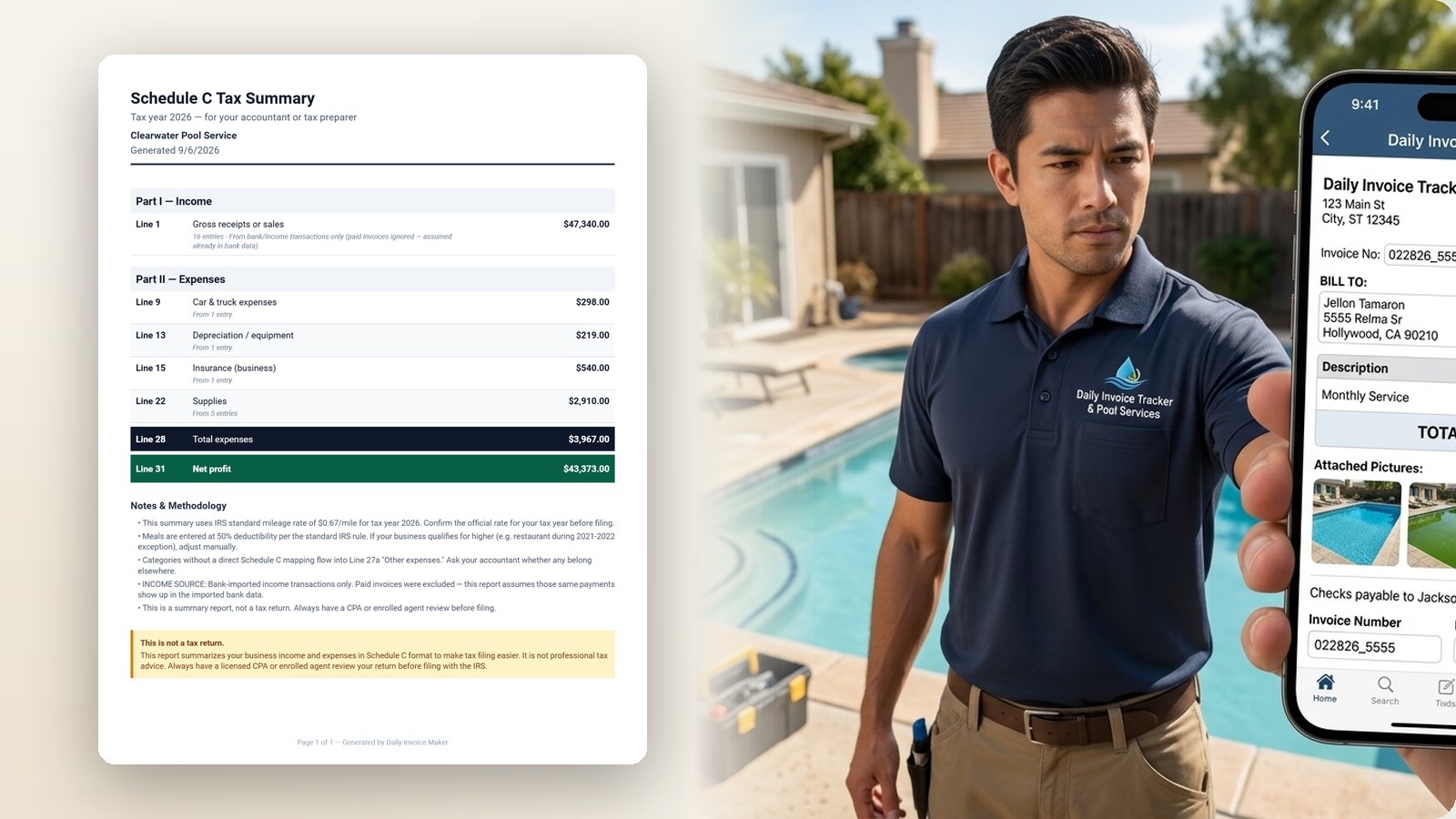
If you want the operator's version — the specific account setup, the import routine, and how the ledger looks when it is running — the companion piece on our sister site walks through it screen by screen: One card in, one account out: the two-account setup that makes bookkeeping take ten minutes a month. The app used for the screenshots here, Daily Invoice Maker, is a one-time purchase for Windows and Mac that keeps your records in a file on your own computer, imports statements from sixteen formats, and produces Schedule C and Schedule E reports separately at year end.


Comments (0)
Be the first to comment.
Leave a comment