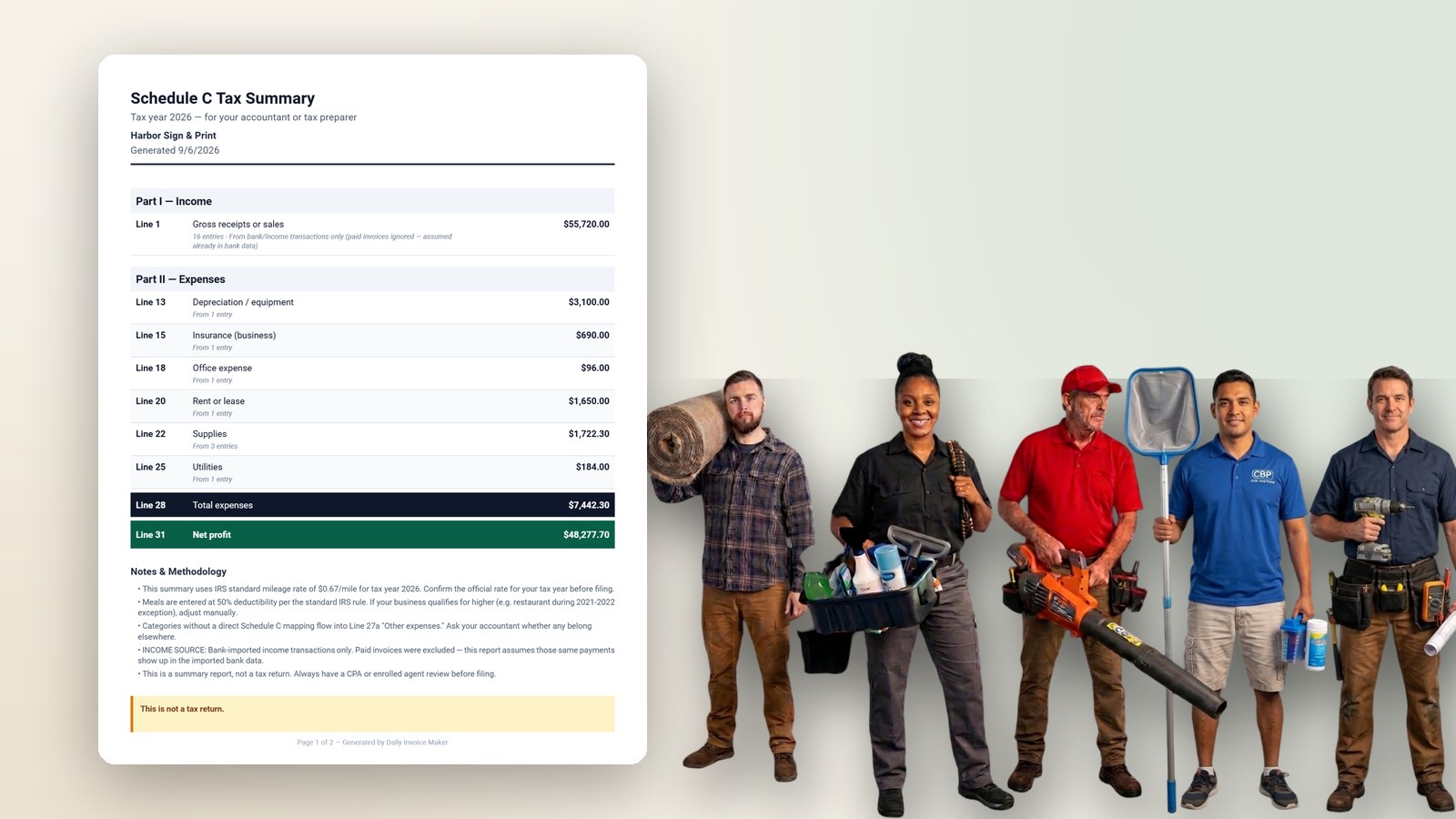
The cheapest accounting software for a small business is the one you will actually keep up to date. A $90-a-month plan that nobody opens between April and January costs $1,080 a year and produces a shoebox anyway. This article is about what a one- or two-person business actually needs from billing and bookkeeping software, what it should cost, and how the choice affects the cash flow and the tax return. The example is Harbor Sign & Print, a two-person shop in Portland, Maine, set up in Daily Invoice Maker, a one-time-purchase desktop app from the publisher of this site; the screenshots are its actual output and the reasoning applies whichever product you choose.
Key takeaways
- A business without payroll or inventory needs four things: invoice, track payment, keep receipts, export for tax. Everything else in the subscription is a module you are renting.
- Over five years a $30-a-month subscription is $1,800; a $150 one-time licence is $150. The difference is a month's rent for most small shops.
- Deposits on custom work are not optional. A sign shop that prints 400 race bibs without a deposit has made a loan.
- Sales tax collected is not income; keep it separate or you will pay income tax on the state's money.
- Quarterly estimated tax is the bill that surprises first-year owners. Set aside 25 to 30 percent of net profit as you go.
What software actually costs
| Option | Year 1 | Five years | Includes |
|---|---|---|---|
| Subscription accounting, entry tier | $360 to $420 | $1,800 to $2,100 | Invoicing, bank feed, basic reports; accountant access and sales tax often cost more |
| Subscription accounting, "plus" tier | $720 to $1,080 | $3,600 to $5,400 | Adds inventory, projects, multiple users |
| One-time desktop licence (the example) | $150 | $150 | Invoicing, estimates, receipts, bank statement import, Schedule C and sales tax reports, two computers |
| Spreadsheet and a folder of PDFs | $0 | $0 plus the accountant's hours | Nothing automated; every deposit and tax line is manual |
The subscription products are excellent at the things a growing company needs: payroll, inventory, multi-user permissions, a live bank feed. A two-person sign shop uses none of them. The honest comparison is the bottom two rows: the one-time licence against the spreadsheet, and the difference there is the accountant's hours in February and the deposits you forgot to record in June.
The deposit is the cash flow
The race package in the example is $1,242 of custom work: a banner, forty arrows, twelve sponsor inserts, 400 numbered bibs, eight shirts. Materials are about $510, bought before the job starts. If the club cancelled after the bibs were printed, none of it is resaleable. The estimate therefore says 50 percent to begin production; the deposit of $621 was received on 7/24 and recorded on the invoice as a partial payment, so the invoice shows the balance and the books show the cash. Deposits on anything custom, over about $300, are the single most important cash-flow rule in a small product business, and the reason to insist on software that records a deposit as a payment on the invoice rather than as a separate mystery credit.

Sales tax is not your money
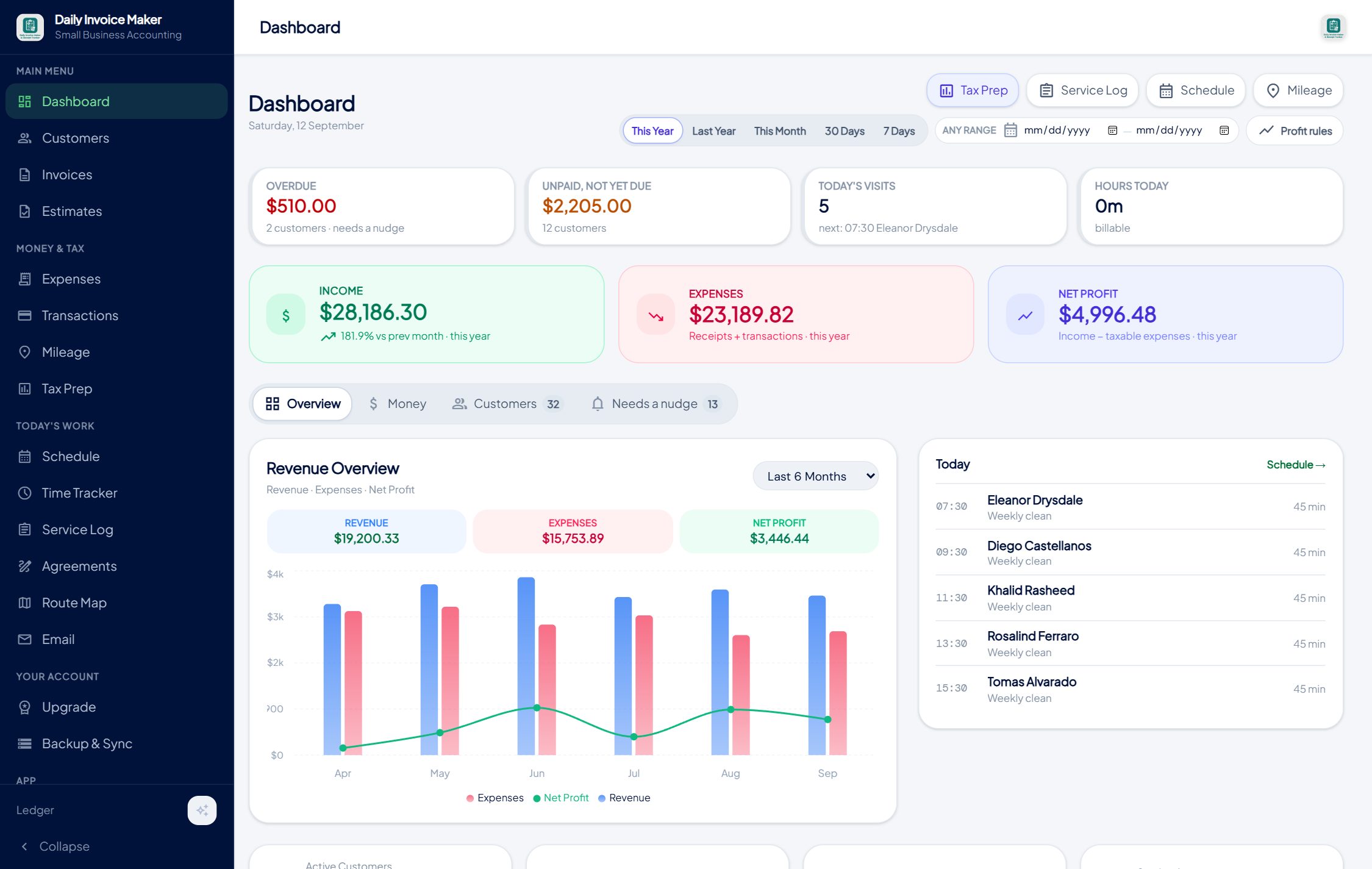
Maine taxes printed goods at 5.5 percent. On $9,120 of August sales that is $475 collected from customers that belongs to the state. Three errors are common: counting it as income (and paying income tax on it), spending it before the return is due, and not being able to say how much was collected at which rate. The fix is mechanical: the software applies the rate on the invoice, keeps collected tax out of the revenue figure, and totals it by rate for the return. The example dashboard's income figure excludes the tax, and the sales tax report lists $475 for August against the 5.5 percent rate. Sole proprietors who sell into more than one state should read the state's rules on economic nexus before it becomes a letter.

The net-30 account and the walk-in
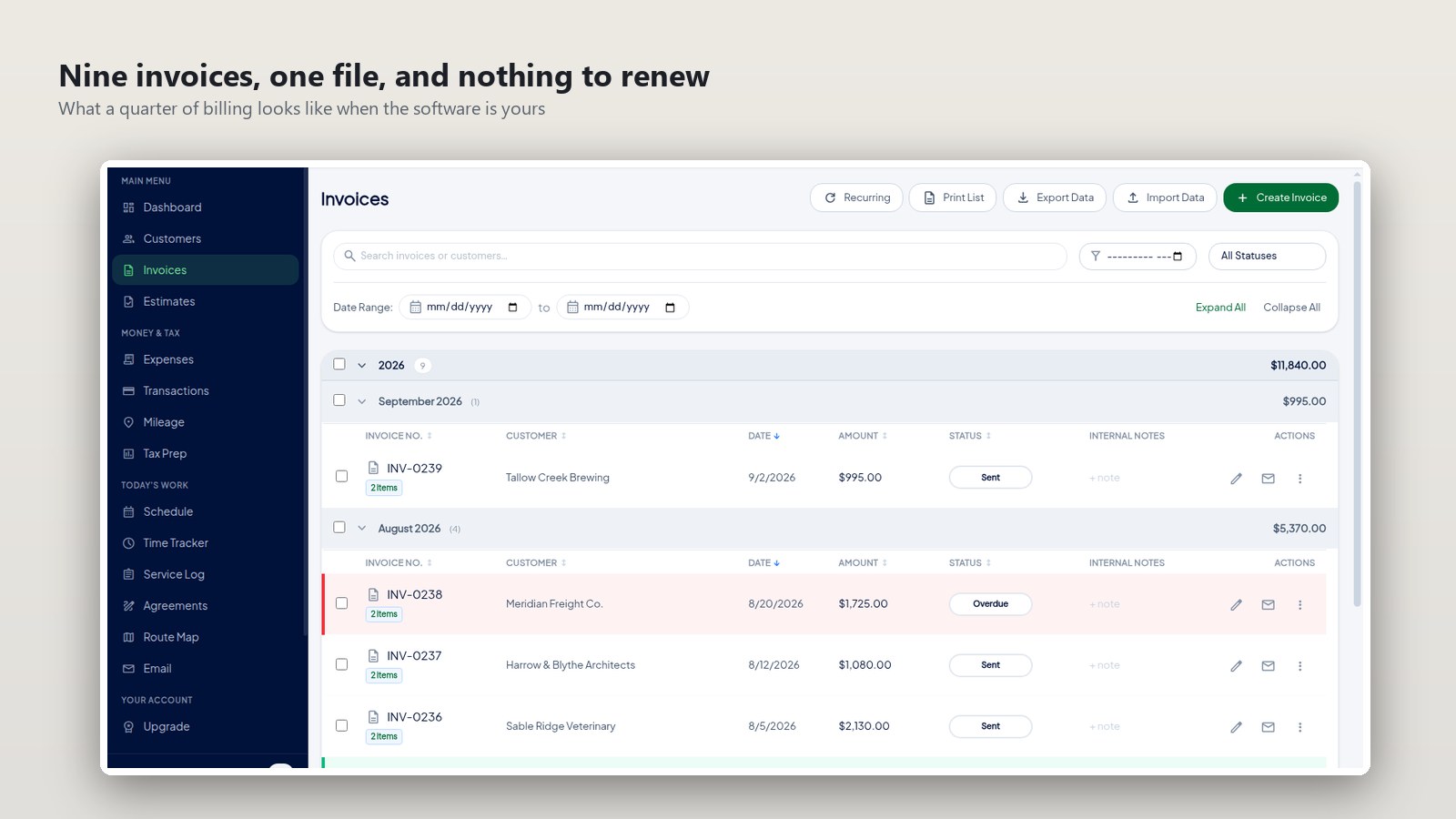
The realty office in the example orders every month and pays on net 30 from accounts payable; the oyster bar pays on pickup. Both are fine, as long as the terms are on the customer and on the invoice, and the net-30 customer is invoiced the day the order ships so the clock starts. A shop with $8,000 a month in sales and a third on net 30 carries about $2,700 of receivables at all times; that is normal, and it is also why the walk-in customers' cash matters. The overdue youth soccer invoice in the example, $958 for field banners, is 11 days late; the reminder email with the invoice attached gets most of those paid in a week. Past 60 days, small-business receivables are collected less than half the time.
What the tax return needs
| Expense | Schedule C line | Note |
|---|---|---|
| Shop rent | Line 20b | |
| Vinyl, coroplast, ink, blanks | Line 22 or cost of goods | Materials that become the product |
| Printer service and repairs | Line 21 | A $3,100 head replacement is repairs, not equipment |
| Software subscriptions | Line 27a or 22 | Adobe, email, the invoicing app if it were a subscription |
| Liability insurance | Line 15 | |
| Utilities | Line 25 |
The Schedule C summary the app produces maps the year's categories onto these lines and hands the accountant one page; the sales tax report sits beside it for the state. The IRS page on estimated taxes explains the quarterly payments that catch first-year owners out.

Four habits worth more than any software
- Invoice the day the job ships. Every day between delivery and invoice is a day added to net 30.
- Photograph every receipt the day you get it. The one you meant to enter in December is gone.
- Import the bank statement monthly and match it to the invoices. Unmatched deposits are either unrecorded income or a customer who paid twice.
- Move 25 to 30 percent of each month's net profit to a tax account, and pay it quarterly.
FAQ
Do I need double-entry accounting?
A sole proprietor without inventory or payroll does not. Cash-basis records of income and expenses, categorized, are what the Schedule C asks for. An LLC taxed as an S corporation or a business with a bank loan is a different conversation; ask an accountant.
Is a bank feed worth paying for?
For most small shops, importing the monthly statement file does the same job in ten minutes a month, with no login stored anywhere. The live feed matters when you have hundreds of transactions a week.
What if I outgrow a simple app?
Export. A good simple app exports to CSV, XLSX and the QuickBooks and Xero formats, so the year's data moves with you.
The bottom line
Buy the four things you need, take deposits on custom work, keep the sales tax separate, and invoice the day the job ships. The one-time-purchase app used for every document above, Daily Invoice Maker, has a free demo at donlinestore.com, and the whole comparison table is the reason it exists.
Comments (0)
Be the first to comment.
Leave a comment