Almost everything written about accounting is written for people who want to become accountants. It starts with debits and credits, spends a chapter on the accounting equation, and by the time it reaches anything you could use on a Tuesday you have stopped reading. That is a shame, because the useful part of accounting is small, and it is mostly about being able to answer three questions about your own money.
This is the concept-first version: what the words mean, which ideas actually earn their keep for someone with a side income or a small operation, and — the part courses skip — which ones you can safely ignore until you are much bigger. Screenshots come from Daily Invoice Maker, our publisher's own desktop app, running a fictional demo file, but the ideas are tool-agnostic. If you want the practical, click-by-click version for a full-time service business, that runs on our sister site and is linked at the end.
Key takeaways
- Accounting answers three questions: did I make money, do I have money, and what do I own versus owe. Three statements, one for each.
- Profit and cash are different things, and the gap between them is what actually sinks small operations.
- Double-entry is a genuinely great invention you probably do not need yet. Knowing when you cross that line is worth more than learning the mechanics early.
- Depreciation is not an accounting trick — it is the rule that stops one big purchase from making a good year look like a bad one.
- The red flags that matter are internal: numbers that stop reconciling, margins that drift, and receivables that age.
The three statements, in plain terms
Formal accounting produces three financial statements. They are not interchangeable and each answers a different question.
The income statement (profit and loss) covers a period — a month, a year. Revenue minus expenses equals profit. It answers did the activity make money.
The cash flow statement also covers a period, but tracks money actually moving. It answers did I have money, which is a different question and often has a different answer.
The balance sheet is a snapshot at one instant: assets on one side, liabilities and equity on the other, always balancing. It answers what do I own and what do I owe.
Here is the whole point of having three. This is a real demo year for a small service operation:
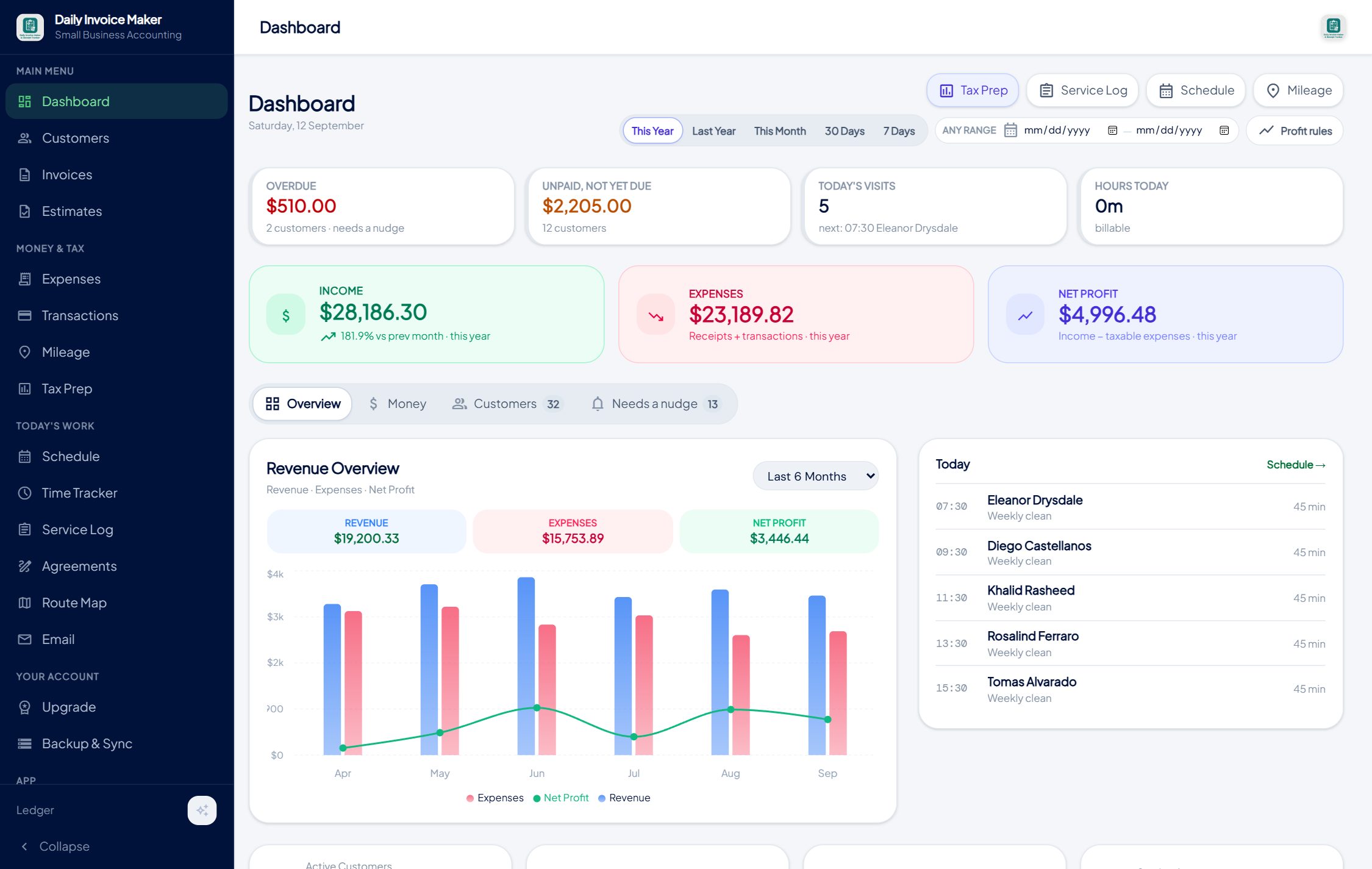
Income $28,186.30, expenses $23,189.82, profit $4,996.48. The income statement says this was a profitable year. But look at the two figures above it: $510.00 overdue and $2,205.00 unpaid but not yet due. Of that $4,996 of profit, $2,715 is not in the bank — it is work already done, sitting on somebody else's desk.
The income statement is not lying. The money was genuinely earned. But you cannot pay a supplier with earned. That gap is the single most useful thing accounting has to teach a small operator, and it is why "we were profitable right up until we closed" is a real sentence people say.
Why profit and cash come apart
Four common reasons, all ordinary:
- You invoiced but were not paid. Profit today, cash in 45 days, rent due in 10.
- You bought something big. A $6,000 trailer is cash gone now, but as an asset it reduces profit slowly over years, not all at once.
- You took money out. An owner's draw reduces your cash and your equity. It is not an expense and does not reduce profit at all.
- You were paid in advance. A deposit is cash in hand for work you still owe. It is a liability, not earnings — spend it and you have to fund the job from future revenue.
Notice that three of the four are invisible on an income statement. That is not a flaw; it is why more than one statement exists.
Double-entry: what it is and when you need it
Double-entry bookkeeping records every transaction twice — once as a debit, once as a credit — so the books must always balance. It dates to 15th-century Venice, it underpins every large company's accounts, and it is genuinely one of the better ideas in commerce.
Its real advantage is self-checking. If the two sides do not agree, something is wrong, and you know before it reaches a tax return. Its cost is that every entry requires you to decide which two accounts it touches, which is a skill.
Single-entry records each transaction once: date, amount, in or out, category. That is a list, and for most people it is the correct choice.
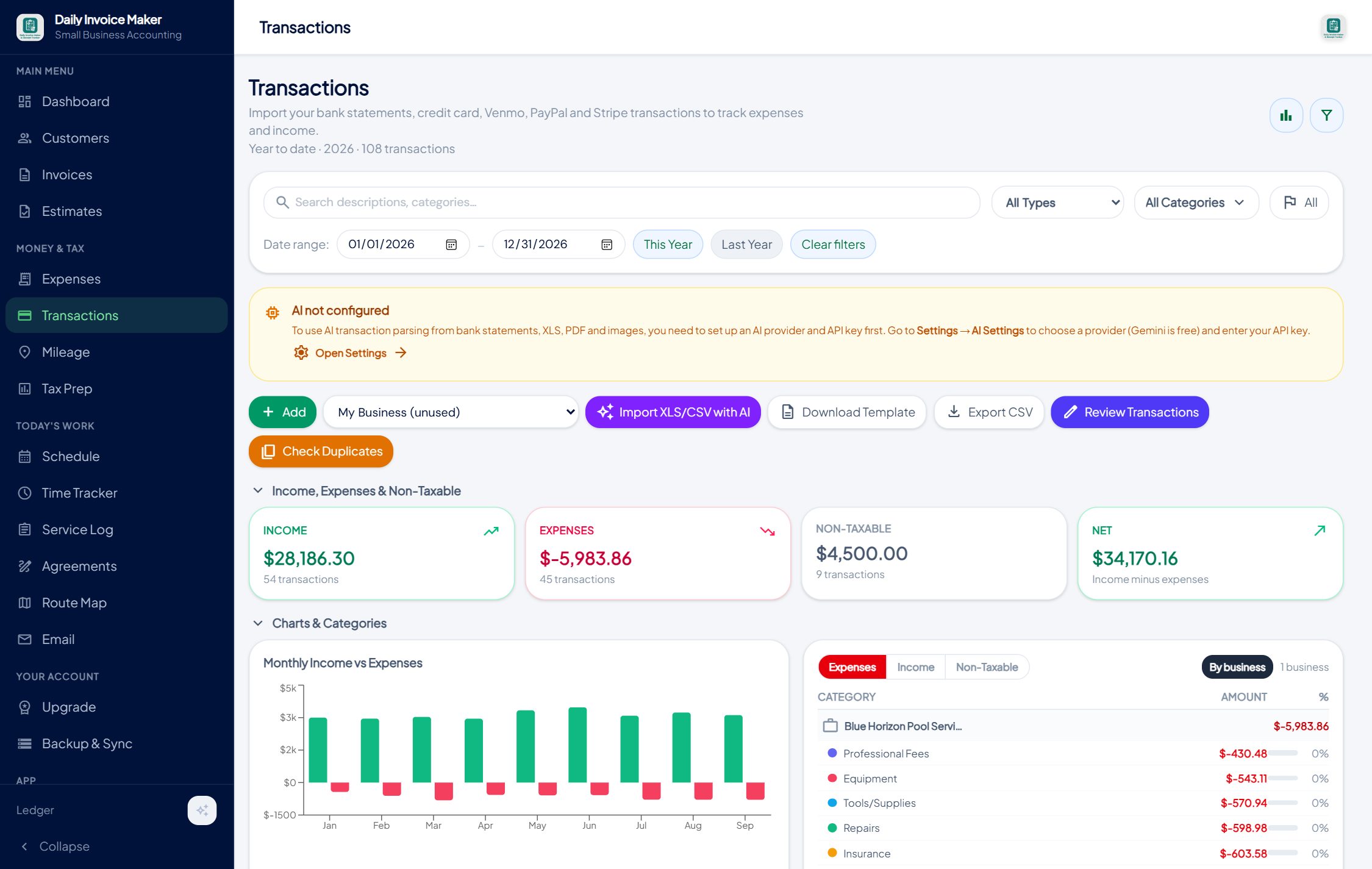
You have outgrown single-entry when any of these become true: you carry real inventory, you have partners or outside investors, you file a corporate return, you owe money on terms you need to track, or a lender wants a balance sheet. Until then, single-entry plus one discipline gets you the same safety.
That discipline is reconciliation. Once a month, check that what moved through the bank account matches what is in your records. If the statement shows $4,180 of deposits and your books show $3,905, you are missing $275 and you go and find it. That one check does the error-catching job that double-entry does automatically. Skip it and single-entry genuinely is dangerous — the criticism is fair, it just has an easy answer.
The two ideas from a real accounting course that are worth your time
Depreciation
You buy a $6,000 trailer that will last six years. If you deduct all $6,000 this year, this year looks terrible and the next five look artificially good — and none of the six years tells you what the business actually earned. Depreciation spreads that cost across the years the asset is useful, so each year carries its fair share.
The reason to care as a small operator is that the tax code has fast lanes — Section 179 and bonus depreciation let many businesses deduct a qualifying purchase immediately. That is often good for your tax bill this year and simultaneously bad for understanding your business, because it puts a six-year cost in one month. Both things are true. Take the deduction; just remember, when you read that month, that the number is distorted.
Internal control
The formal version is about separation of duties and fraud prevention — mostly irrelevant when you are the only person touching the money. The version that applies to you is smaller and worth adopting:
- Business money lives in a business account. Always. Not for tidiness — so that "what did this activity earn" has an answer that does not require reconstructing a year.
- Every expense has evidence attached, not just an amount. A line saying "Supplies $186" is an assertion. The same line with a photo of the receipt is a record.
- Somebody other than you looks at the numbers once a year. Even briefly.
What to ignore for now
Being honest about this saves more time than any technique. A full accounting syllabus covers inventory valuation methods, cost and performance auditing, managerial cost allocation, and the mechanics of external audit. If you have a side income or a small operation, essentially none of that applies to you yet, and studying it is procrastination dressed as diligence.
Two you can specifically drop: inventory management theory — reorder points, demand classification, carrying-cost models — is for businesses that hold stock; a service business holds a van and some consumables. And audit preparation as a discipline: keep good records and you are prepared, and the actual event, if it ever happens, is something you hire for rather than study for.
The red flags that actually matter
Courses teach you to spot fraud in someone else's books. More useful is spotting decay in your own. Four signals:
- Reconciliation stops matching. The earliest warning of anything, from a duplicated charge to a missed deposit. If the gap is not zero, do not move on.
- Margin drifts down while revenue holds. You are busier and no richer. Something on the cost side moved and you have not repriced.
- Receivables age. Track how old the outstanding money is, not just how much. A $500 invoice at 15 days is business; at 90 days it is a collection problem, and the odds of collecting fall sharply the longer it sits.
- You stop wanting to look. Genuinely the most reliable indicator. Avoidance almost always means something in there is already known and unwelcome.
Where the tax system forces structure on you
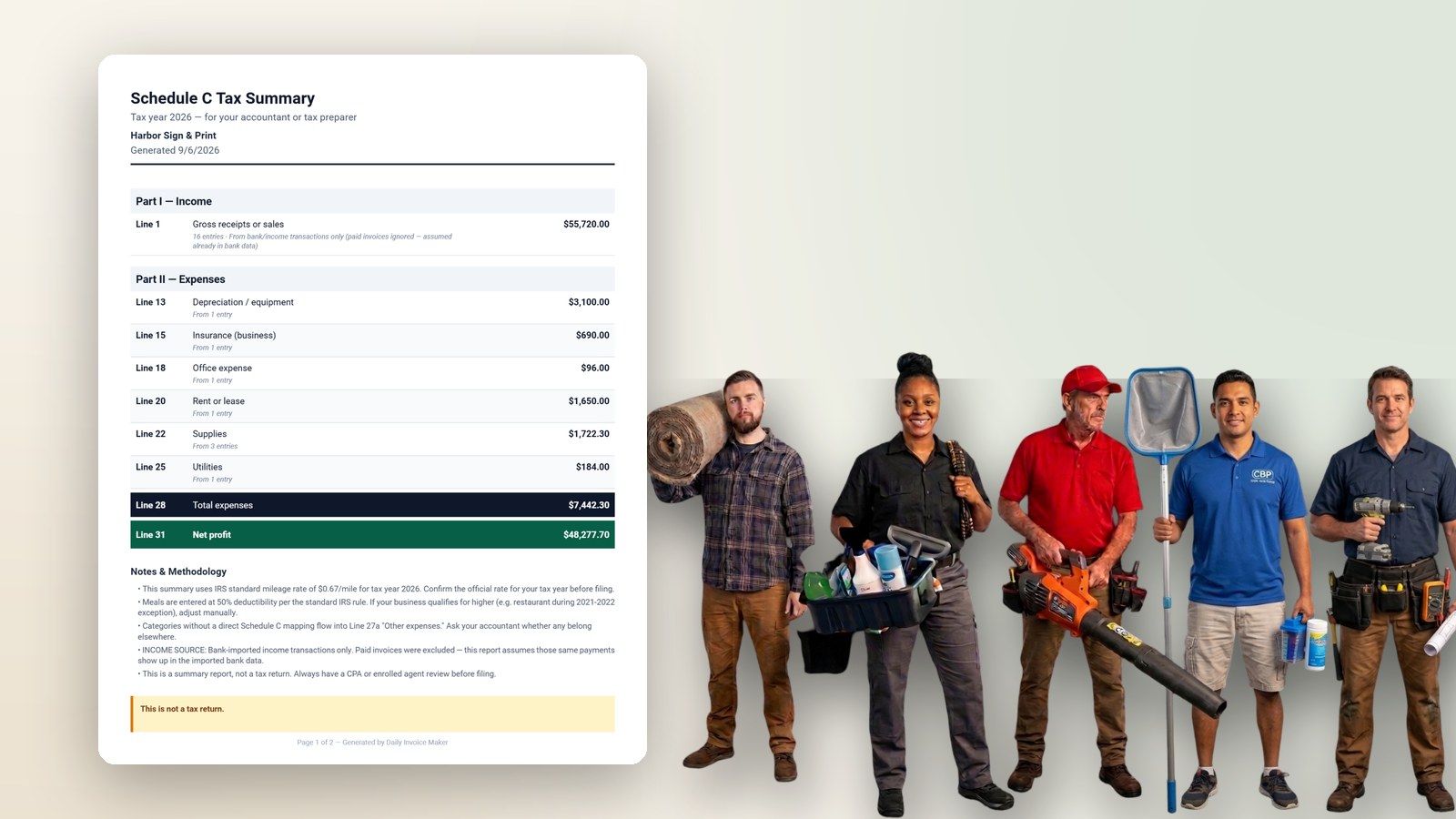
One thing that surprises people with more than one income source: the tax system does not care that it is all "your business". Different activities file on different forms, and that means separate books.

The demo file has four activities: two trades on Schedule C, and a rental property on Schedule E. Rental income is not self-employment income, it is not subject to self-employment tax, and it follows different rules for expenses and losses. Blend it into one pot and the return is wrong in both directions.
The other item on that screen worth knowing about is the income-source selector, which exists to prevent double-counting. If you record a payment as a paid invoice and also import the same deposit from your bank statement, you have reported the income twice. It is an easy mistake, it always goes against you, and the defence is simply to decide which record is the source of truth — for most people, the invoices.
A realistic monthly routine
Not a system. Ten minutes:
- Import last month's bank and card statements.
- Categorise anything unlabelled. If you cannot remember, it is personal — the honest default is also the safe one.
- Reconcile: bank deposits should equal recorded income. Chase any gap now.
- Look at what you are owed and how old it is.
- Read the profit figure for one minute. Not to act — just to notice.
Twelve of those a year and you have current books, an early warning system, and a tax return that is a copy job rather than an excavation.
FAQ
Do I need to learn debits and credits?
Not to run a small operation. Learn them when you take on partners, carry inventory, or start filing a corporate return. Before that, the effort is better spent on categorising consistently and reconciling monthly.
What is the difference between bookkeeping and accounting?
Bookkeeping is recording what happened — daily, repetitive, with a right answer. Accounting is interpreting the record: grouping it into statements and drawing conclusions. You need current bookkeeping before accounting is worth anything.
Cash basis or accrual?
Cash basis counts income when money arrives and expenses when paid. It is simpler, it matches your bank account, and it is what most small operations use. Accrual counts income when earned and expenses when incurred, giving a truer picture of a period at the cost of more discipline.
Is bookkeeping software enough, or do I need an accountant?
They do different jobs. Software keeps the record; an accountant advises on position — entity structure, deductions you did not know about, multi-state issues. Good records make an accountant cheaper, because they are not billing you to sort receipts.
How much should I set aside for tax?
A common working figure for self-employment income is 25–30% of profit, moved to a separate account on the day income lands. It is not advice for your situation, but it is a far better default than nothing, and the mechanical act of moving it is what makes it work.
The bottom line
You do not need an accounting qualification to run your money well. You need to know that profit and cash are different, that your categories should match the form you file, that reconciling monthly is what keeps simple books honest, and that the earliest warnings show up in your own numbers before they show up in your bank balance.
The demo year above — $28,186.30 in, $23,189.82 out, $4,996.48 kept, and $2,715 of it not yet collected — is a complete education in that last point. If you want the hands-on version showing exactly how a service business records and reports this month by month, our sister site has the step-by-step walkthrough with the same demo file.
Comments (0)
Be the first to comment.
Leave a comment