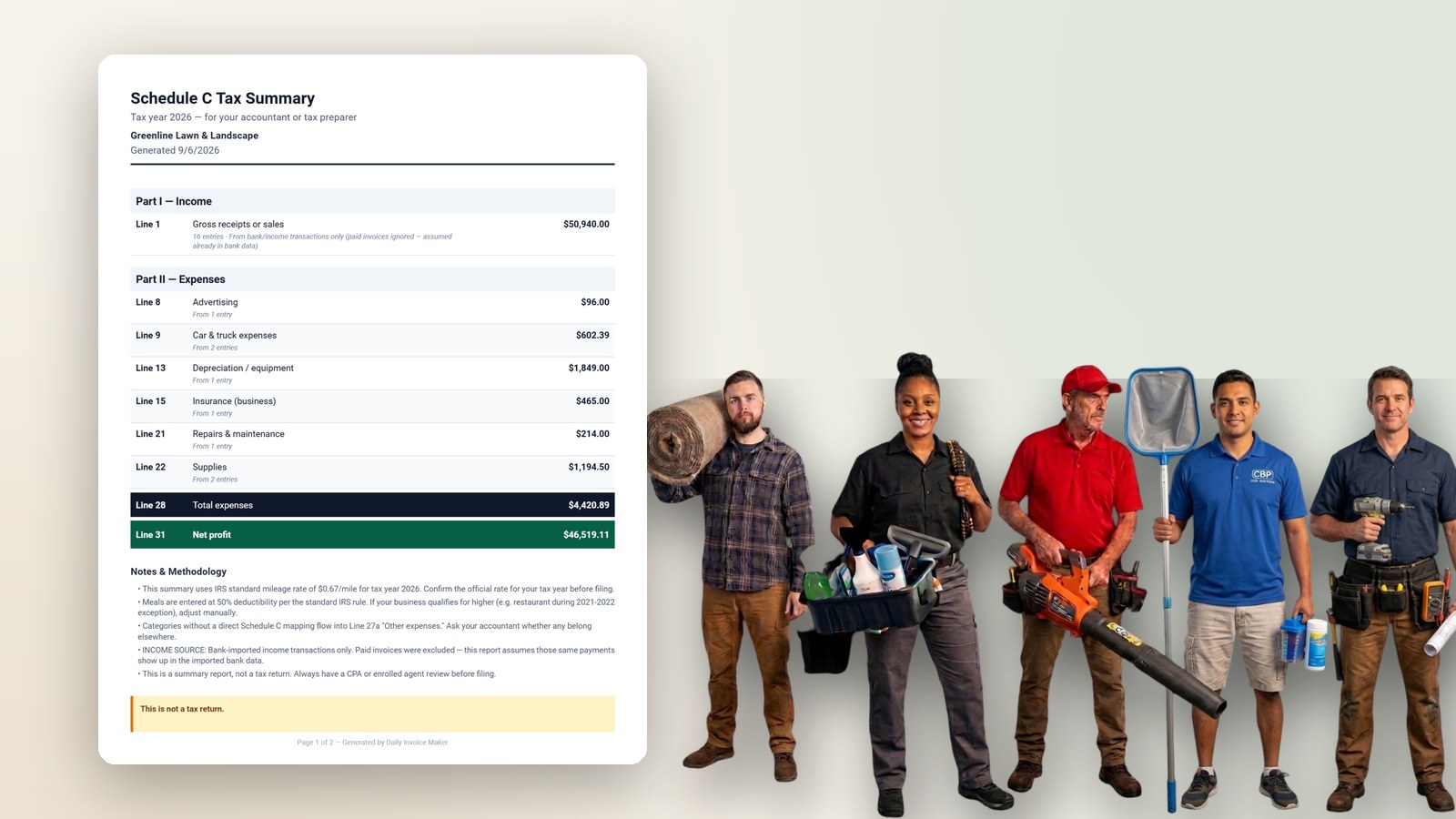
A lawn care business earns most of its money in six months and pays its bills in twelve. That single fact explains why so many mowing companies that look busy in July are broke in February: the pricing was set per cut, the equipment was bought in spring on a card, and nobody ever looked at the year as a whole. This article is about the money side of running a mowing and landscape operation: how to price it, how the seasonality actually plays out in a profit and loss, and what the tax return needs from you. The figures come from a two-crew Raleigh company, Greenline Lawn & Landscape, set up in Daily Invoice Maker, a desktop invoicing app from the publisher of this site; the screenshots are its real output and the principles apply whatever software you use.
Key takeaways
- Price on an annual basis even when you bill monthly: a $160 monthly customer is a $1,920-a-year customer, and that is the number to compare against your costs.
- Flat monthly pricing smooths your cash flow but shifts weather risk onto you; per-visit pricing does the opposite. Pick deliberately and write the rain rule into the terms.
- Keep a reserve equal to about three months of fixed costs by the end of August. That is the number that gets a lawn business through January.
- Equipment over roughly $2,500 is usually better expensed under Section 179 in the year you buy it, but confirm it with your preparer; the software puts it on the depreciation line so nothing is missed.
- Mileage between properties is normally a bigger deduction than fuel receipts. Log it.
The shape of a lawn care year
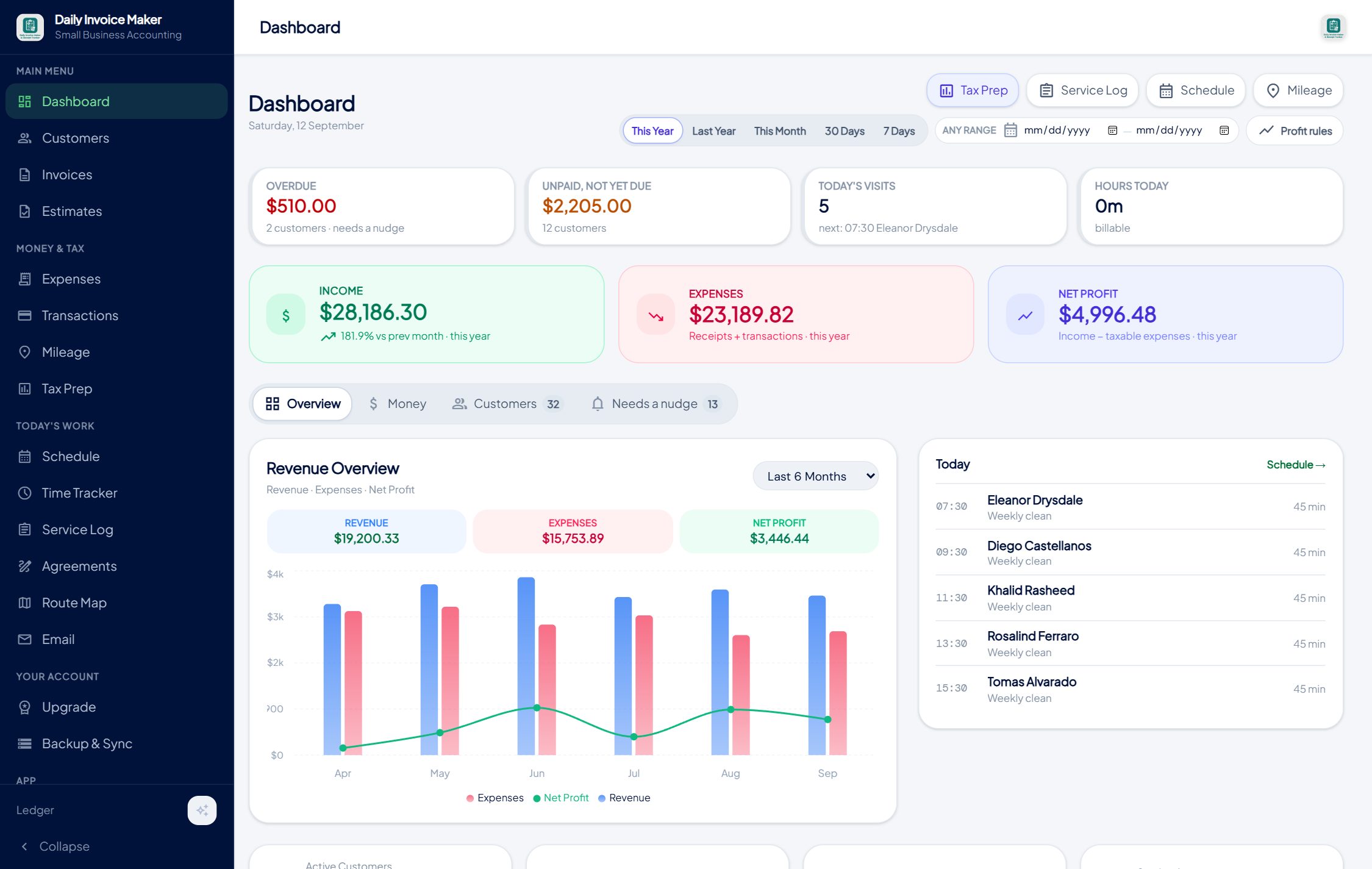
Here is Greenline's income by month for the year to date, the way it comes out of the app's dashboard after the bank statements are imported.

| Month | Income | What is happening |
|---|---|---|
| January | $2,140 | Two commercial contracts only |
| February | $2,380 | Same, plus one cleanup deposit |
| March | $6,410 | Spring cleanups and mulch |
| April | $7,920 | Weekly mowing starts |
| May to August | $7,650 to $8,340 | Full route, 20 to 25 visits a week |
Eight months in, income is $50,940. If the pattern holds, September and October add roughly $12,000 more and November through February add about $8,000 combined. Call it $71,000 for the year, of which $55,000 arrives between March and October. The costs do not follow that curve: insurance, the truck payment, the phone and the storage unit are the same in January as in July. The business is profitable, but only if July's money is still in the account in January.
Per cut, flat monthly, or prepaid: who carries the weather
There are three ways to price weekly mowing and each one moves risk somewhere.
| Model | Customer pays | Who eats a rainy month | Best for |
|---|---|---|---|
| Per visit ($40 a cut) | Only for work done | You: five rainy Thursdays are $200 gone | New customers, irregular properties |
| Flat monthly ($160) | Same every month, 4 or 5 visits | Customer in a 5-visit month, you in a 3-visit month | Established route, steady cash flow |
| Prepaid season ($1,280 for April to November) | Up front, usually with 5 to 8 percent off | You, but you are holding the cash | Funding spring equipment without a card |
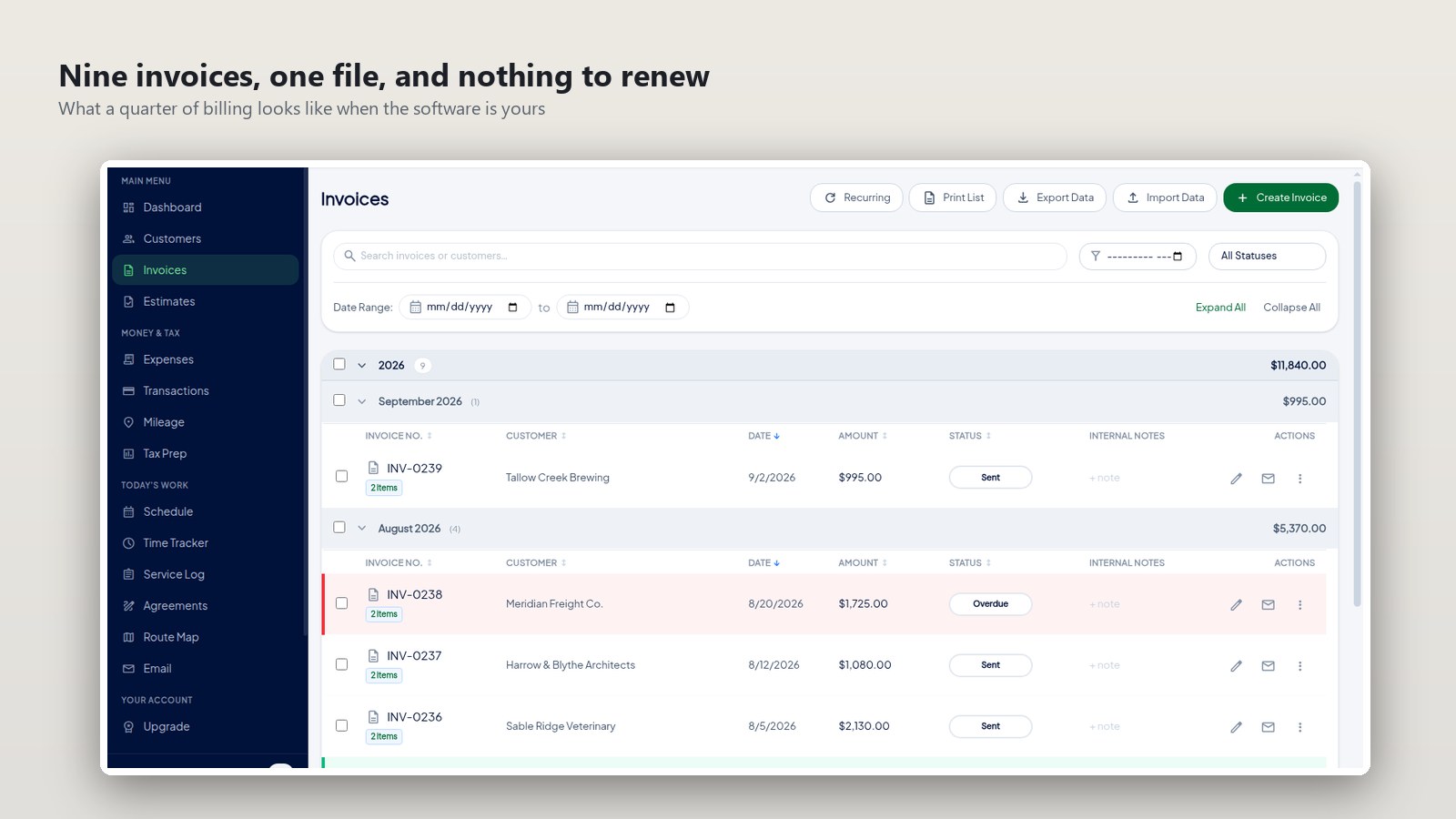
Greenline mixes them: residential customers on per-visit pricing with a written rain rule (a skipped visit is credited on the invoice, and the example August invoice shows exactly that, five visits billed and one credited), the HOA and the dental office on flat monthly contracts. Whatever you choose, the rule has to be on the invoice. A credit line that says "Rain skip credit, 8/14 (no service)" ends the argument before it starts, and it is also correct bookkeeping: income is reduced by a visible credit, not by a number that was never invoiced.
Pricing a cut with real costs
Take a typical residential property at $40 a cut. A two-person crew does it in 25 minutes including the drive between neighbouring properties. The direct costs per cut are roughly:
- Labor: 50 crew-minutes at $22 loaded (wage plus payroll taxes) is $18.30
- Fuel for mowers and truck, allocated: about $2.60
- Equipment wear and repairs: about $2.00 per cut on a $12,000 fleet doing 1,800 cuts a season
- Trimmer line, blades, oil: $0.40
That is $23.30, leaving $16.70 gross profit per cut, or 42 percent, before insurance, the truck payment, advertising and your own time quoting and invoicing. At 22 cuts a day the crew produces about $370 of gross profit. At $35 a cut the same day produces $260. The five dollars is the whole difference between a business and a job, which is why the price should be set from the costs and not from what the neighbour's kid charges.
The one-off work is where the margin is
Mowing keeps the lights on; cleanups, mulch and plantings are where the year is made. The spring cleanup estimate in the example is $3,253 for one HOA: 22 yards of mulch delivered at $48 and installed at $35, six crew-hours of cleanup at $145, a pre-emergent treatment, six boxwoods. The mulch alone is $1,826 of revenue against $1,056 of cost, and the crew hours are billed at roughly three times the loaded wage. A company that does twelve of these in March and April books $35,000 to $40,000 in six weeks. Two rules protect it: quote every one in writing with a deposit term (50 percent to schedule, because you are buying the mulch and the plants), and convert the accepted quote straight into the invoice so the number the board approved is the number they are billed.

What the tax return needs
A sole-proprietor lawn business files Schedule C. The categories that matter, and where they land:
| Expense | Schedule C line | Note |
|---|---|---|
| Mowers, trimmers, blowers | Line 13 (depreciation) or Section 179 | Most small shops expense the whole cost in the year of purchase; ask your preparer |
| Fuel, truck repairs, or the standard mileage rate | Line 9 | Mileage rate or actual costs, not both, per vehicle |
| Mulch, plants, seed, chemicals | Line 22 (supplies) or cost of goods | Consistent treatment year to year |
| General liability insurance | Line 15 | Not health insurance, which goes elsewhere |
| Crew wages | Line 26 | Requires payroll filings; 1099 contractors go on line 11 |
The app's Schedule C summary does this mapping from the expense categories you used all year, so the preparer gets one page with line numbers instead of a shoebox. The IRS publishes the Schedule C instructions if you want to check a line yourself.

The winter plan
By the end of August, have three months of fixed costs in a separate account. For Greenline that is about $6,000. Then use the quiet months for the two things that raise next year's income: renew the commercial contracts in writing with a price increase that matches your cost increase, and offer prepaid seasons to the residential list in January with a modest discount. Prepay money in January is what buys the new mower in March without a card.
FAQ
Should I charge sales tax on lawn care?
It depends on the state. Several states tax landscaping services, most do not tax mowing. Check your state's department of revenue; if you do collect it, keep it out of your income figure and report it separately.
Is flat monthly pricing worth the rainy-month risk?
For an established route, usually yes: predictable cash flow is worth more than the occasional five-visit month you give away, and customers stay longer on flat pricing. Write the visit count into the agreement.
How much should I keep back for taxes?
Set aside 25 to 30 percent of net profit for federal and state income tax plus self-employment tax, and pay it quarterly. The Schedule C summary gives you the running net profit to base it on.
The bottom line
Price each cut from its costs, choose who carries the weather and write it down, quote the one-off work with a deposit, and keep enough of August's cash to reach March. The tools are simple; Daily Invoice Maker, which produced every document above, is a one-time purchase at donlinestore.com with a free demo you can run on your own route.
Comments (0)
Be the first to comment.
Leave a comment