
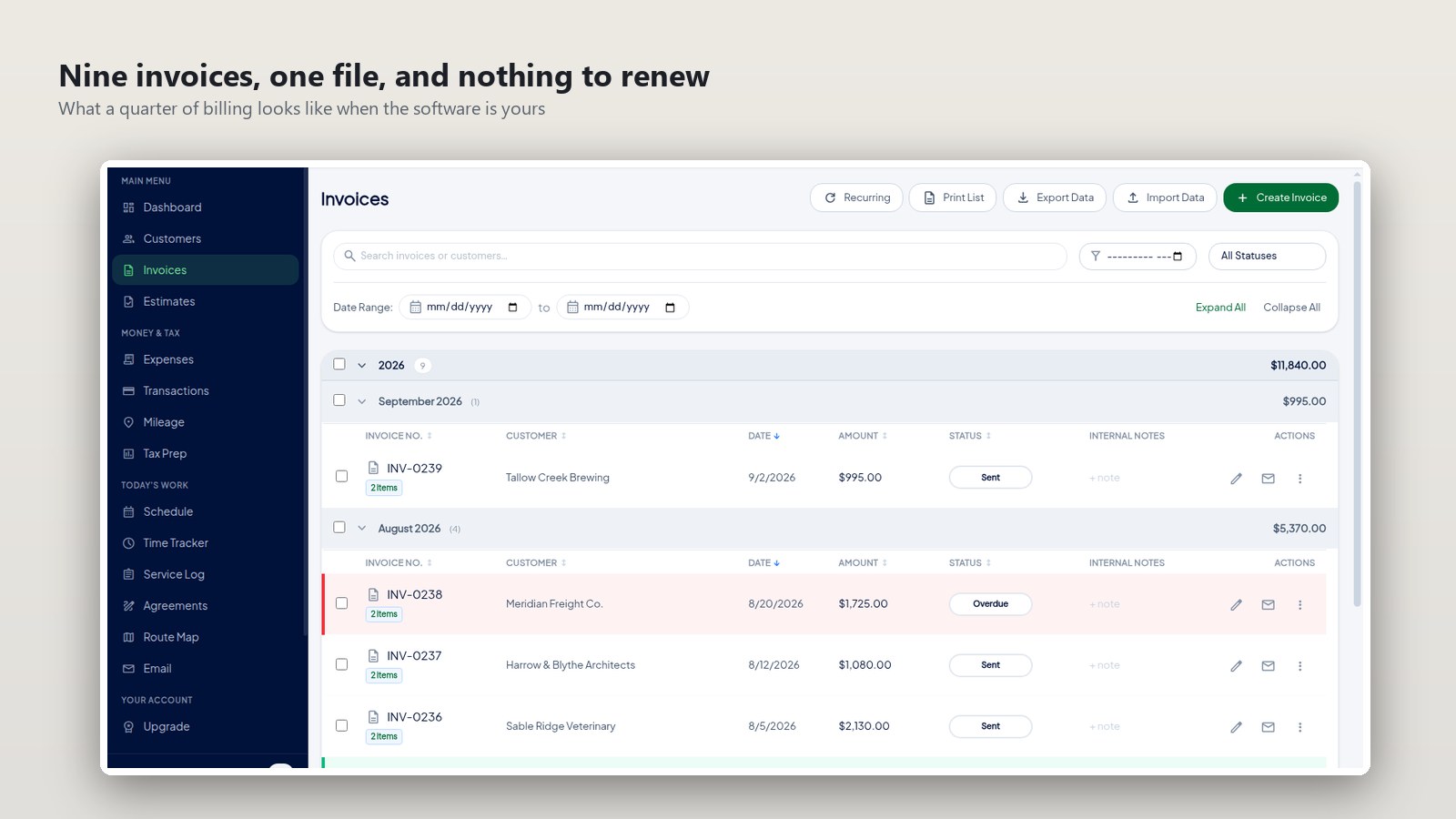
HVAC is the trade where a small contractor can be profitable on paper and out of cash in the same month. The reason is the size of the tickets. A $6,300 replacement means buying $3,800 of equipment two weeks before the customer pays the balance, and a summer of them means tens of thousands of dollars of your money sitting in other people's attics. This article is about managing that: deposits, equipment markup, the summer-winter swing, sales tax on parts, and what the tax return needs. The numbers come from Summit Heating & Air, a two-van shop in Chandler, Arizona, set up in Daily Invoice Maker, a desktop invoicing app from the publisher of this site; the screenshots are its actual output.
Key takeaways
- Take a 50 percent deposit at acceptance on every replacement and buy the equipment with the deposit, not with your line of credit.
- Mark up equipment 35 to 50 percent and labor at three times the loaded wage; the equipment line pays for the van, the labor line pays for the tech.
- June income is 2.3 times January income in this example. The winter is funded by the summer or it is funded by a card.
- In most states parts are taxable and labor is not; keep them on separate lines or the sales tax return is a guess.
- Equipment bought for a job is cost of goods, not a capital purchase. Do not depreciate the customer's condenser.
The deposit is the business model
Here is the cash timeline on the example replacement, a 3-ton Goodman split system for the Ashcrofts, quoted at $6,266 plus tax.
| Date | Event | Cash in | Cash out |
|---|---|---|---|
| June 9 | Estimate accepted, 50 percent deposit by check | $3,133 | |
| June 10 | Equipment ordered from the distributor | $3,835 | |
| June 10 | Permit pulled | $165 | |
| June 15 | Installed, started up, balance due on startup | $3,133 + tax | 2 techs, 8 hours |
Without the deposit, the shop is $4,000 in the hole for six days per job. With three replacements a week in June, that is $12,000 of the contractor's money out at any time, and one slow payer turns it into a line of credit. With the deposit, the shop is never more than about $900 exposed on any job. That is why the estimate terms say 50 percent at acceptance, balance on startup, and why the invoice records the deposit as a partial payment so the customer sees only the balance.
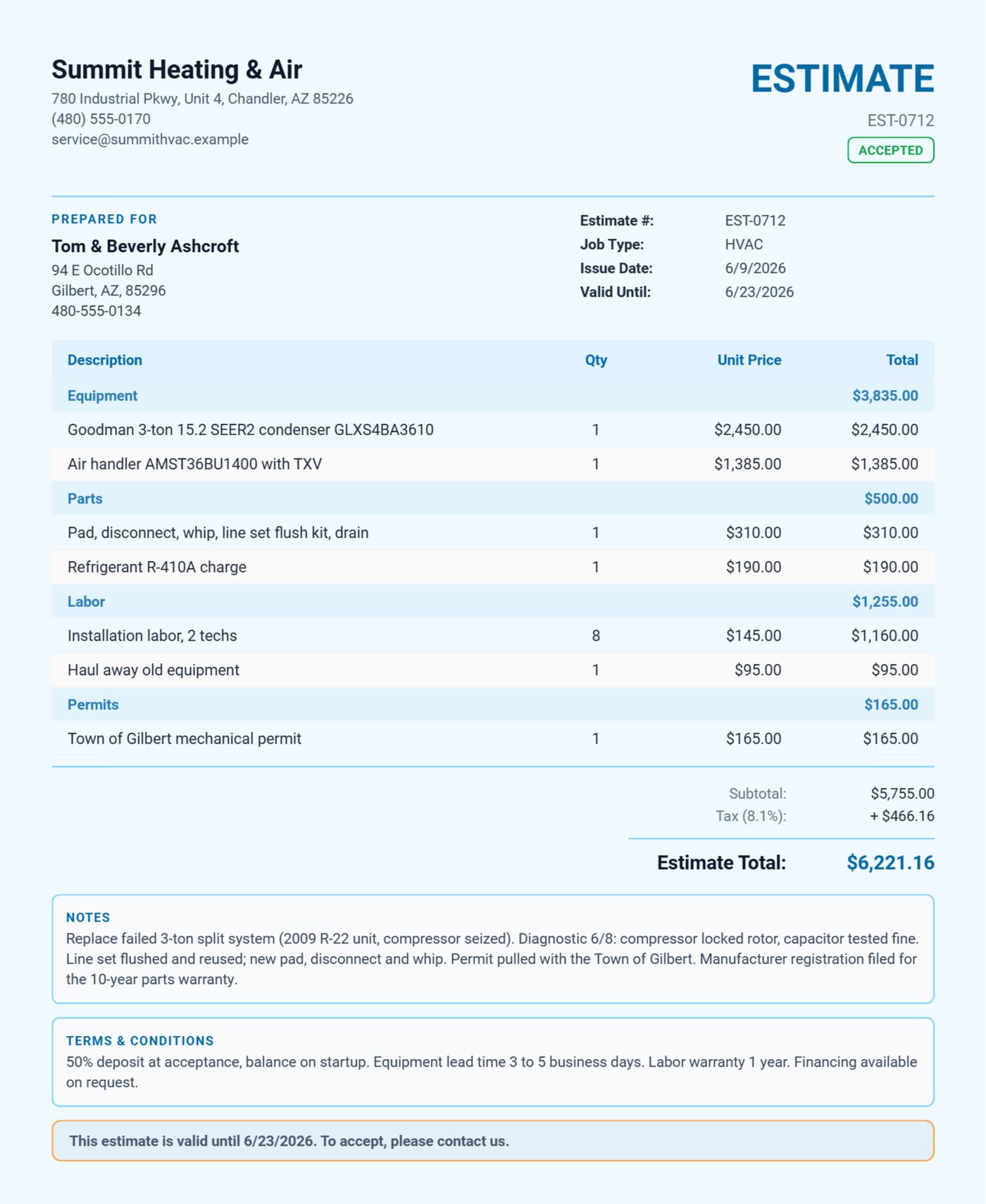
Where the margin is on a replacement
| Section | Billed | Cost | Gross margin |
|---|---|---|---|
| Equipment (condenser + air handler) | $3,835 | $2,760 | $1,075 (28%) |
| Parts (pad, whip, refrigerant, flush kit) | $500 | $290 | $210 (42%) |
| Labor, 8 hours × 2 techs at $145 | $1,160 | $520 | $640 (55%) |
| Haul away | $95 | $40 | $55 |
| Permit (pass-through) | $165 | $165 | $0 |
| Job | $5,755 | $3,775 | $1,980 (34%) |
Three things to notice. Equipment margin looks large in dollars and thin in percent; distributors know what the customer can find online, and 25 to 30 percent is the realistic range on name-brand systems. Labor is where the percentage lives, and it has to be, because that $640 is also paying for the van, the insurance and the tech's unbillable hours. And the permit is a pass-through, on its own line at cost, so nobody thinks you are marking up the town.
The summer-winter swing
Summit's monthly income from the app's dashboard: $9,820 in January, $8,410 in February, then climbing to $19,620 in June and $18,110 in July. Eight months in, income is $110,780. The equipment purchases follow the same curve, so June's expenses are high too, but the net profit line still swings from about $5,000 in a winter month to $12,000 in a summer month.
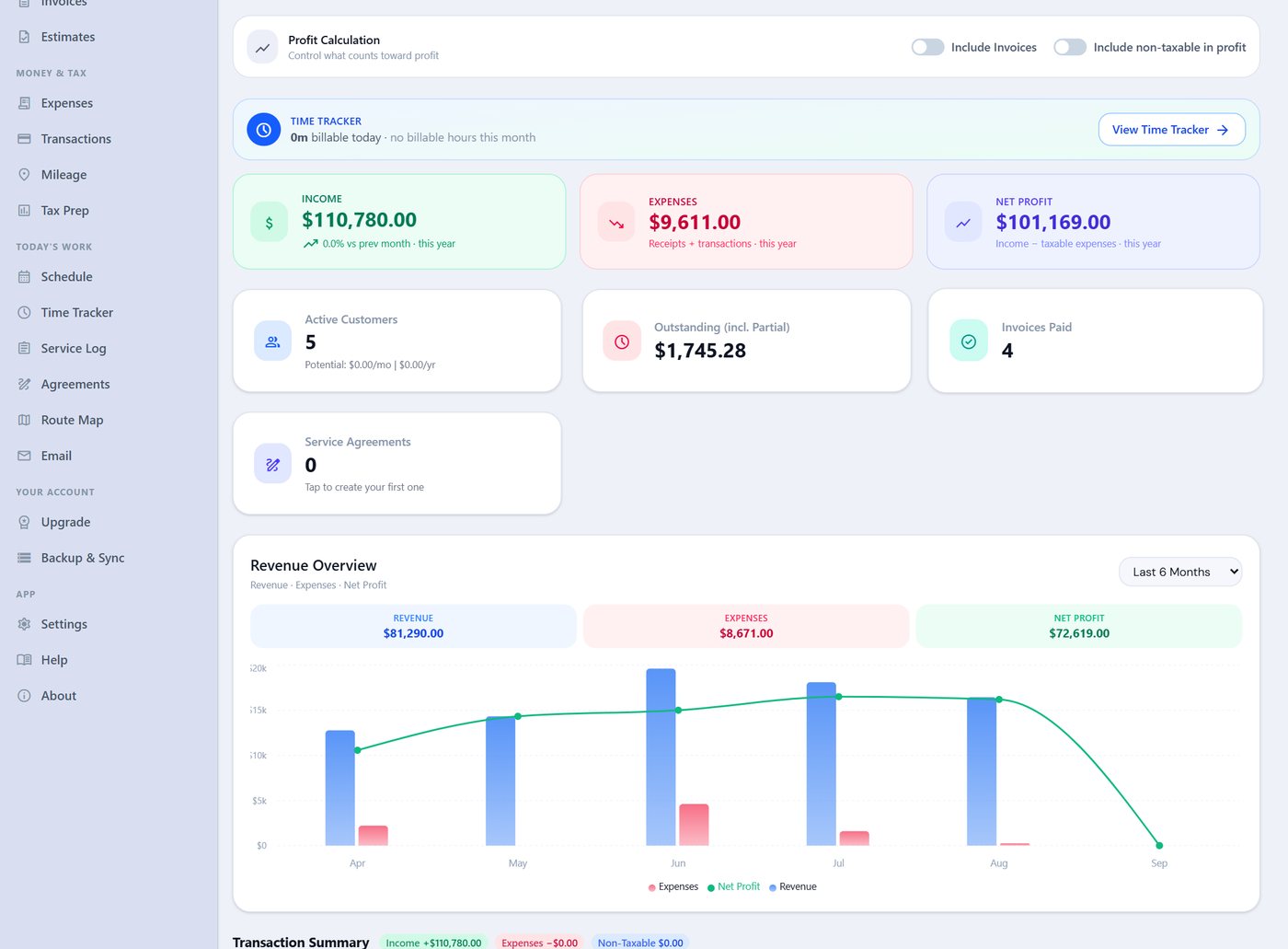
The winter plan is written in the summer numbers: put a third of each summer month's net profit aside, sell maintenance agreements in September (the 24-unit apartment agreement in this example is $1,644 a visit, twice a year, invoiced on net 30), and schedule the winter marketing for heating tune-ups in October. The maintenance agreement is the single best cash-flow tool in HVAC because it converts a summer customer into a predictable spring and fall invoice.
Sales tax: the parts-versus-labor problem
Arizona taxes retail sales of tangible goods; many states tax the parts on an HVAC invoice and not the installation labor, and some tax both under a contractor rule. Whatever your state does, the return asks for taxable sales by rate, and if your invoices mix parts and labor into one line you cannot answer it. The example business puts equipment and parts in their own sections, so the sales tax report can total what was taxable. Collected tax is not income; keep it out of the revenue figure and remit it on time. The IRS self-employed center covers the federal side; your state department of revenue covers the sales tax rules for contractors, which vary more than almost any other trade.
What the Schedule C needs from an HVAC shop
| Expense | Where it goes | Note |
|---|---|---|
| Equipment bought for a customer's job | Cost of goods sold (Part III) | Not depreciation; it was resold |
| Recovery machine, vacuum pump, gauges | Line 13 or Section 179 | Tools you keep |
| Refrigerant, capacitors, filters stock | Line 22 supplies or COGS | Be consistent year to year |
| Permits | Line 17 legal and professional | Or pass through in COGS |
| Two vans: fuel, insurance, repairs | Line 9 | Actual costs usually beat mileage for a van full of tools |
| Liability and commercial auto | Line 15 |
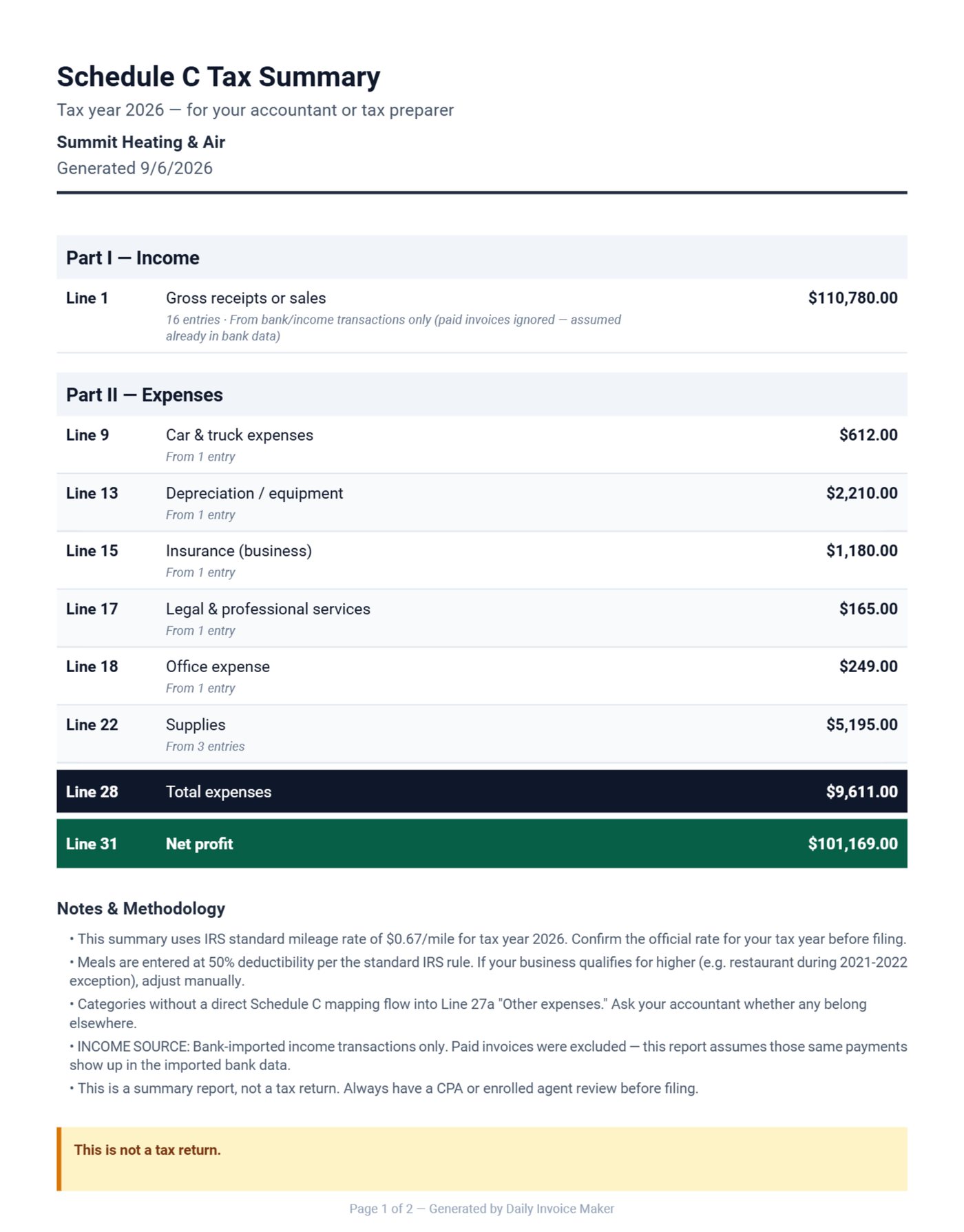
The app's Schedule C summary maps the expense categories you used all year onto these lines, which is the page your accountant wants before they ask the cost-of-goods question.
Common money mistakes in small HVAC shops
- Financing the customer's equipment. No deposit, equipment on the card, and the balance collected "at the next visit". Take the deposit.
- Pricing labor to win the bid. Cutting the labor rate to $110 to beat a competitor gives away the one line that pays for overhead.
- Depreciating resold equipment. It inflates the balance sheet and understates cost of goods; the tax return is wrong in both directions.
- Letting commercial accounts drift past 30 days. The overdue cafe invoice in the example is $683; at 60 days it is usually a write-off.
FAQ
What deposit can I legally ask for?
Some states cap contractor deposits (California limits home improvement deposits to 10 percent or $1,000, for example). Arizona does not for HVAC. Check your state's contractor board; where there is no cap, 50 percent at acceptance is standard for equipment jobs.
Should I offer financing?
Yes if the ticket is over $5,000; third-party financing raises close rates on replacements and pays you in full at funding. Record the funded amount as the payment on the invoice.
Mileage or actual vehicle costs?
For a service van with tools, actual costs (fuel, insurance, repairs, depreciation) usually exceed the mileage rate. Pick one method per vehicle and keep it.
The bottom line
Take the deposit, keep equipment and labor and permits on separate lines, fund the winter from the summer, and keep the sales tax out of your income. Daily Invoice Maker, which produced every document above, is a one-time purchase with a free demo at donlinestore.com; the estimate with sections, the deposit as a partial payment and the sales tax report are all in it.
Comments (0)
Be the first to comment.
Leave a comment