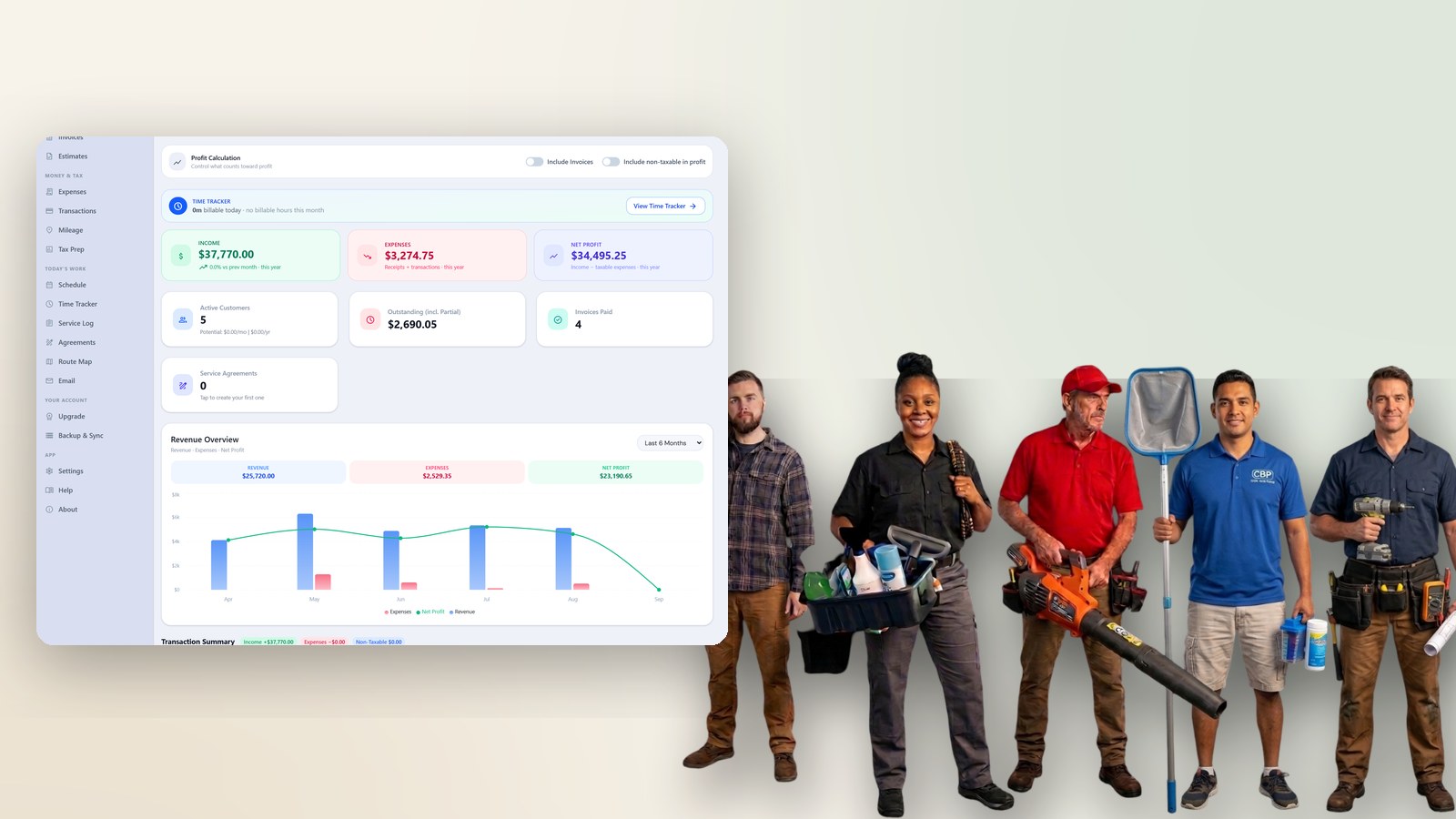
The handyman business has the best hourly rate in the trades and the worst hourly income. $85 an hour on paper becomes $40 an hour in the bank because of drive time, unbilled quoting, materials runs, tiny jobs that do not cover the trip, and $300 invoices that never get chased. This article is about closing that gap: the real cost of an hour, the materials markup that clients accept, minimum charges, deposits, and how the tax return treats a truck full of tools. The example is Northside Handyman Services in Chicago, set up in Daily Invoice Maker, a desktop invoicing app from the publisher of this site; the screenshots are its actual output.
Key takeaways
- Only about 55 percent of a handyman's working hours are billable. Your rate has to be set on billable hours, not on the hours you work.
- Charge materials at cost plus a stated 15 to 20 percent, on the invoice, with receipts. Silent markup loses clients; visible markup does not.
- A minimum charge (two hours, or a fixed $150) is not greed; it is the drive, the quote and the materials run for a 40-minute job.
- Take a materials deposit on any job where you buy more than $200 of supplies. You are a handyman, not a lender.
- Property management accounts are steady but slow; price them for net 30 and invoice monthly with work order numbers.
What an hour really costs
A typical week for a solo handyman: 45 hours worked, of which about 25 are on a job with a customer being billed. The rest is driving between jobs, quoting, picking up materials, invoicing and calls. At $85 an hour billed, that is $2,125 a week, or $47 per hour worked. Now the costs of that week:
| Cost | Per week | Note |
|---|---|---|
| Truck (fuel, insurance, maintenance, depreciation) | $190 | About $9,500 a year |
| Liability insurance | $22 | $1,120 a year |
| Tools and consumables | $60 | Blades, bits, caulk, plus replacements |
| Phone, software, lead fees, advertising | $55 | |
| Self-employment tax reserve (15.3 percent of net) | $275 | Set aside, not spent |
That leaves about $1,520 before income tax, or roughly $34 for each hour worked. Not bad, but it is not $85, and the difference is why the billable share matters more than the rate. Two ways to raise it: cluster jobs by neighbourhood (the example business works one Chicago zip code), and stop doing the unbillable things for free, which is what the next three sections are about.
Materials: the markup that clients accept
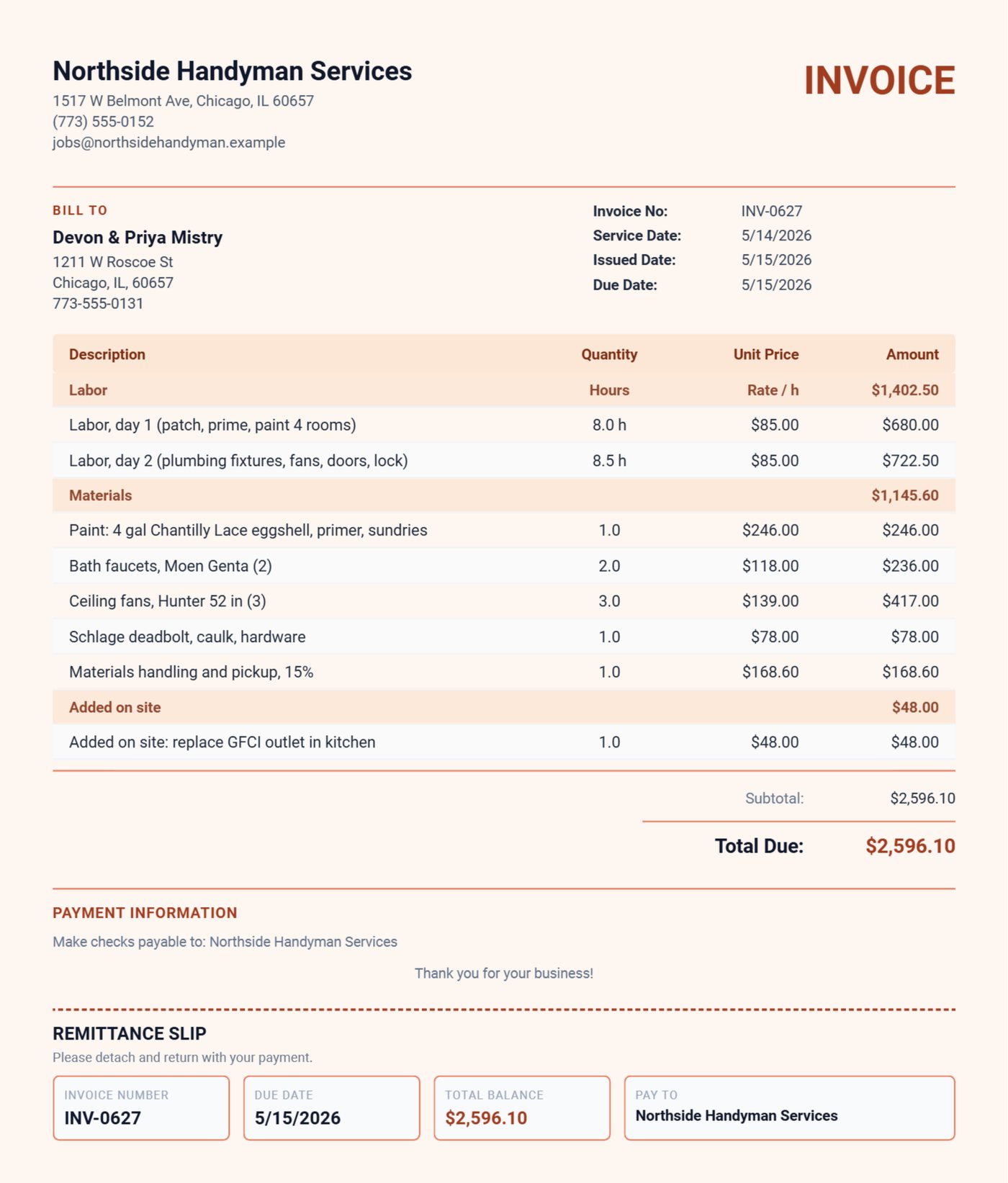
The punch-list job in the example bills $1,094 of materials: paint, two faucets, three fans, a deadbolt and hardware, each at cost, then a separate line, "Materials handling and pickup, 15%", $168.60. Compare the two ways to do this:
- Hidden markup: faucets billed at $140 that cost $118. The client sees the box, checks the price online, and every line on your invoice is now suspect.
- Stated handling: faucets at $118, handling at 15 percent on its own line. The client sees the receipt, sees the percentage, and pays it, because the alternative is spending Saturday at the store themselves.
Fifteen to twenty percent covers the trip, the return of the wrong part, and the card float. The receipts attached to the invoice are what make it work. Never put customer-supplied materials on your invoice; you did not buy them, you do not warranty them, and they are not your income.
Minimums, deposits and the added-on-site rule
Three terms, all of them printed on the estimate and invoice in the example, that together add about 20 percent to a handyman's income without raising the rate:
- Minimum charge. A garbage disposal swap is 40 minutes of work and 75 minutes of the day. The example invoice bills 1.5 hours plus a "minimum service charge adjustment" of $22.50 to reach the $150 minimum. Customers accept a minimum that is stated when they book.
- Materials deposit. The punch list took a $400 deposit before the store run. Without it, a cancelled job leaves you holding three ceiling fans.
- Added on site at the hourly rate. The GFCI the inspector flagged was 30 minutes and $48, billed under its own "Added on site" heading. Because the estimate terms said extras are billed at the rate, it was not a negotiation.
The property management account
Lakeview Property Management sends the example business six to nine work orders a month at $80 an hour, a lower rate than residential, paid net 30 against one monthly invoice. That is 14 to 21 billable hours a month you did not have to sell, at a 6 percent discount, with a 30-day wait. Priced correctly it is the backbone of the year; priced like residential it is a slow payer that resents the rate. Invoice once a month with every work order number in the description, on the day the month ends, and the payment arrives on schedule.

The small-invoice problem
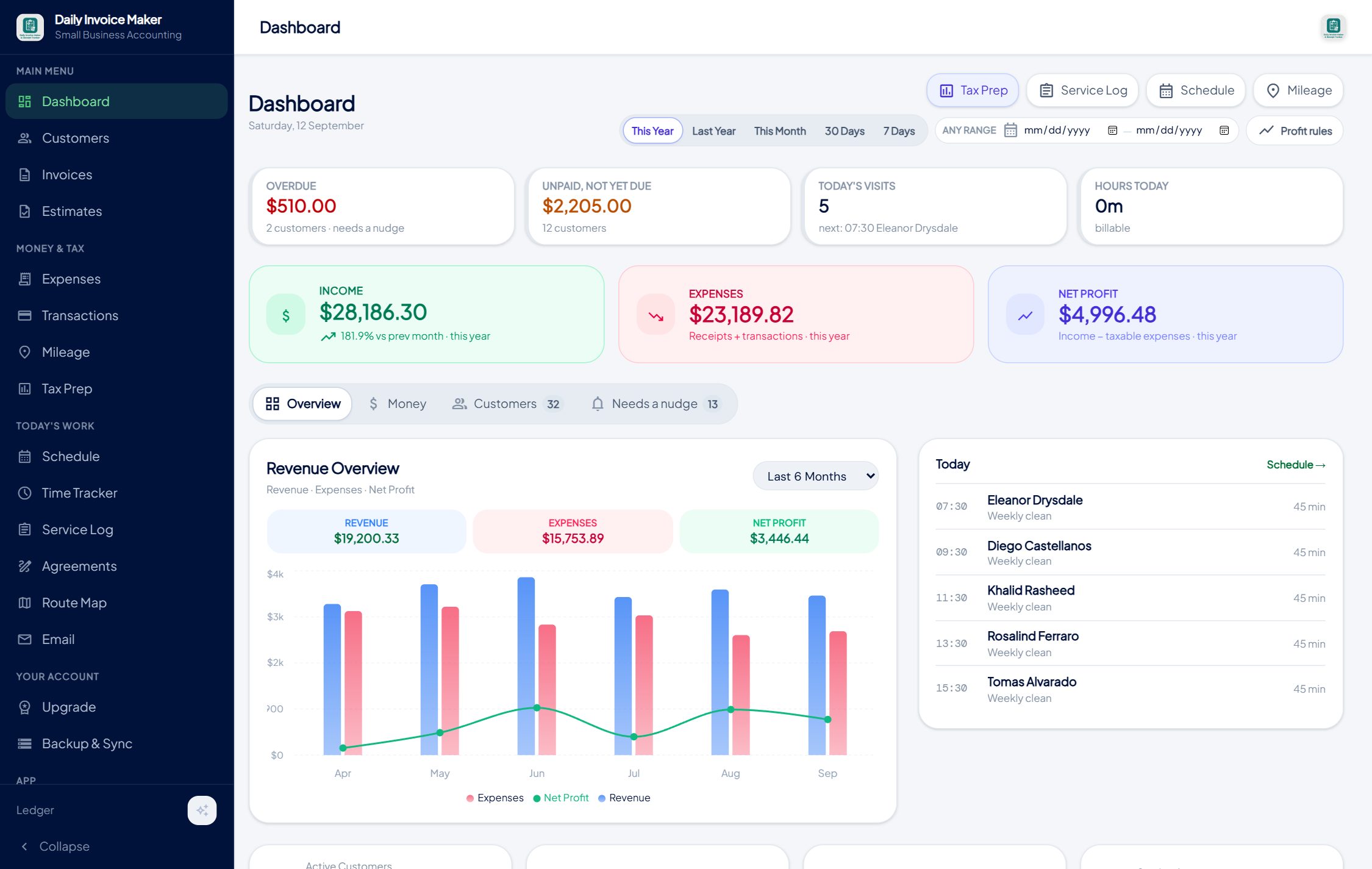
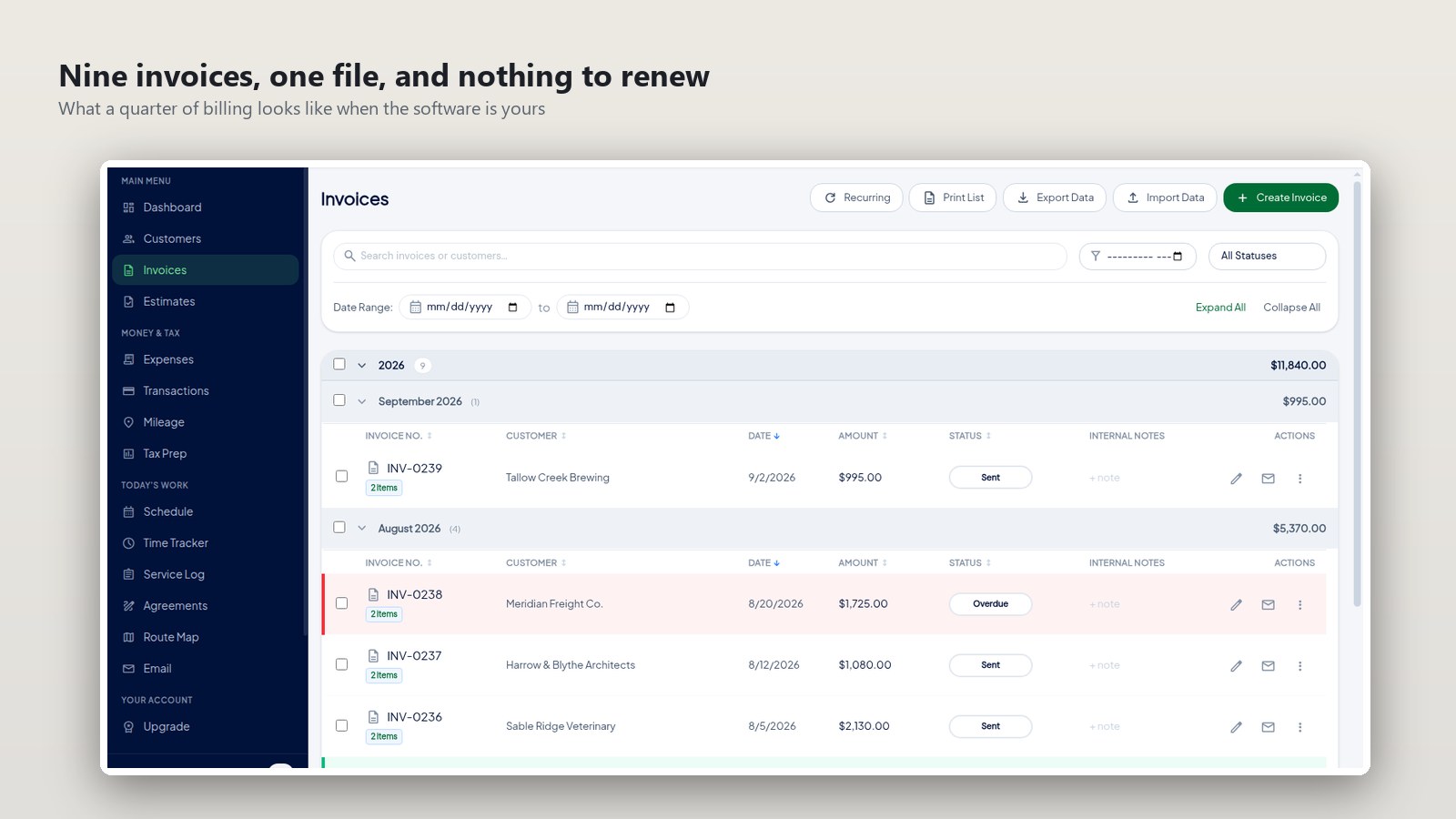
The example dashboard shows $2,300 outstanding across a $347 threshold repair from June and two August invoices. Handyman receivables are small, numerous and easy to ignore, which is exactly why they go bad: nobody chases $347 hard, and the client has forgotten by August. The rule is simple: every invoice is due in 7 days for residential, a reminder goes out at day 10 with the invoice attached, and anything past 30 days gets a phone call. Kept under 30 days, handyman receivables are collected almost entirely; past 60 they are mostly lost.
What the tax return needs
| Expense | Schedule C line | Note |
|---|---|---|
| Materials billed to clients | Cost of goods (Part III) or line 22 | Also income on the invoice; both sides must be recorded |
| Power tools over about $200 | Line 13 or Section 179 | Small tools and consumables go to supplies |
| Truck | Line 9 | Mileage rate is often better for a pickup; log it |
| Liability insurance | Line 15 | |
| Lead fees, ads, door hangers | Line 8 | |
| Parking, tolls | Line 27a or line 9 | Keep them; downtown jobs add up |
The app's Schedule C summary maps the year's categories to these lines. The point of recording materials on both sides is that the IRS sees the $1,094 you were paid for fans and faucets as income; if the expense is missing, you pay tax on money that was never yours. The IRS Schedule C instructions explain the cost-of-goods section.

FAQ
Should I raise my rate or my minimum?
The minimum first. Most handyman income is lost on tiny jobs, not on underpriced big ones. A $150 minimum raises income more than a $10 rate increase and loses fewer clients.
Is a materials markup legal?
Yes, and it is normal in every trade. Stating it on the invoice keeps it that way; some states require written contracts above a threshold for home repair, and a signed estimate with the markup stated satisfies that.
Do I need an LLC?
Not for the tax return; a sole proprietor files Schedule C either way. An LLC is about liability, and insurance does more for a handyman than the entity does. Talk to a local accountant before deciding.
The bottom line
Set the rate on billable hours, state the materials markup and the minimum, take a deposit for materials, and invoice property managers monthly with their numbers. The documents above were produced in Daily Invoice Maker, a one-time-purchase desktop app with a free demo at donlinestore.com; the sections, deposit recording and Schedule C summary described here are standard features.
Comments (0)
Be the first to comment.
Leave a comment