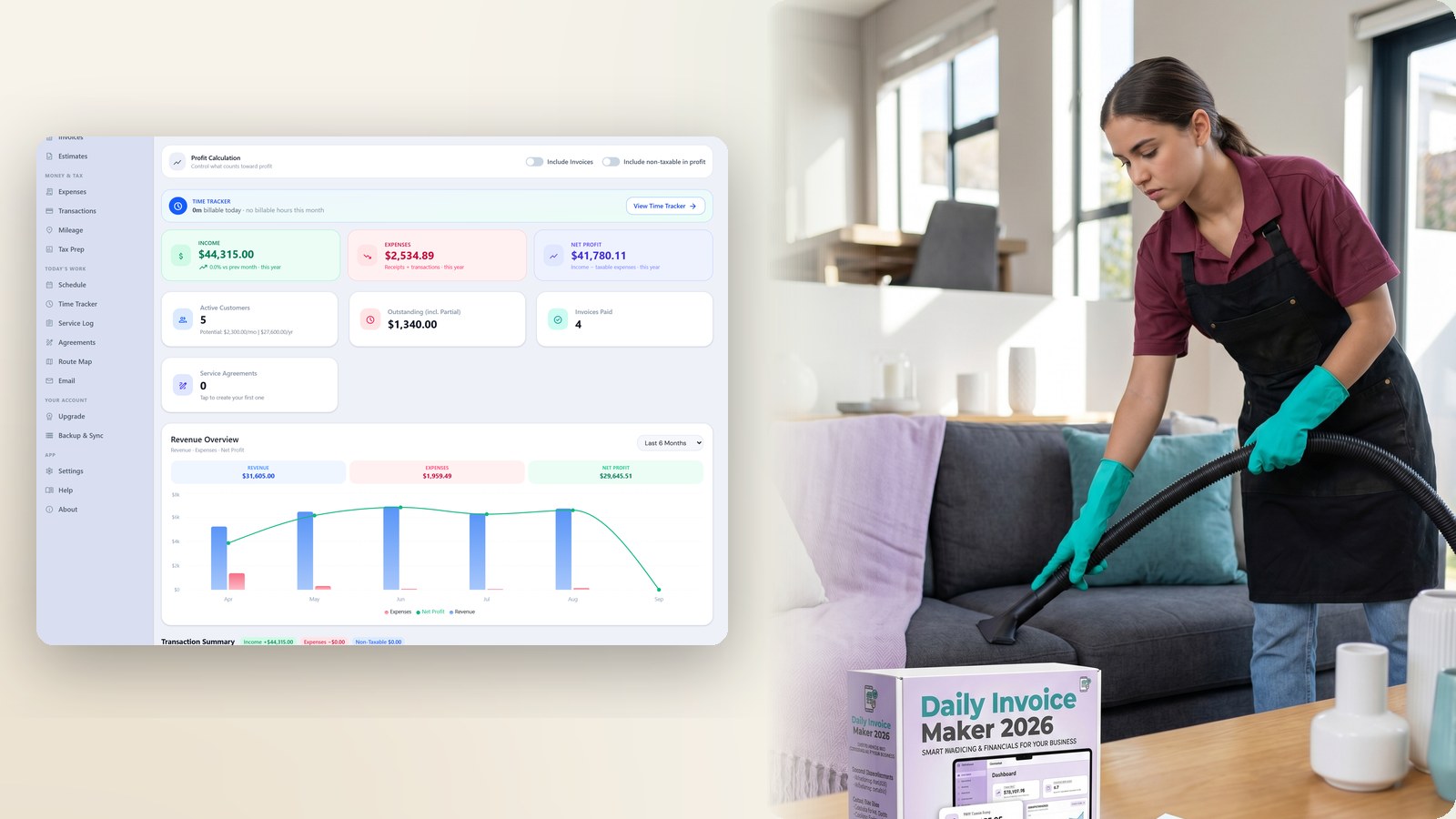
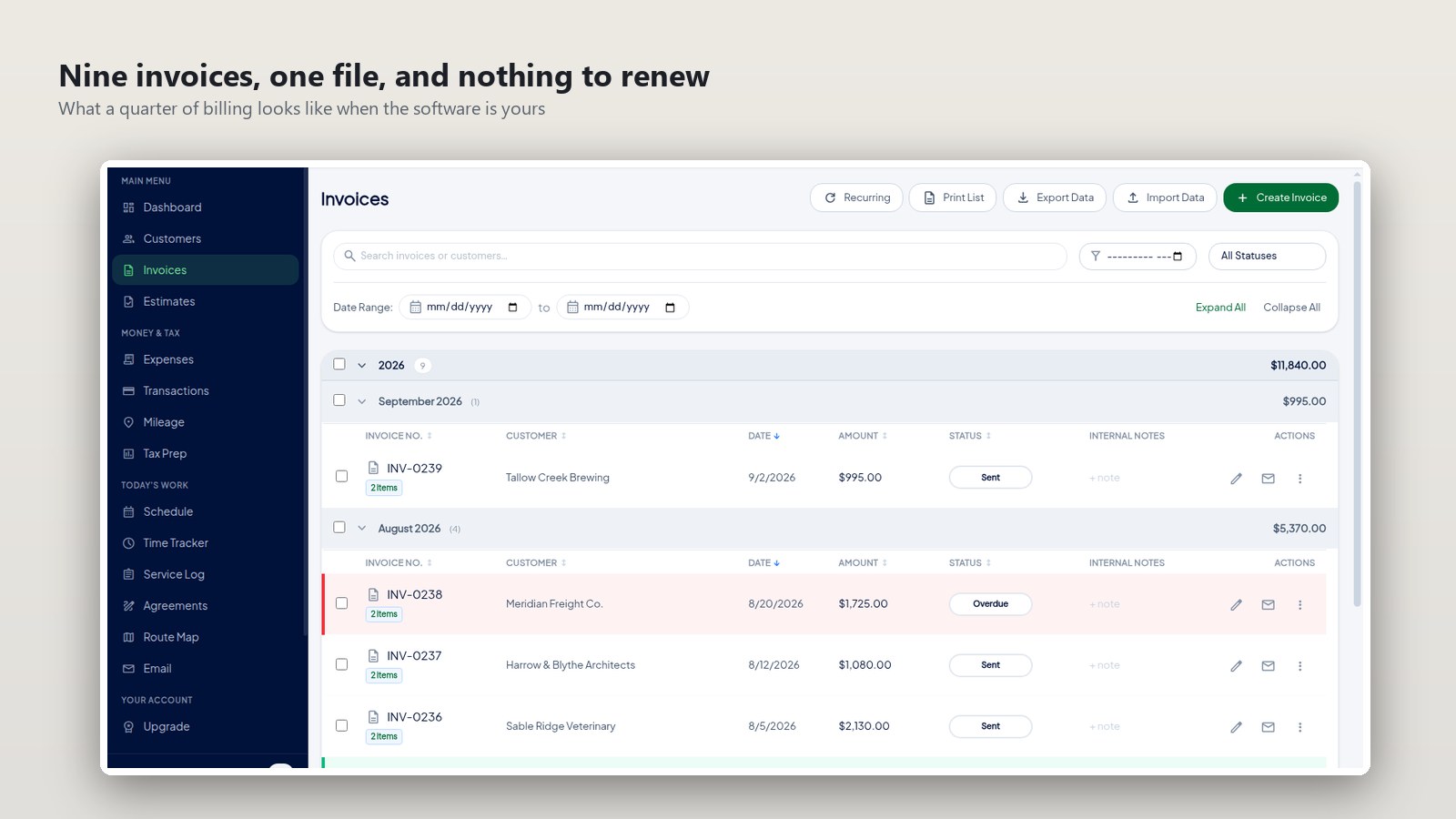
A cleaning business is a labor business with a supplies problem, and most owners price it backwards. They set a price per house that sounds fair to the customer, then discover at tax time that after the helper, the fuel, the insurance and the vacuum there was less left than a job would have paid. This article works through the money in a two-person home and office cleaning company: how to price a clean from the hours, what a cancellation policy is actually worth, where the margin hides in move-outs, and what the Schedule C wants from you. The example is Bright & Tidy Home Cleaning in Dallas, set up in Daily Invoice Maker, a desktop invoicing app published by the company behind this site; the screenshots are its real output.
Key takeaways
- Price from cleaner-hours, not from the house. A 2,000 sq ft home that takes two people 2.5 hours is 5 cleaner-hours; at a $28 loaded cost per cleaner-hour it costs you $140 before you drive there.
- A 50 percent late-cancellation fee is not about the $65. It is about the $3,400 a year that unfilled slots cost a two-person crew.
- Move-outs earn roughly double the margin of a recurring clean per hour. Price them separately and quote them in writing.
- Your helper is a deductible wage only if it is paid and recorded as one. Cash from the drawer is neither.
- Set aside 25 to 30 percent of net profit for tax; the quarterly bill is the one that sinks cleaners in April.
Where the money actually goes
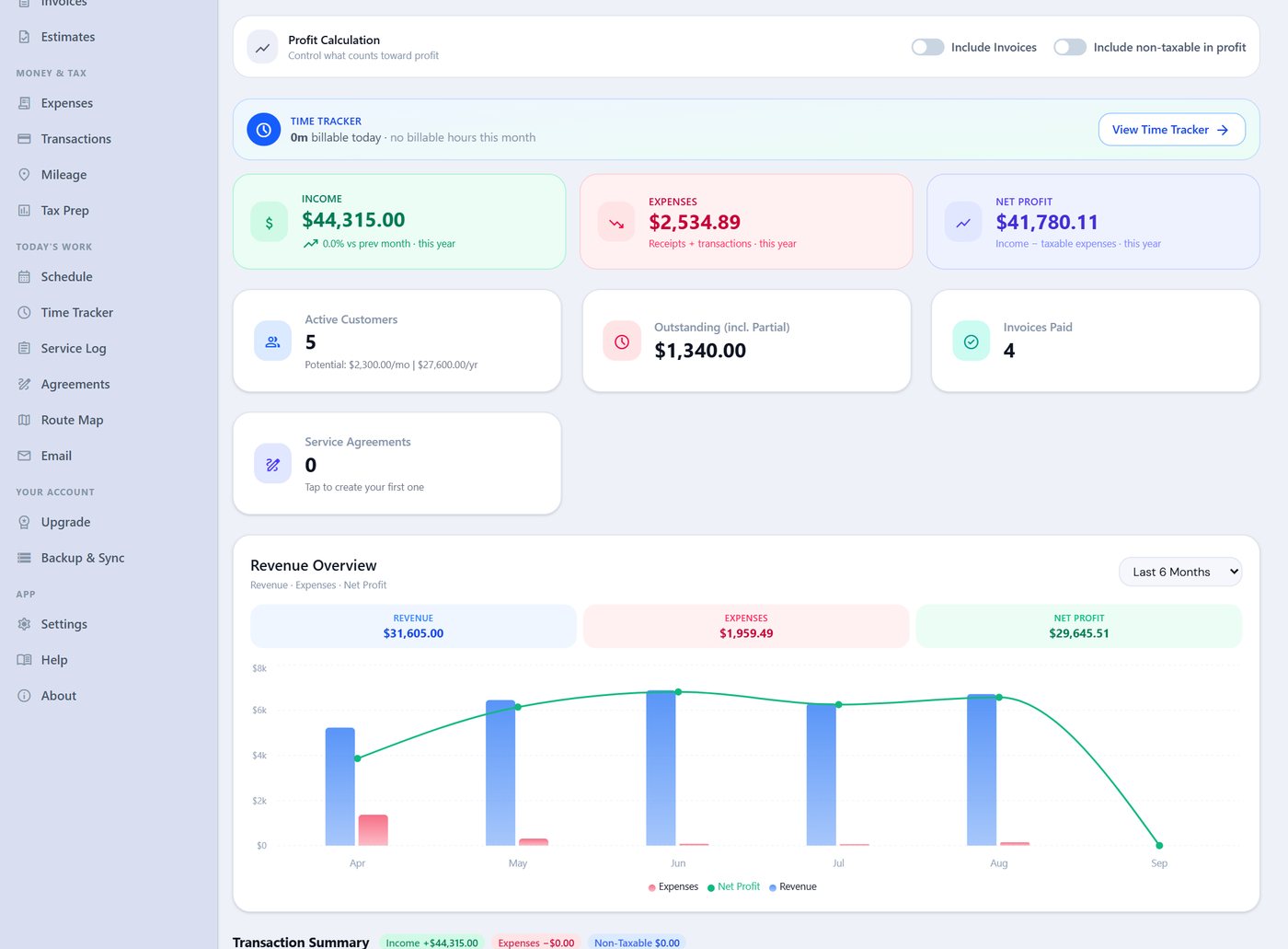
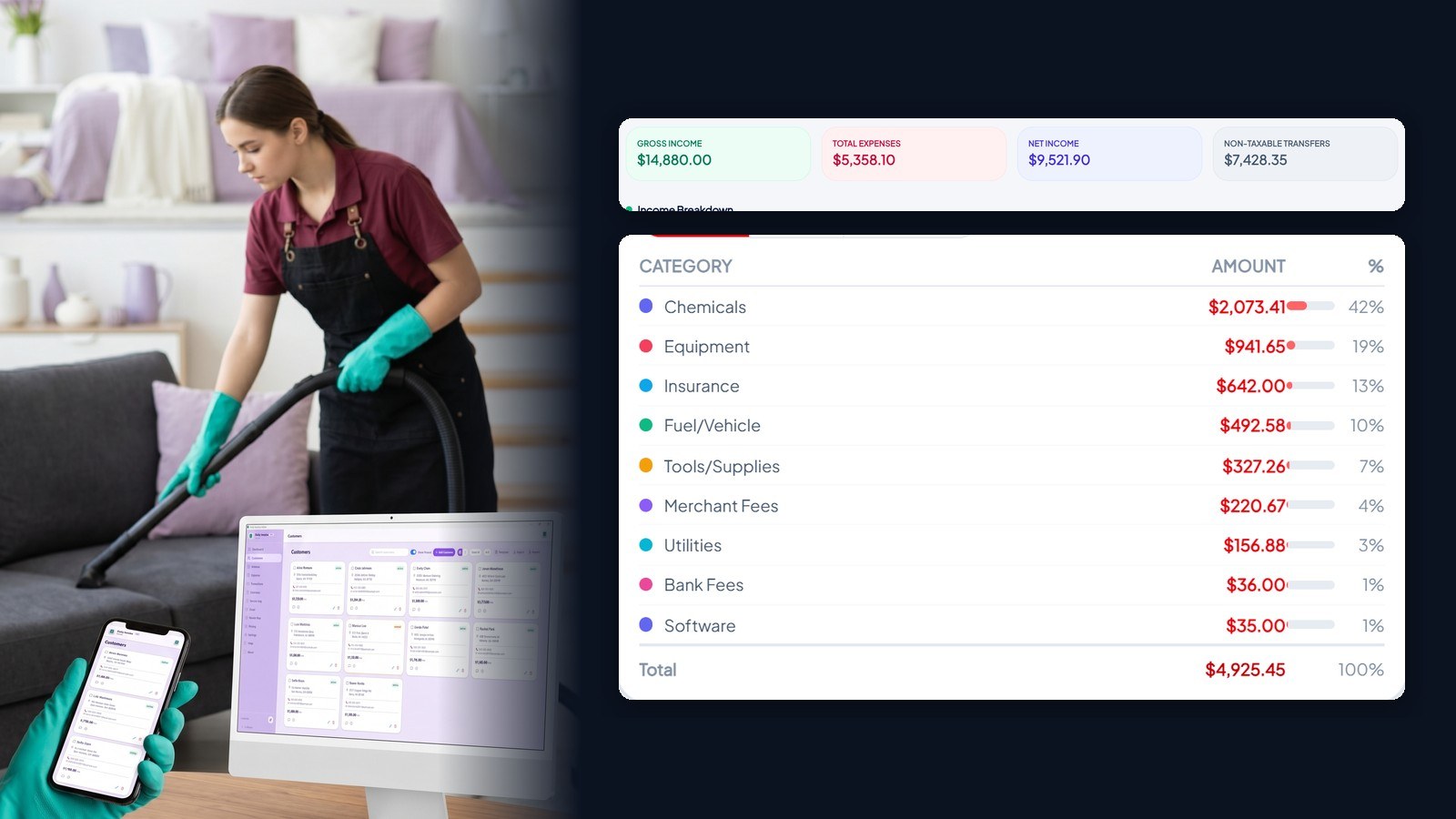
Here is the year to date for Bright & Tidy, straight from the app after the bank statements were imported and the receipts photographed.
| Item | Year to date | Share of income |
|---|---|---|
| Income (5 recurring clients, 1 office, move-outs) | $44,315 | 100% |
| Part-time cleaner | $1,240 recorded (should be about $9,900) | see below |
| Supplies and small equipment | $650 | 1.5% |
| Insurance and bonding | $312 | 0.7% |
| Fuel, software, marketing | $333 | 0.8% |
Notice the helper line. One month of the helper's pay is on the books; the rest was paid in cash and never recorded. That is the most common bookkeeping error in cleaning and it cuts two ways: the owner thinks the business made $41,000 when it made $32,000, and the $8,600 of unrecorded wages is a deduction thrown away, worth roughly $2,500 in tax. Pay the helper through payroll or at minimum by a traceable method, and record every payment as a labor expense the day it happens.
Pricing a clean from the hours
Take a weekly clean priced at $130. Two cleaners, 2 hours on site, 20 minutes of driving each way.
- Labor: 4 cleaner-hours on site plus 1.3 hours of drive time, at $22 wage plus 15 percent payroll cost = $134 if both are employees, or $67 plus your own time if one is you
- Supplies: about $4 per clean at scale (microfiber, solutions, liners)
- Fuel and vehicle: about $6
- Insurance, phone, software, spread across 40 cleans a month: about $9
With a paid helper and yourself, the direct cost is roughly $86 and the gross margin about $44, or 34 percent. That is a reasonable margin for a recurring clean and it depends entirely on the 2-hour figure. Every 15 minutes the job runs over costs about $11. The fix is not to rush; it is to time the first three cleans, set the price from the real time, and re-price the client who added a room.
What the cancellation policy is worth
A two-person crew has about 8 slots a day. A cancellation inside 24 hours cannot be refilled, so the slot is paid time with no income. If clients cancel late once a month each and you have 30 clients, that is 30 empty slots a year, about $3,900 in lost revenue against wages you still owe. A 50 percent fee, charged as a line on the next invoice with the policy printed in the terms, does two things: it recovers half the loss and it cuts the cancellations by more than half, because the customer now has a reason to reschedule instead. In the example, the Trans' June invoice carries "Late cancellation 6/13 (inside 24 h), 50%" as its own line. Nobody argued, because it was on paper before it happened.
Move-outs: double the margin, double the risk
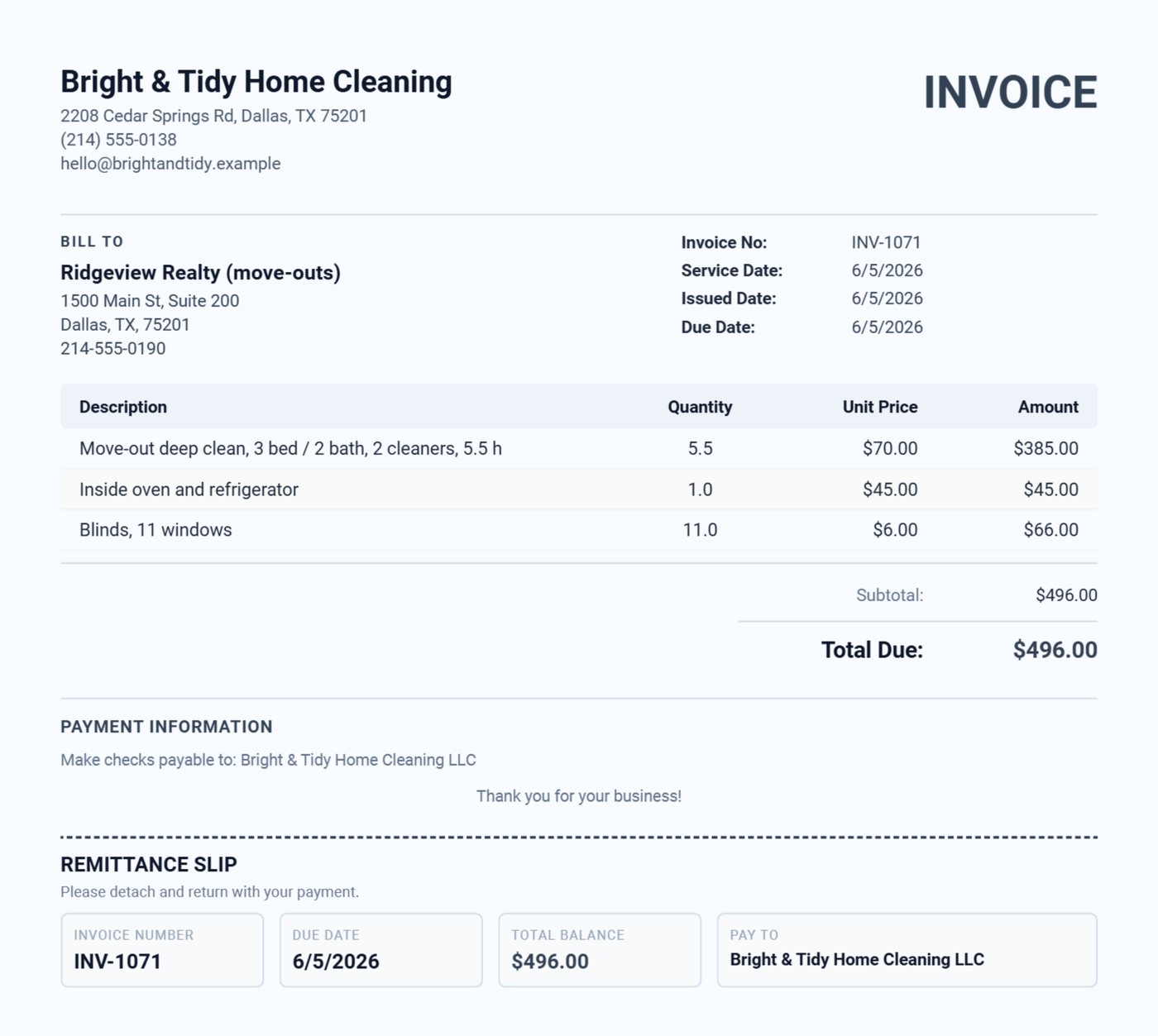
The move-out clean in the example bills $497 for 5.5 hours of two cleaners: $70 an hour for the pair, plus $45 for the oven and fridge and $66 for blinds. The labor cost is about $190, so the gross margin is over 60 percent, roughly twice a recurring clean. Property managers pay it because a $497 clean protects a $1,800 deposit and lets them re-let a week sooner. The risk is scope: the "3 bed / 2 bath, vacant" you quoted becomes a house with a garage full of boxes. The protection is a written estimate with the scope in the notes, optional work (carpet shampoo) as a separate section the manager accepts or declines, and dated before-and-after photos on the invoice.
What the tax return needs
Cleaning is a Schedule C business for most sole proprietors. The lines that matter:
| Expense | Schedule C line | Note |
|---|---|---|
| Helper's wages | Line 26 | Needs payroll filings; contractors go on line 11 with a 1099 |
| Supplies and cleaning solutions | Line 22 | Keep the receipts; photograph them the day of purchase |
| Commercial vacuum, floor machine | Line 13 or Section 179 | Usually expensed in full in the purchase year |
| Bonding and liability | Line 15 | Not your health insurance |
| Mileage between houses | Line 9 | Standard mileage rate; log it, it is usually your largest vehicle deduction |
The app's Schedule C summary maps the categories to the lines and totals them, which is the page your preparer wants. The IRS self-employed tax center covers the quarterly estimated payments that catch most first-year cleaners out.

Three habits that separate profitable cleaners
- Re-price every client once a year, in writing, by the amount your costs rose. A client who leaves over a $10 increase was underpriced by more than $10.
- Bill on the last day of the month, every month, with the visit dates on the invoice, and chase anything unpaid at 14 days. Cleaning debts over 60 days are rarely collected.
- Separate the business account and pay yourself from it. When supplies and helper pay come out of the same card as groceries, nobody knows the margin.
FAQ
Should I charge by the hour or by the house?
Quote by the house, but calculate by the hour. Customers want a fixed number; you need to know the hours behind it and re-quote when they change.
Is bonding worth it?
For home cleaning, yes: a janitorial bond costs a few hundred dollars a year and is the first thing a property manager or an office asks about. It is also deductible.
How much should I save for taxes?
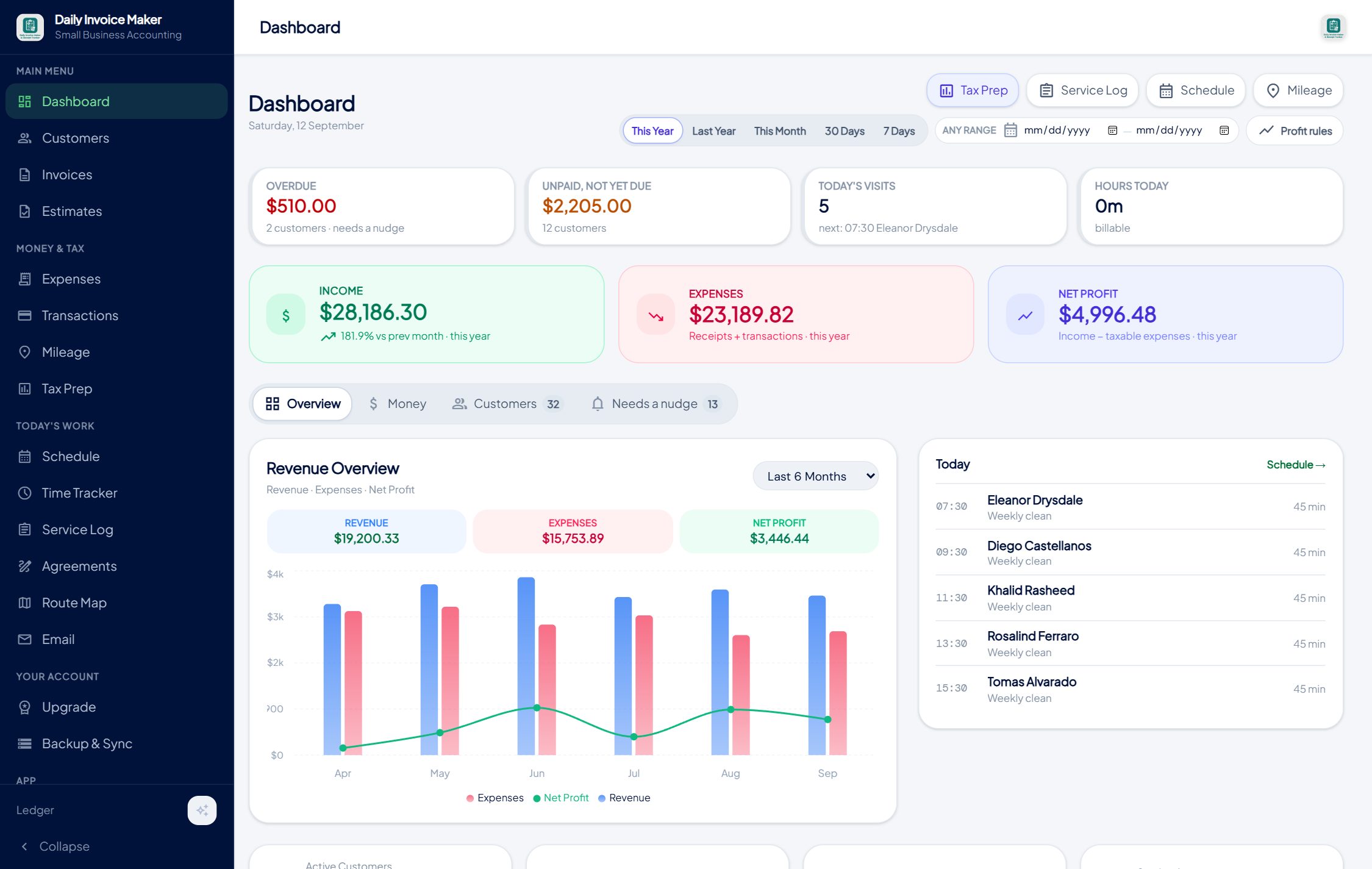
Put 25 to 30 percent of each month's net profit into a separate account and pay estimated tax quarterly. The dashboard's net profit figure is the base for that.
The bottom line
Price from cleaner-hours, charge the cancellation fee, quote move-outs in writing with photos, and pay the helper on the books. The invoicing app that produced these documents, Daily Invoice Maker, is a one-time purchase at donlinestore.com, with a free demo that handles the month-end batch and the Schedule C summary described here.
Comments (0)
Be the first to comment.
Leave a comment