Most auto repair shops do not have a pricing problem. They have a paperwork problem that looks like a pricing problem. The shop rate is fine and the parts markup is fine, but the invoice blends both into one number, the customer argues with the number, the deposit never gets recorded, and at tax time nobody can say how much of the year's revenue was parts and how much was wrenching. This article is about the money side of shop invoicing: what to price separately, why, how the margin math works, and what a correct repair estimate and invoice look like. The screenshots are from Daily Invoice Maker, the desktop invoicing app made by the same people who publish this site, which recently added a repair-shop layout; the principles hold for any tool.
Key takeaways
- Parts and labor are two different businesses on one ticket. Parts earn a markup; labor earns a rate. Blend them and you can see neither.
- A typical independent shop runs 30 to 50 percent gross margin on parts and needs its labor rate to cover a technician's loaded cost roughly three times over. You can only check that if the invoice splits the two.
- Write the estimate before the work and get it signed. It is the law in several states and the cheapest dispute insurance there is.
- Keep a saved price list for the top parts and each labor rate, so pricing stops being a memory test at 5 p.m.
- Convert the approved estimate into the invoice instead of retyping it. Transcription is where "$189" becomes "$198".
Two businesses on one ticket
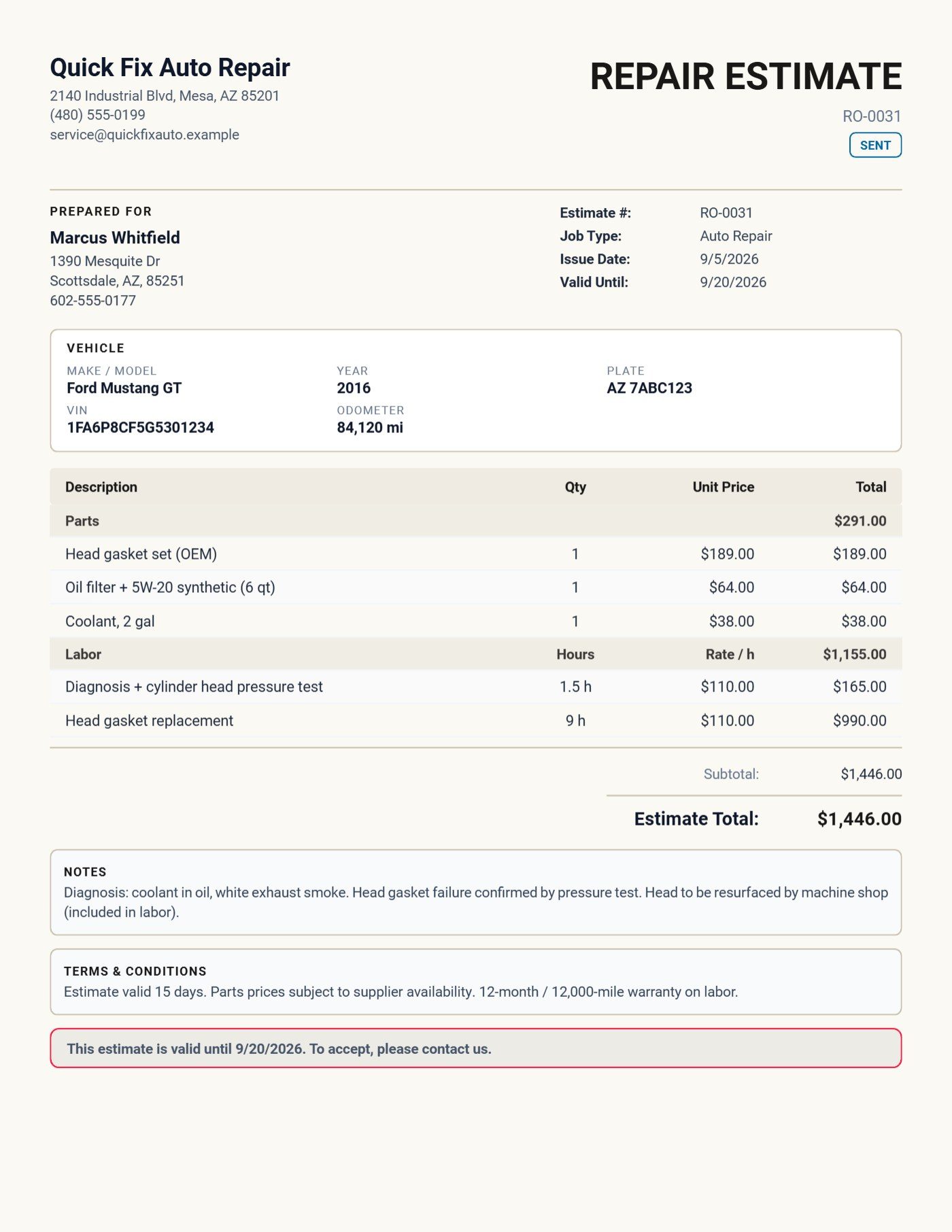
When a customer pays $1,446 for a head gasket job, they are buying two things. About $291 of it is parts you bought and resold; the rest, $1,155, is nine and a half hours of skilled time. The economics of those two are completely different.
Parts are a retail business. You buy a gasket set for $120 from the supplier and sell it for $189; the $69 is gross margin that has to cover ordering, stocking, returns and the occasional wrong part. Labor is a service business. Your $110 an hour has to cover the technician's wage and payroll taxes, the bay, the lift, the tools, the insurance and the hours nobody bills. If those two numbers live in one line on the invoice, you cannot tell whether the shop is profitable because of the wrenching or in spite of it.
The margin math, on a real job
Here is the job from the screenshots, a 2016 Mustang GT with coolant in the oil, with a plausible cost side added so the margin shows.
| Line | Qty | Charged | Your cost | Gross margin |
|---|---|---|---|---|
| Head gasket set (OEM) | 1 | $189.00 | $121.00 | $68.00 (36%) |
| Oil filter + 6 qt 5W-20 | 1 | $64.00 | $38.50 | $25.50 (40%) |
| Coolant, 2 gal | 1 | $38.00 | $24.00 | $14.00 (37%) |
| Parts | $291.00 | $183.50 | $107.50 (37%) | |
| Diagnosis + pressure test | 1.5 h | $165.00 | $52.50 | $112.50 |
| Head gasket replacement | 9 h | $990.00 | $315.00 | $675.00 |
| Labor (tech at $35/h loaded) | $1,155.00 | $367.50 | $787.50 | |
| Ticket | $1,446.00 | $551.00 | $895.00 (62%) |
Two things jump out that a blended invoice hides. First, the labor margin looks enormous, and it has to: the $787.50 is what pays for the building, the equipment and the two hours a day the technician is not billing. Second, the parts margin is only $107.50 on a $1,446 job. If your supplier raises the gasket price by $20 and you do not notice, a third of the parts margin on that line is gone. You only notice if the part is its own line with its own price.
Keep a price list, with rates that are per hour
The fix for pricing from memory is a saved list. The app has a Products & Rates screen with two kinds of entry: a product, priced per unit, and a labor rate, priced per hour. Fluids get a per-quart or per-gallon price so the quantity does the multiplying.

Keep more than one labor rate if you charge more than one. Diagnostic time with a scope on the car is worth more than the hour spent bolting on pads, and most shops know that; few print it. Ten parts and three rates cover the large majority of tickets at a general repair shop.
What the estimate has to show
An estimate that will survive a dispute has the vehicle at the top (make, model, year, plate, VIN, odometer), every part on its own line with quantity and unit price, every labor line with hours and rate, the diagnosis in plain words, a valid-until date, and a place for the customer to sign. In the app, tapping the Auto Repair job type adds the vehicle card and marks each line as a part or labor; picking a saved labor rate makes the quantity field hours.

The PDF that comes out is laid out like a European repair quotation: vehicle block, Parts table, Labor table with hours and rate, totals.
Get it signed before the work
This is a legal point as much as a financial one. California's Bureau of Automotive Repair requires a written estimate and the customer's authorization before repairs start, and the FTC's consumer guidance tells drivers to insist on a written estimate wherever they live. Practically: a signature on the phone takes fifteen seconds and ends the "I never agreed to that" conversation before it starts. If the customer is remote, send the PDF and keep the reply.
Convert, don't retype
When the car is done, the approved estimate becomes the invoice with one tap; the vehicle block and the parts and labor lines, hours included, carry over. That is not laziness, it is control: what the customer signed is what they are billed, to the cent. If reality changed (a bolt sheared, a hose was cracked), edit the line on the invoice and note it, and the original estimate stays as the record of what was agreed.

The cash-flow habits that follow from a clean invoice
- Record deposits as partial payments. A $400 deposit on a $1,446 job should show as amount paid and balance due on the invoice itself. Deposits kept in someone's head are how shops "lose" money that was never lost.
- Charge sales tax on the right lines. Most states tax parts and not labor, some tax both. Separate lines make the taxable amount obvious; a blended line makes it a guess.
- Look at parts revenue and labor revenue as two numbers at month end. If labor is flat and parts are up, you are becoming a parts store with a lift; that is a decision, not an accident.
- Send the reminder. An invoice that is 30 days old with no reminder is a loan you did not mean to make.
Common mistakes
- "Brake job, $480." One line, no split. The customer cannot see the pads from the hours, and you cannot see your margin.
- Labor without hours. An amount with no hours and no rate reads as arbitrary even when it is not.
- No plate or VIN. Fleet customers with several identical trucks will ask which one got the alternator, a year later.
- Verbal approval. Free to get in writing, expensive to argue about.
- Retyping the estimate into the invoice. Every transcription is a chance for a wrong price.
FAQ
What gross margin should a repair shop make on parts?
Independent shops commonly run 30 to 50 percent gross margin on parts, higher on small items and lower on expensive OEM parts where the customer can price-check. The only way to know your own number is to have the part and its price on its own line.
How do I set a labor rate?
Start from the technician's loaded hourly cost (wage plus payroll taxes and benefits), add the shop's overhead per billable hour, then the margin you want. Most shops land at roughly three times the loaded wage. Charge a higher rate for diagnostic time if it uses expensive equipment and your best technician.
Do I have to give a written estimate?
In several states, yes, before any work begins, with the customer's authorization. Everywhere else it is still the smart move: the FTC advises consumers to ask for one, so a shop that offers it first looks like the trustworthy one.
Can one invoice have different prices for different parts?
Yes, and it should. Each part is its own line with its own quantity and unit price. A saved price list gives you the starting number; you can change the price on any single line without changing the saved one.
Which software does this?
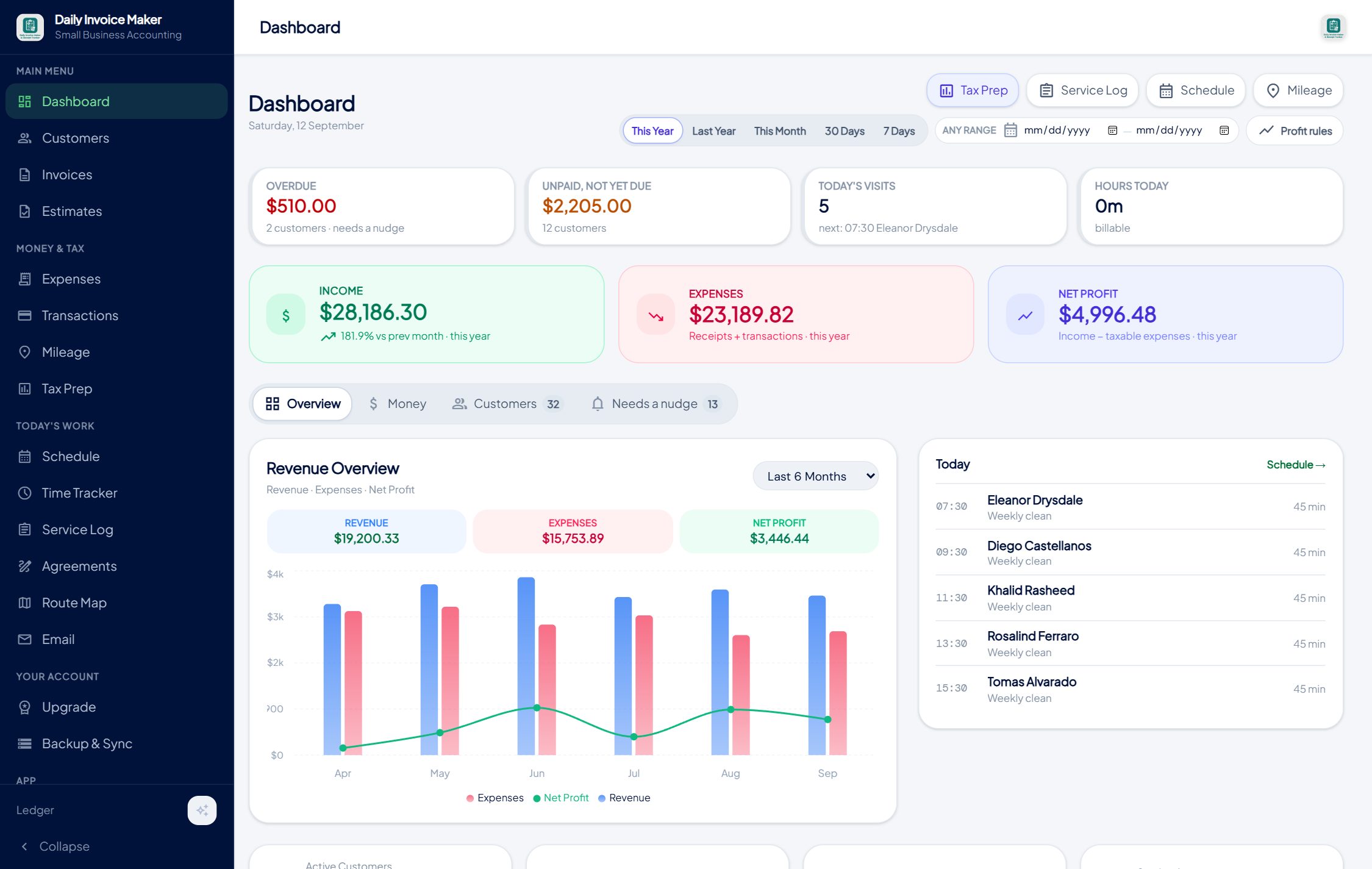
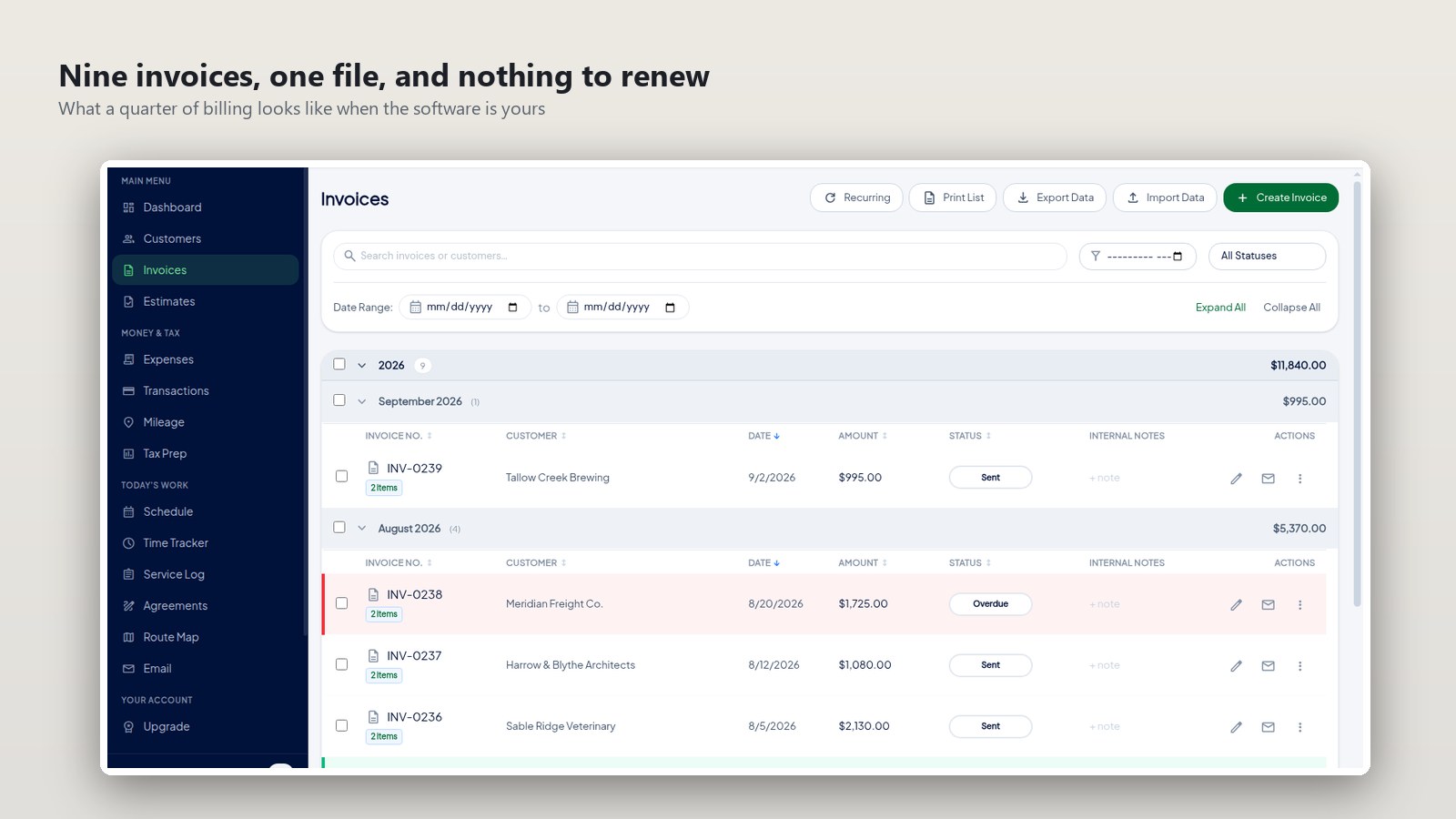
The screenshots are from Daily Invoice Maker, a one-time-purchase desktop app from the publisher of this site that added an auto-repair estimate layout in September 2026. Any invoicing tool that lets you separate parts from labor, print hours and rate, and capture a signature will do the job; the point is the split, not the brand.
The bottom line
Price parts as a retailer and labor as a service business, on the same ticket, on separate lines. Save the prices once, get the estimate signed, convert it into the invoice. A shop that does those four things knows its margin every month and rarely argues about a bill. The one in the example turned $551 of cost into a $1,446 ticket and could show every dollar of it.
Comments (0)
Be the first to comment.
Leave a comment