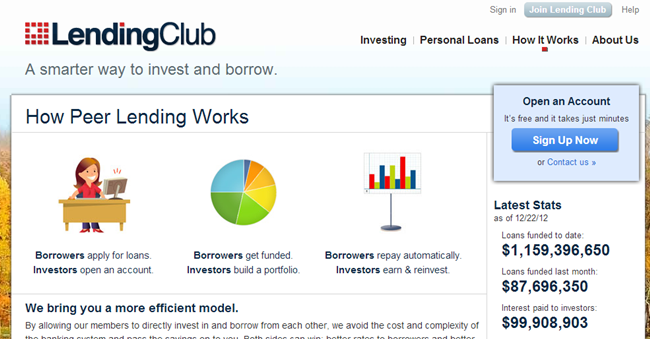
This is a two-year retrospective from May 2013 through May 2015. LendingClub closed its retail Notes platform for individual investors in December 2020, so you cannot do this exact experiment today. The lessons, though, map directly onto the asset-backed and real-estate-backed alternatives that retail investors still have access to in 2026.
Key takeaways
- I deposited in stages from $2,000 to roughly $23,000 over two years.
- Blended portfolio yield ran near 13 percent gross.
- Three charge-offs by the two-year mark, with several late notes I expected to lose.
- Manual note selection became impossible once institutional bots showed up. Automation was mandatory.
- The platform itself eventually died for retail in 2020. Always assume platform risk.
How I started: small, then ramped
I opened the LendingClub account on May 1, 2013, with $2,000 because I did not want to learn anything expensive. Once I trusted the mechanics, I scaled deposits over the next two years: $250 in September 2013, $1,000 in early 2014, then another $6,000 toward the end of 2014. By the end of May 2015 the plan was to add another $13,000 on top of the $10,000 already at work.


Selecting the right notes
The platform listed thousands of loans but only a small slice met my filter. I looked for:
- FICO above 795
- No delinquencies and no derogatory public records
- At least five years of employment
- Monthly income above $5,000
- Reasonable debt-to-income ratio
Loans that met all of those criteria typically funded within seconds of being listed. Sitting at the website manually clicking Invest was hopeless.
The bots arrived: high-frequency lending
By 2014 it was obvious that institutional and sophisticated retail investors were using LendingClub's API to scoop up qualifying notes the moment they appeared. To stay competitive I went automated as well, using filter-based scripts and third-party services (peer lending server-style virtual instances) that watched the new-listing feed and submitted orders programmatically. Even with that, cash sat idle for days at a time waiting for matches.
If you cannot react inside one second, you are not competing on the best paper. You are picking through what the bots passed on.
The secondary market: Folio
LendingClub had a secondary marketplace called Folio where investors could resell notes to each other. I used it to dump notes that were starting to look shaky and occasionally to buy seasoned notes from other sellers at small discounts. The trick was setting the resale markup high enough that you were not giving away yield, but low enough that the notes actually sold. Folio added meaningful return when used carefully and was a real liquidity escape hatch.
Treating P2P as a high-yield junk bond
Right or wrong, I mentally bucketed LendingClub alongside high-yield junk bonds, not alongside investment-grade credit. The probability of any single loan defaulting was meaningful, the recovery rate after default was poor, and the comp was a junk-bond ETF yielding 6 to 8 percent. LendingClub's gross 13 percent had to beat that by enough to compensate for default risk, fee drag, and the lack of liquidity. For a while it did.
What worked
- Starting small and scaling only after the mechanics made sense.
- Sticking to a tight credit filter rather than chasing higher coupons.
- Diversifying across hundreds of small notes (typical position size $25 to $50).
- Using Folio actively to manage liquidity and trim weakening positions.
What did not work
- Manual note selection. Bots ate that lunch by mid-2014.
- Letting cash sit idle. Yield suffers immediately when capital is uninvested.
- Trusting the platform to exist forever. It eventually closed retail Notes in 2020.
What is available in 2026 instead
If you found this post because you wanted to replicate the experiment, here is the closest current map:
- U-Haul Investors Club - asset-backed notes at roughly 4 to 9 percent, $100 minimum, real equipment behind every dollar.
- Groundfloor - real-estate-backed short-term loans starting at $10 per loan. Closest in feel to picking individual notes.
- Fundrise and Arrived - real-estate equity exposure, no fixed coupon, more like owning rental property fractionally.
- Yieldstreet - alternative debt for accredited investors, higher minimums, broader risk.
- T-bills and brokered CDs at 4 to 5 percent - the boring benchmark every alternative has to beat after defaults and fees.
FAQ
Why did Lending Club close its retail Notes platform?
LendingClub bought Radius Bank in 2020 and pivoted to digital banking. Retail Notes were a small, regulatory-heavy slice of the business. They wound it down on December 27, 2020.
What was your effective return after charge-offs?
Net of charge-offs and cash drag, my dollar-weighted return was well below the 13 percent gross yield. Closer to 5 to 7 percent annualized depending on how you treat the idle balance.
Did automation actually help?
Yes, materially. Without automation I would have stayed mostly in cash by mid-2014. With it I could at least compete for filled positions, even if I rarely got the very best notes.
Would you do it again if it existed?
With the lessons learned, yes, but smaller as a percentage of net worth and only if the gross yield was a clear 4 percent or more above Treasuries.
What is the safest equivalent in 2026?
There is no apples-to-apples safer version. The closest cousins are the U-Haul Investors Club for asset-backed notes and short-duration Treasuries for the risk-free baseline.



Comments (0)
Be the first to comment.
Leave a comment