
Roughly one in seven Americans has money sitting in a state unclaimed property fund. As of 2026, U.S. state treasuries collectively hold more than $70 billion in forgotten assets. The search is free, the process still works exactly the way it did a decade ago, and the only reason most people leave the money there is they have never checked.
Key takeaways
- Search every state you have ever lived in — unclaimed property is held by the state where the company that owed you was located, not where you live now.
- Use the official sites only: your state treasurer site or MissingMoney.com, the NAUPA-endorsed multi-state search.
- It is always free. If a site asks for a credit card or a finder's fee, leave.
- Typical claims pay in 30 to 120 days by paper check, after you verify your identity.
- There is no deadline. States hold the money indefinitely, and heirs can claim on behalf of a deceased relative.
What counts as unclaimed money
Unclaimed money is any financial asset a business or government agency owes you but cannot deliver, usually because you moved without leaving a forwarding address. After a dormancy period (typically three to five years), the holder is legally required to turn the asset over to the state. Common examples include:
- Uncashed payroll, refund, and dividend checks
- Old bank and credit union accounts
- Utility, cable, and landlord security deposits
- Insurance policy payouts and unclaimed life insurance benefits
- Brokerage accounts, stocks, and mutual fund shares
- Refunds from PayPal, eBay, Stripe, and similar platforms
- Tax refunds returned to the IRS as undeliverable
- Contents of forgotten safe deposit boxes
Physical property such as houses, cars, and boats is not part of the unclaimed property system.
Where to search in 2026
Start with MissingMoney.com
MissingMoney.com is run by the National Association of Unclaimed Property Administrators (NAUPA) and searches roughly 45 participating states in a single query. It is the fastest first pass and is genuinely free.
Then check each state individually
Not every state participates in MissingMoney.com, and even those that do sometimes list newer records on their own portal first. Search the treasurer or comptroller site for every state you have lived in, worked in, or had an account in. A quick way to find the official site: search Google for unclaimed property [state name] and look for a .gov domain. Examples:
- California: sco.ca.gov
- New York: osc.state.ny.us
- Texas: claimittexas.gov
- Florida: fltreasurehunt.gov
Federal databases worth checking too
- IRS — search "Where's My Refund" for undeliverable tax refunds.
- Pension Benefit Guaranty Corporation — unclaimed pensions from terminated plans.
- TreasuryDirect — for matured U.S. savings bonds.
- FDIC — funds from failed banks.
- NCUA — funds from failed credit unions.
- HUD — FHA mortgage insurance refunds.
The claim process, step by step
The screens have been redesigned a few times since this blog first covered the topic, but the seven-step pattern is unchanged. Using California as the example:
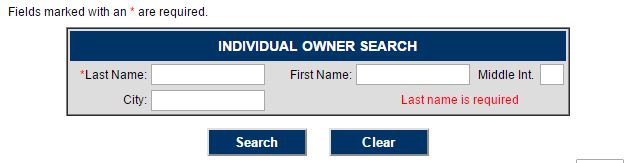
Step 1. Enter your name and a city you have lived in. Try every spelling variant: maiden name, middle initial, initials, nicknames. Search every former city.
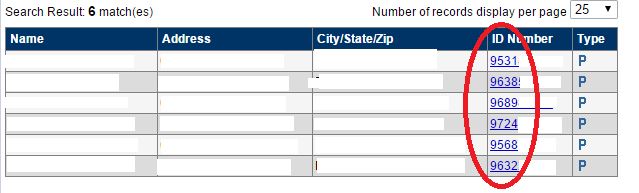
Step 2. Click any ID number that looks like it might be yours to see the holder, last known address, and approximate amount range.
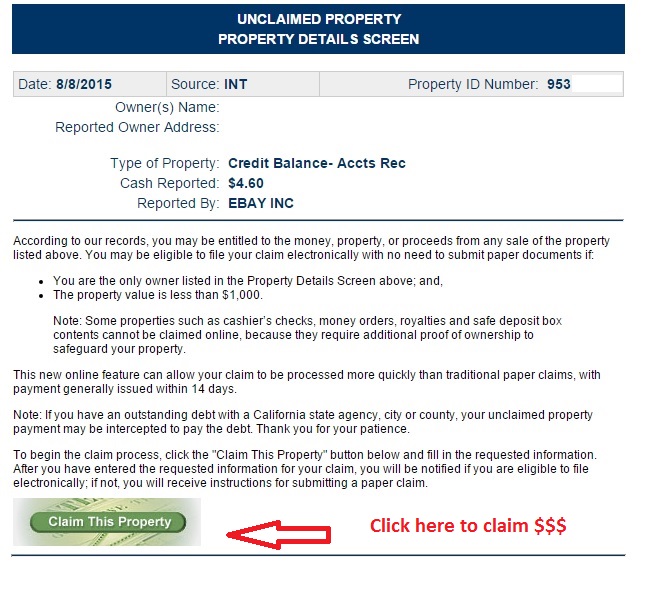
Step 3. Click Claim This Property.
Step 4. Choose E-file when offered. It is faster than mailing paper and most states now process e-claims in under 60 days.

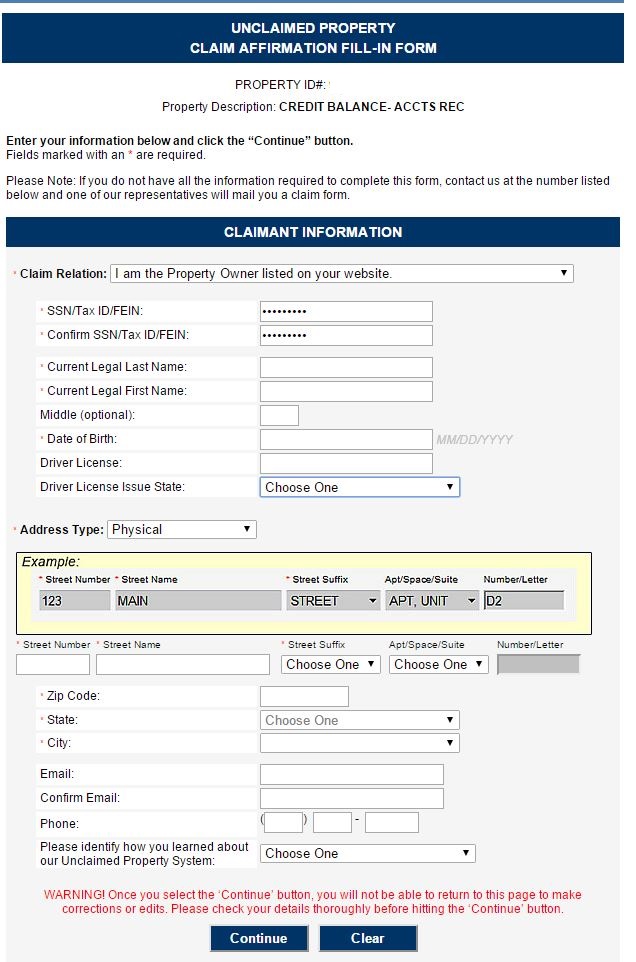
Step 5. Fill in the claim form. Be ready to upload proof of identity (driver license or passport) and proof you lived at the address on file (old utility bill, bank statement, lease, W-2).
Step 6. Review and submit. Print or save the confirmation.
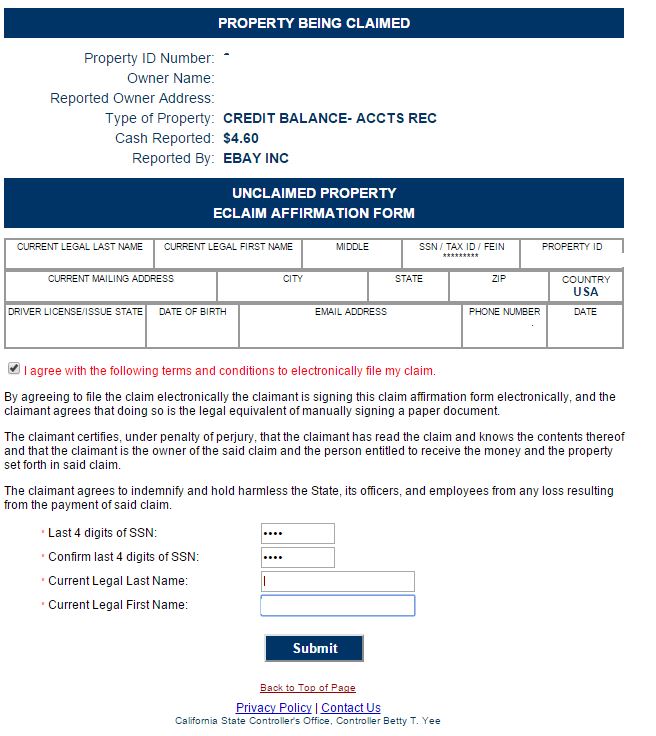
Step 7. Wait for the check. Most states pay by paper check to the address on the claim. Some now offer ACH for amounts under a few thousand dollars.
Claiming for someone who has died
If a parent or relative passed away, you can usually claim their unclaimed property as an heir. The state will ask for the death certificate, a copy of the will or letters of administration, and proof of your relationship. Sibling-to-sibling claims work the same way. There is no statute of limitations on these claims.
How to avoid the scam sites
If a site charges a fee, a percentage, or wants your credit card to "unlock" results, close the tab. Real state treasury sites are free.
Common red flags:
- URL ends in .com, .net, or .info instead of .gov
- Asks for Social Security number before showing any results
- Promises to find "hidden" money the state will not show you
- Requires a credit card to file the claim
- "Locator services" that want 10 to 40 percent of whatever is found — they file the same free form you can file yourself
The only legitimate paid service is a licensed estate attorney for complicated probate claims. Even then, get a flat fee.
FAQ
How much unclaimed money is out there right now?
As of 2026, U.S. state treasuries hold over $70 billion in unclaimed property. About one in seven Americans has at least one claim in their name.
Does unclaimed money expire?
No. Once funds are turned over to the state, you or your heirs can claim them indefinitely. A handful of states do convert very old assets to general revenue after several decades, but the practical answer is to claim it whenever you find it.
Is MissingMoney.com legitimate?
Yes. It is operated by the National Association of Unclaimed Property Administrators (NAUPA), the organization of state treasury officials. It is free and does not require payment information.
How long does it take to receive a claim payment?
Most states pay e-filed claims in 30 to 90 days once identity is verified. Paper claims and complicated heir claims can take 4 to 6 months.
Will I owe taxes on the money I claim?
It depends on the source. Recovered wages, dividends, or interest are usually taxable income in the year you receive them. Returned principal (security deposits, refunds of money you already paid tax on) is generally not. Each state issues 1099 forms when required.
Can I claim unclaimed money from another country?
Yes. Canada has the Bank of Canada unclaimed balances database. The UK has gov.uk/find-lost-money. Australia uses MoneySmart's Lost and Unclaimed Money search. Search the official .gov site for the country involved.


Comments (0)
Be the first to comment.
Leave a comment