
Most self-employed tradespeople pay their accountant to do the same job twice: categorize the receipts, then file the return. The first half is yours to do well — and if you do, the second half gets dramatically cheaper.
Key takeaways
- A clean Schedule C summary can take CPA prep from 4 hours to 30 minutes — roughly $450 in savings per filing.
- The structure should mirror IRS Schedule C lines exactly: Part I income, Part II expenses, Line 28 total, Line 31 net.
- Mileage belongs on Line 9 with the math shown — miles × IRS rate.
- Meals are halved automatically on Line 24b (50% deductibility rule).
- Always document your income source — paid invoices, bank imports, or both — to prevent double counting.
Why the shoebox costs $600
If your accountant bills $150 an hour and has to categorize an unsorted year of receipts and bank statements, you are paying for four hours of bookkeeping that you could have done in five minutes a week. Worse, they are guessing — they do not know which Home Depot run was for a job and which was for your kitchen remodel.
The fix is simple: hand them a one-page worksheet that already maps every transaction to the correct Schedule C line.
Part I — income
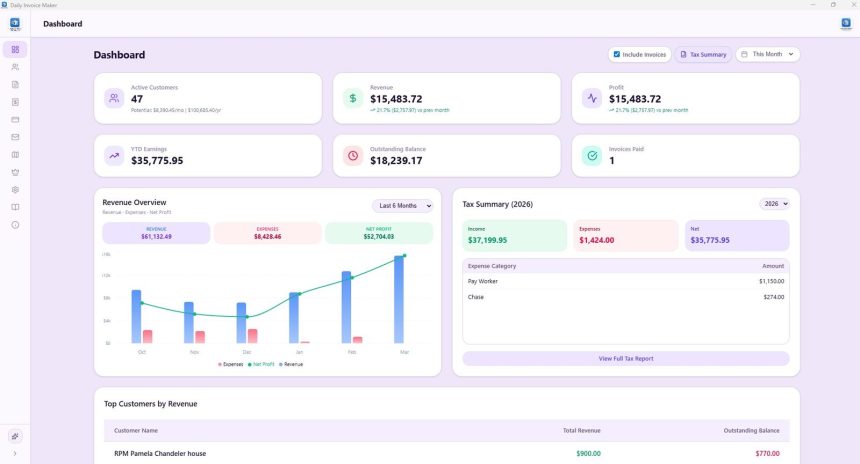
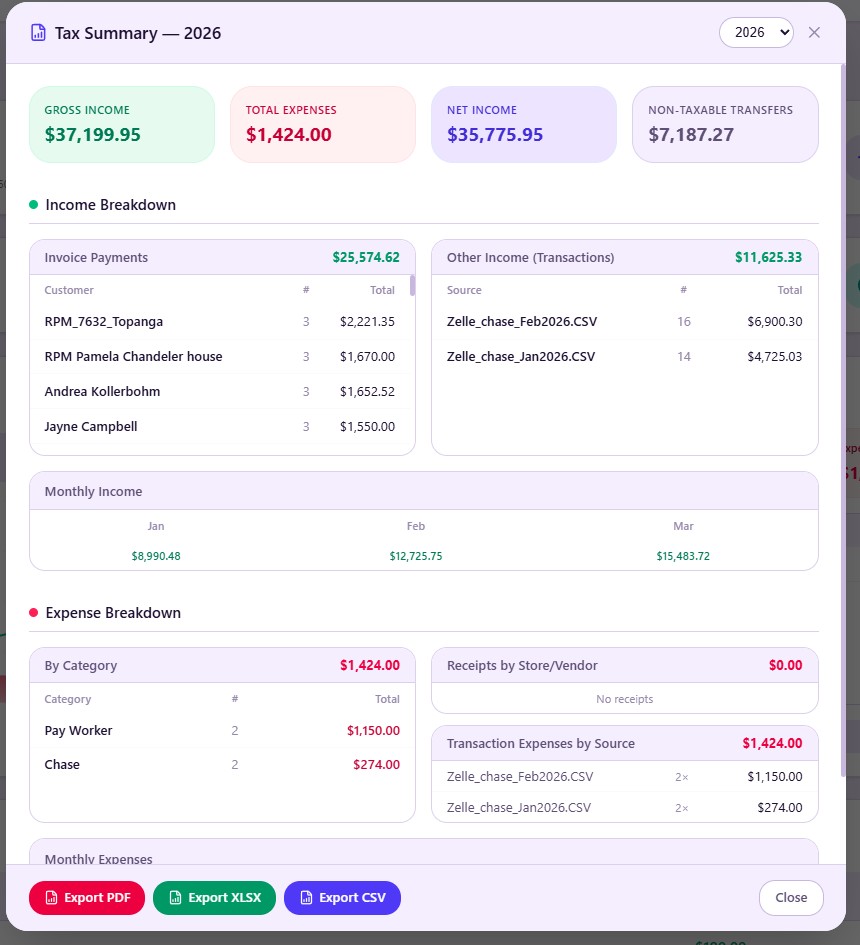
One line. Line 1, Gross receipts: the sum of every paid invoice plus income-classified transactions for the tax year. Include the source count, e.g. "47 paid invoices + 12 income transactions." The count is what a reviewer or auditor uses to sanity-check the number.
Part II — expenses, line by line
Map your internal categories to IRS lines. The common mapping for a service business looks like this:
- Line 8 — Advertising: marketing, ad spend, business cards, truck wrap.
- Line 9 — Car and truck: fuel and vehicle expenses, plus the GPS mileage deduction (miles × IRS rate).
- Line 13 — Depreciation: equipment over the de minimis threshold.
- Line 15 — Insurance: business liability, commercial auto, tools coverage.
- Line 17 — Legal and professional: CPA fees, attorney consults, certifications, training.
- Line 18 — Office expense: software, admin supplies, printer ink.
- Line 20 — Rent or lease: shop, storage unit, equipment rentals.
- Line 21 — Repairs and maintenance: on tools and equipment, not on customer property.
- Line 22 — Supplies: consumables — chemicals, uniforms, parts.
- Line 24a — Travel: overnight trips for business.
- Line 24b — Meals: business meals, halved automatically.
- Line 25 — Utilities: business phone, internet, shop utilities.
- Line 26 — Wages: W-2 employees, not contractors.
- Line 27a — Other: anything that does not fit cleanly.
Bottom of the page: Line 28 Total expenses, then Line 31 Net profit (or loss).
The double-counting trap
If you mark invoices Paid in one system and also import your bank statements, the same money shows up twice. Without protection, gross receipts inflate roughly 2× — and an inflated income line is a fast way to draw an audit flag.
Pick an income source and document it on the worksheet:
- Paid invoices only — the safest default for most service businesses.
- Bank transactions only — if you exclusively rely on bank imports for revenue.
- Both — only valid when invoices were paid in cash you never deposited. Document the reasoning.
The methodology footnote
Add a short notes block at the bottom of the worksheet so your CPA — and any future auditor — can verify the math without calling you:
- The IRS standard mileage rate used and the tax year it applies to.
- That meals are reported at 50% per Line 24b rules.
- Which categories flow to Line 27a as Other.
- Which income source was used (paid invoices, bank, or both) so there is no double-counting question.
- A reminder that the worksheet is a summary, not a tax return — the CPA still has to file Form 1040 with Schedule C attached.
FAQ
Can I file Schedule C myself from this worksheet?
You can — millions of sole proprietors file their own Schedule C through tax software. The worksheet just gives you the numbers to plug in. Whether to DIY or hire a CPA depends on complexity, comfort, and how much an extra deduction or two might be worth.
What if my expense categories don't match IRS lines?
Map them. Anything that does not have a clean IRS line goes to Line 27a Other expenses. Keep an itemized breakdown of Line 27a — that is the line most likely to be questioned.
How is the mileage deduction handled on Schedule C?
Mileage goes on Line 9, Car and truck expenses. The math should be visible: number of business miles × the IRS standard rate for that tax year. For 2026 that rate is $0.70 per mile.
Why are meals only 50% deductible?
The IRS treats half of a business meal as a personal benefit. Line 24b is for the 50% you can deduct — your worksheet should already do the math.
Does the worksheet replace the actual tax return?
No. It is the input that drives the return. A Schedule C is part of Form 1040 and has to be filed through normal channels — paper, e-file, or your tax software.


Comments (0)
Be the first to comment.
Leave a comment