A $29-a-month invoicing subscription costs $1,740 over five years. That is not a rhetorical flourish, it is just multiplication, and it is the number almost no comparison article puts next to the monthly price. For most small businesses the decision about invoicing software is presented as a features question. It is mostly a pricing question, and on Linux it is also a question about whether the thing you are paying for is a program or a tenancy.
Disclosure: I build and sell one of the products named below. The arithmetic applies to everything in the table, mine included, and I have tried to be specific about where the subscriptions are the better buy.
Key takeaways
- Five years of a mid-tier invoicing subscription is $1,200 to $2,400. The same period on a one-time desktop licence is a single $150-ish payment.
- The cheap tiers are usually capped on clients, invoices or users, and the cap is set just below where a growing business lands.
- The real cost of leaving is not the monthly fee, it is that your invoice history is on someone else's server and your access to it stops when the payments do.
- Free and open-source is genuinely free of licence cost and genuinely not free of your time. Budget the hours honestly and it often still wins.
- If your side income is a few hundred dollars a year, none of this applies — a spreadsheet and the Schedule C instructions are enough.
The number nobody puts in the comparison table
Vendors quote a monthly price because a monthly price is small. Here is the same set of options priced the way you actually experience them, which is cumulatively, and on the plan a real one-or-two-person business ends up on rather than the entry tier.
| Option | Typical monthly | Five years | Runs on Linux as… |
|---|---|---|---|
| QuickBooks Online, Simple Start | ~$38 | ~$2,280 | a website |
| FreshBooks Plus | ~$33 | ~$1,980 | a website |
| Zoho Invoice | $0 (capped) | $0 | a website |
| Wave Pro | ~$16 | ~$960 | a website |
| Invoice Ninja, self-hosted | $0 + hosting | ~$300 of server | software you run |
| Daily Invoice Maker (mine) | — | $149.95 once | a .deb or AppImage |
Prices move and tiers get renamed; check them yourself before you decide anything. The pattern is what matters, and the pattern has not changed in a decade: the recurring options cost between six and fifteen times the one-time option across five years, and the gap widens every year you keep trading.
The catch, and it is a real one: that gap buys something. A hosted service gives you a customer-facing payment portal, several staff logged in at once, a mobile app maintained by someone else, and the ability to be hit by a bus without your bookkeeping becoming unreachable. If you have employees who all need to be in the billing system, the subscription is not a rip-off, it is the correct product. What I object to is pricing pages that never show the five-year figure to the sole trader who will never use any of that.
Why this lands differently on Linux
Someone running Linux on their work machine has usually already made a decision about control — over updates, over what runs at startup, over whether the operating system phones home. Then they reach invoicing, and the entire market answers "use our website."
That is not a contradiction you have to accept, but it does narrow the field sharply. Almost nothing in mainstream small-business finance ships a native Linux desktop build. The practical options are: a browser tab, something you self-host, or one of the handful of desktop applications that package for Linux at all.
What "free" costs when you self-host
Invoice Ninja, Akaunting and Crater are real software and the licence genuinely costs nothing. The honest budget looks like this: a small VPS at $5 to $7 a month, an afternoon to install it, a domain, a TLS certificate to keep renewing, database backups you have to test rather than assume, and the periodic upgrade where a PHP version bump breaks something during your busiest week.
If you enjoy that — and plenty of people genuinely do, it is the same skill set that made them choose Linux — it is an excellent answer and the five-year cost is mostly server rent. If you do not, you have not avoided a subscription. You have replaced a $29 monthly bill with an unpaid on-call rota, and the bill was cheaper.
A worked example, at the scale this actually matters
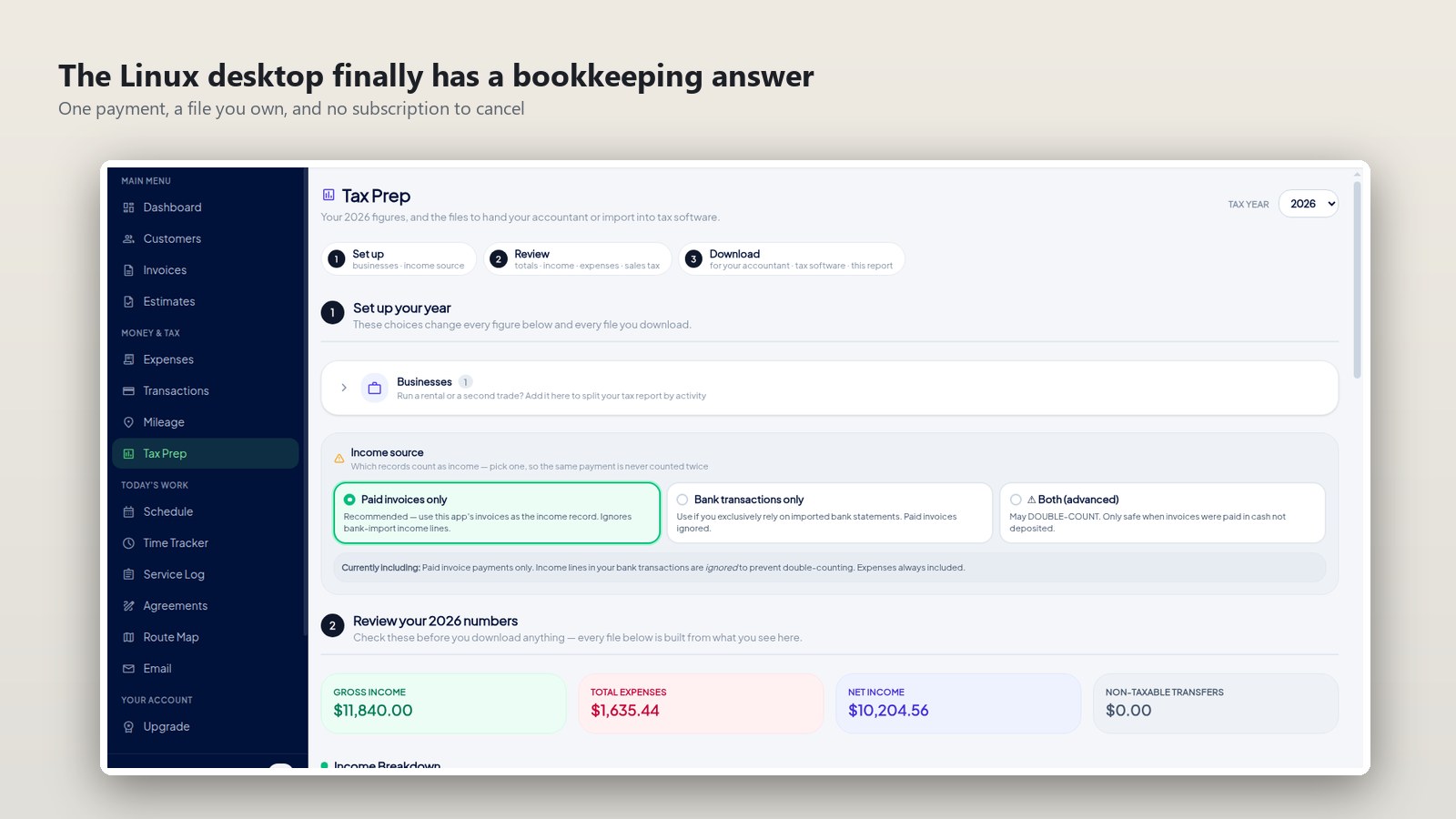
I ran a quarter of a fictional two-person consultancy through the Linux build to see what the figures look like at the size where the decision is finely balanced: nine invoices across three months, six clients, $11,840 billed.
| Item | Amount |
|---|---|
| Billed across the quarter | $11,840.00 |
| Collected and matched to bank deposits | $9,120.00 |
| Still outstanding at quarter end | $5,930.00 |
| Business costs | $1,635.44 |
| Net profit for the quarter | $7,484.56 |
Annualise that and you get roughly $30,000 of profit. A $29 monthly subscription is about 1.2% of it — which is the argument the vendors make, and at that scale it is a fair one. The reason I still think the one-time option wins for this business is not the percentage. It is that the $1,740 is spent whether or not the business has a bad year, and that at the end of five years the subscriber owns nothing and the buyer owns a working program.

The part of the bill that is not the bill
Ask what happens to five years of invoice history if you stop paying. Most services will let you export a CSV on the way out, which is better than nothing and considerably worse than it sounds — a CSV of invoice rows is not the invoices. The PDFs your clients received, the attachments, the payment history and the numbering sequence are frequently not in it, and you will discover which parts are missing at the exact moment you no longer have an account to check.
This matters more than people expect because the IRS expects you to keep records that support what you filed; its guidance on recordkeeping for small businesses is about supporting documents, not about spreadsheets of totals. "Our former vendor holds them" is not a filing position.
When I would tell you to buy the subscription anyway
- You have staff. Two or more people who need to be in the system at once is a genuine multi-user requirement, and a desktop file is the wrong shape for it.
- You need clients to pay through a portal. A hosted checkout needs a host. A payment link on a PDF is not the same experience.
- Your accountant has a strong preference. If they live in QuickBooks and charge by the hour, fighting them can cost more than the licence.
- You want someone else on the hook. Paying monthly buys support and a maintained mobile app. That is worth money to some people, and pretending otherwise is dishonest.
The bottom line
Do the multiplication before you read the feature list. If the five-year figure is uncomfortable and you do not need multi-user access or a hosted payment portal, the recurring bill is buying you very little that a one-time program does not. If you do need those things, pay and stop feeling clever about it — and if you are turning over a few hundred dollars a year, buy neither and use a spreadsheet until the arithmetic changes.
The how-to side of this — what installs on Linux, the .deb versus the AppImage, the library error that stops a first launch — is written up on the product side at invoicing software for Linux.
FAQ
Is there genuinely no free invoicing software that runs natively on Linux?
There is, but almost all of it is self-hosted web software rather than a desktop program — Invoice Ninja, Akaunting and Crater are the usual names. The licence is free; the server, the backups and the upgrades are your problem. GnuCash is a genuine native desktop option and is free, but it is double-entry accounting first and invoicing second, and most people find it steep.
Does a one-time licence really include updates?
It depends entirely on the vendor and you must check. Some "lifetime" licences mean the current major version only, with a paid upgrade every couple of years, which quietly converts it back into a subscription with extra steps. Ask whether updates are included indefinitely and get the answer in writing before you pay.
What about the exchange rate between my time and the money saved?
Price your hours honestly. If self-hosting costs you eight hours a year and you bill $90 an hour, that is $720 of your time annually — far more than the subscription you avoided. The calculation only favours self-hosting if you would not have billed those hours anyway, or if you actively enjoy the work.
Can I move my data later if I change my mind?
From a desktop program, yes — the file is yours and the exports are CSV, XLSX and PDF. From a hosted service, partly: check specifically whether the export includes the invoice PDFs and attachments or only a table of rows. Test the export before you need it, not after.
Does any of this change how I file my taxes?
No. The software changes how easily you produce the figures, not what the figures have to be. A sole trader files Schedule C regardless of what produced the totals, and the recordkeeping obligation is the same whether your books are in a browser, a desktop file or a shoebox.



Comments (0)
Be the first to comment.
Leave a comment