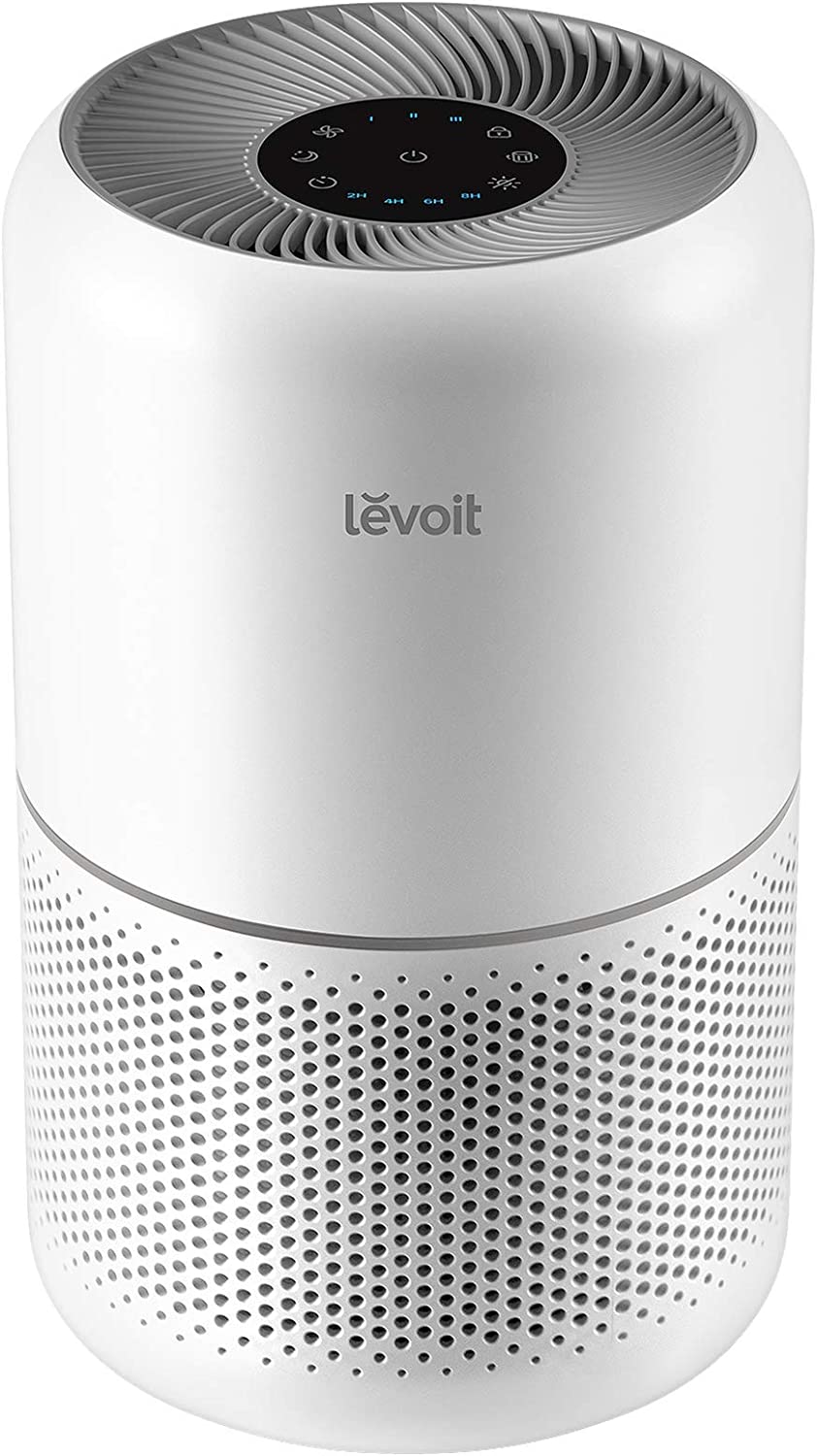
The LEVOIT Core 300 has been the default bedroom air purifier recommendation for the better part of a decade, and it is still one of the easiest small-room HEPA units to recommend in 2026. Small, quiet, ozone-free, and a true H13 HEPA filter — for most bedrooms under 220 sq ft, it just works.
Rating
9 out of 10. The best small-room HEPA purifier for the money. Loses a point only because the carbon pre-filter is thin and the CADR is just average for spaces above 300 sq ft.
Key takeaways
- True H13 HEPA — captures 99.97% of airborne particles down to 0.3 microns, including pollen, dust, smoke, and pet dander.
- Ozone-free. No UV-C, no ionizer. Safe to run all night in a bedroom.
- 24 dB on sleep mode — quieter than a whisper. You will forget it is on.
- Covers up to 547 sq ft in 30 minutes (CADR 141 CFM). Best for bedrooms, offices, nurseries.
- Replacement filters run roughly $25–$35 every 6–8 months — call it $50/year in upkeep.
Pros and cons
Pros
- True H13 HEPA, not the watered-down "HEPA-type" filters cheaper units use.
- 360° air intake means you can put it almost anywhere — even mid-room.
- Whisper-quiet on low; surprisingly punchy on high.
- Display light can be fully turned off — actually usable for sleep.
- Three filter options (Original, Toxin Absorber, Smoke Remover, Pet Allergy) so you can tune for your worst trigger.
- Red Dot design award winner — it does not look ugly on a nightstand.
- Energy Star verified, CARB compliant, FCC certified, ETL listed.
Cons
- The activated-carbon layer is thin — fine for everyday odors, not great for heavy cooking or wildfire smoke. Step up to the Core 400S if smoke is your main concern.
- No air-quality sensor. The Core 300S adds one but costs more.
- Only the official LEVOIT Core 300-RF filter is reliable — third-party knockoffs vary wildly in quality.
- CADR is modest for rooms above 300 sq ft; run on medium-high or buy a larger unit.
What it actually does well
Allergies and pet hair
This is the use case it was built for. The H13 HEPA layer pulls dust, pollen, and pet dander out of the air, and with the optional Pet Allergy filter you also get more carbon for odor. In a typical 150 sq ft bedroom running on medium 24/7, allergy sufferers report meaningful relief within the first week.
Sleep
The 24 dB sleep mode is the killer feature. Most cheap purifiers either run too loud at night or are too quiet to actually move air. The Core 300 sits in the sweet spot. The fact that you can fully turn off the indicator light is the cherry on top.
Smoke and wildfire season
Adequate, not exceptional. The carbon layer is thin. If you live somewhere that wildfire smoke is a regular event, get the LEVOIT Core 400S or pair the Core 300 with the dedicated Smoke Remover filter and accept that you will need to replace it more often.
Filter cost over time
- Official LEVOIT Core 300-RF replacement filter — about $25–$35.
- Lifespan with daily use — 6 to 8 months.
- Annualized — roughly $50 in filters. Power draw is trivial (~$10/year on low).
The filter-lifetime indicator on the unit is honest. Do not buy third-party filters from random Amazon sellers — they almost always underperform and a few cases have damaged the motor over time. Search part number Core 300-RF for the genuine item.
Who should buy it
- Best for: bedrooms, home offices, nurseries, small living rooms up to about 220 sq ft for fast turnover or 540 sq ft for slower turnover.
- Allergy sufferers, pet owners, and light sleepers — basically the target audience.
- Look elsewhere if: your main room is bigger than 350 sq ft, you want a built-in air-quality sensor, or wildfire smoke is your daily problem.
Where to buy
Check the LEVOIT Core 300 price on Amazon — pricing fluctuates but it usually sits between $90 and $110 for the base unit. Make sure the listing is sold and shipped by Amazon or LEVOIT directly to avoid counterfeit units.
FAQ
Is the LEVOIT Core 300 a true HEPA?
Yes. It uses an H13 True HEPA filter that captures 99.97% of particles down to 0.3 microns. "H13" is a real medical-grade certification, not the marketing-friendly "HEPA-type" label cheaper units use.
Does the LEVOIT Core 300 produce ozone?
No. It does not use UV-C or an ionizer. It is CARB-compliant, which is the strictest U.S. standard for indoor ozone emissions.
How often do I change the filter?
Every 6 to 8 months with daily use, depending on how dirty your air is. The unit has a filter-life indicator that tells you when it is time.
What is the difference between the Core 300 and Core 300S?
The 300S adds Wi-Fi, an air-quality sensor, and smartphone control. Same filtration. If you want auto mode, get the 300S. If you just want quiet clean air in a bedroom, the regular Core 300 is the better value.
Will the Core 300 help with wildfire smoke?
Yes, but it is not its strongest use case. Swap in the dedicated Smoke Remover filter and consider the larger Core 400S for living-room sized spaces.
Is it safe to run all night?
Yes. Sleep mode runs at 24 dB, the indicator light can be fully turned off, and the unit is Energy Star verified. It uses less power than a small light bulb.

Comments (0)
Be the first to comment.
Leave a comment